
Odebrecht: Bribery tentacles around the world
 GETTY IMAGES
It is the corruption probe that has left politicians around the world looking over their shoulders.
Prosecutors in a dozen countries are untangling a massive web of corruption that ran across a continent and further afield.
Illegal payments may have sloshed through presidential campaigns, boosted the careers of political top brass in country after country, and oiled the wheels of worldwide construction projects including motorways, gas pipelines and hydroelectric dams.
If you have never heard of a company called Odebrecht, you probably do not live in Latin America.
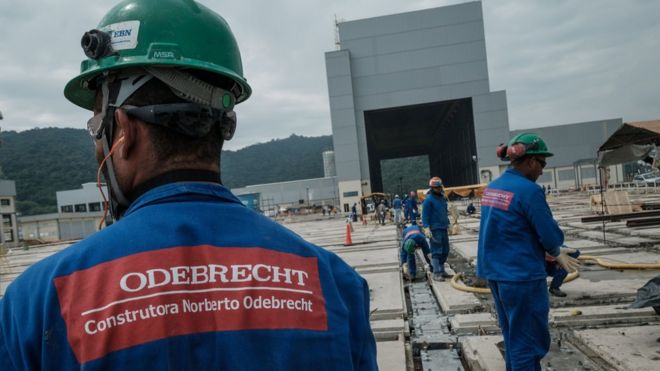
It is a Brazilian construction giant behind venues for the 2016 Olympics, infrastructure for the 2014 World Cup and the metro system in Caracas, plus dams and airport terminals further afield.
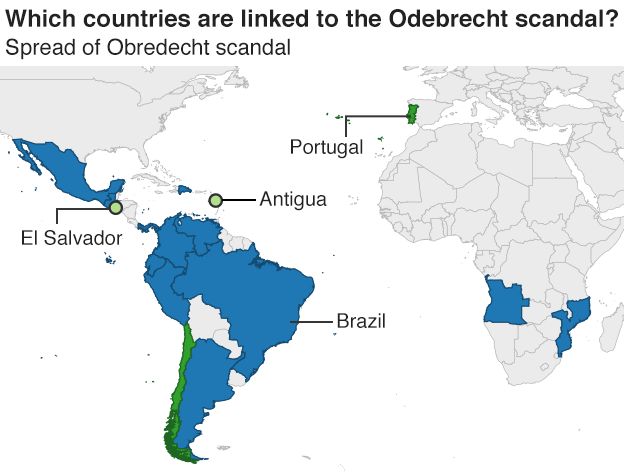
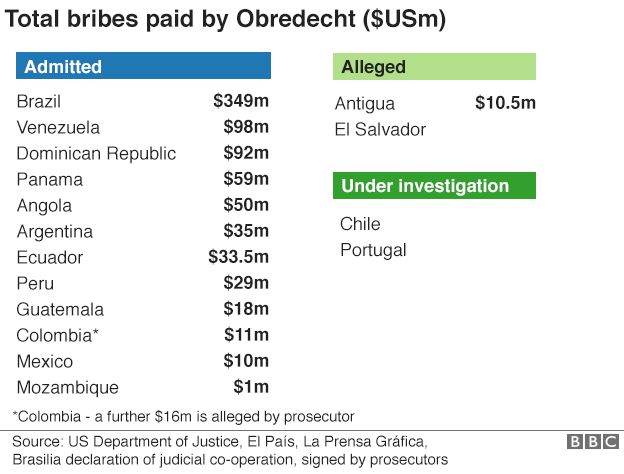
But anti-corruption investigators caught up with the company, and it admitted paying bribes in more than half of the countries in Latin America, as well as in Angola and Mozambique in Africa.
How high up did bribery go?
Odebrecht played a game of quid pro quo: I will help you pay for your election campaign if you make sure I get that building contract.
In country after country, it is alleged that Odebrecht employees made connections with those in power and those who looked like they would be getting into power soon. They did not restrict themselves to those of any particular political hue.
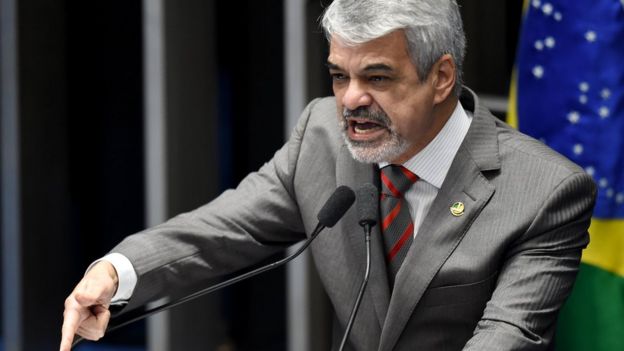
Almost a third of Brazil's current government ministers are facing investigation, including the foreign minister and President Michel Temer's chief of staff. The president has said he will suspend any ministers who are charged, but is himself facing an investigation. He denied all allegations of corruption and accused the country's judiciary of heeding rumours and destroying reputations.
- One of the biggest corporate corruption cases in history
- Who's who and what's what in corruption probe
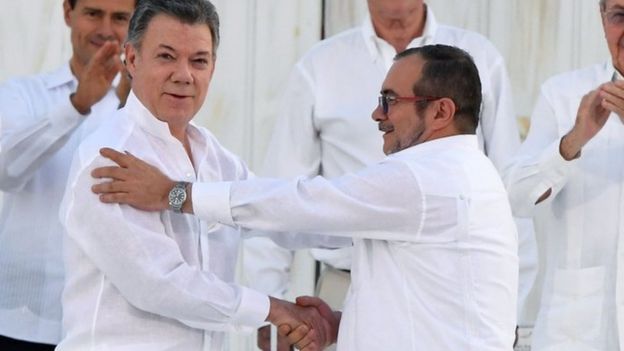
Further north, Colombia has already charged a former vice-minister for transport and a former senator. The man who ran the election campaign of the current president, Juan Manuel Santos, has alleged it was financed with irregular Odebrecht payments. Mr Santos, who is a Nobel Peace Prize winner, said he did not authorise any payments or know about them.
 AFP
AFP
Next door in Venezuela, former chief prosecutor Luisa Ortega has fled the country after being sacked. She alleges that President Nicolás Maduro is implicated and that a top court is blocking an investigation. Odebrecht has denied her other allegation - that they paid $100m (£76.5m) to the socialist party's vice-president, Diosdado Cabello. Venezuela has taken unfinished projects away from Odebrecht and blocked the company's bank accounts.
In Peru, two ex-presidents are under investigation. Ollanta Humala and his wife Nadine Heredia have been put in pre-trial detention for 18 months while charges are prepared against them for allegedly receiving payments to fund his presidential campaigns in 2006 and 2011.
Former President Alejandro Toledo, accused of taking $20m in bribes, is thought to be living in the US and the Peruvian government has put up a $30,000 reward for information leading to his arrest.
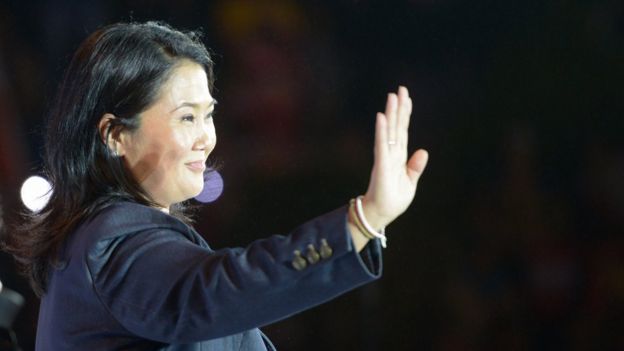
Staying with Peru, opposition leader Keiko Fujimori has come under preliminary investigation. The attorney general says a note found on Marcelo Odebrecht's mobile phone implicates her. She denied receiving money from the company.
 GETTY IMAGES
In neighbouring Ecuador, a judge has banned Vice-President Jorge Glas from leaving the country, due to suspicions he took bribes. Mr Glas - who has also been stripped of his functions - denies corruption.
Panama has charged 17 people including government officials, and charged Odebrecht $59m in compensation. A lawyer from Mossack Fonseca - the firm at the centre of the Panama Papers leak - accused President Juan Carlos Varela of receiving Odebrecht donations. Mr Varela denies all wrongdoing.
Antigua and Barbuda's Prime Minister Gaston Browne has adamantly denied an allegation he accepted payment to stay quiet about Odebrecht's banking activities in the Caribbean nation.
Mexico has summoned a former director of state oil company Pemex and other employees to give evidence over alleged Odebrecht bribes, while the Dominican Republic has asked Odebrecht for $184m compensation over the next eight years.
Chile has started an investigation and seized documents from the company's offices, while Guatemala's investigation is supported by a UN anti-corruption commission. Argentina and Brazil are co-operating but prosecutors have said their governments are "presenting obstacles".
And Brazilian newspaper O Globo reports (in Portuguese) that 29 countries, including Sweden, the US, France and the UK have asked Brazil for help with their own Odebrecht investigations.
Who is serving jail time?
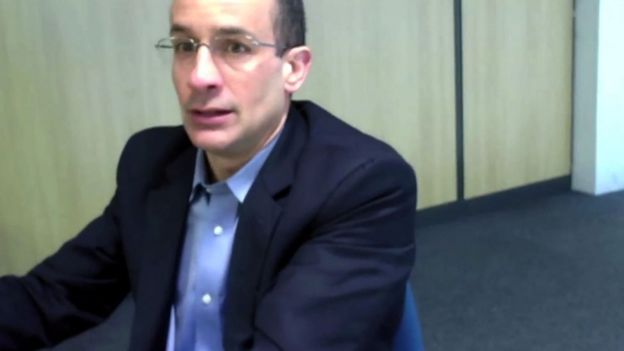
The biggest scalp so far is former CEO Marcelo Odebrecht. He started a 19-year jail term last year after being convicted of paying more than $30m (£21m) in bribes to officials in Brazil's state oil company in exchange for contracts and influence.
 AFP
AFP
More than 70 other Odebrecht executives were jailed but have agreed to plea deals, that is they agreed to provide information in exchange for more lenient sentences. Some are already out of jail and serving their sentences at home.
How they did it: The bribery department
The epicentre of the operation had a much more run-of-the-mill name, the Division of Structured Operations, but it was essentially the bribery department. Employees spent their time bribing government officials and political parties at home and abroad, to win business.
The company has admitted this to US, Brazilian and Swiss prosecutors. Money went through as many as four bank accounts in countries with good banking secrecy laws before getting to a recipient, usually an intermediary to someone with political power.
When the department's employees wanted to communicate, they used a system unconnected to the main computer systems, to avoid detection.
 GETTY IMAGES
And they gave their recipients flippant codenames: Dracula, Sauerkraut, Decrepit, Totally Ugly. One politician, whose wife was 40 years younger than him, got the codename Viagra.
What effect has the scandal had?
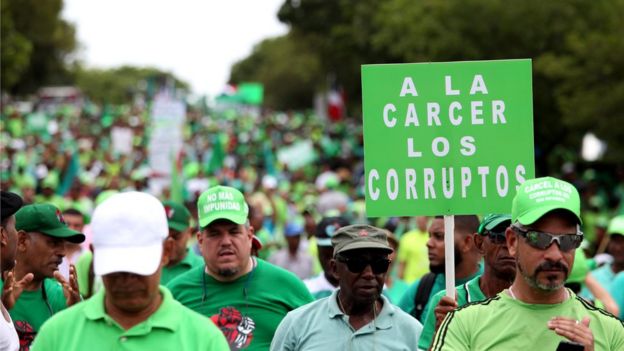
Protesters have hit the streets over the Odebrecht case in country after country, and the chain of events has brought corruption to the top of news agendas and prosecutors' agendas.
They are "clamouring for justice", political analyst Geovanny Vicente Romero told the BBC.
"Protesters are demanding people be held responsible for the negligence and corruption that are part and parcel of the historic inequalities in many of the region's countries," he said.
"Overall, people hope that the Odebrecht case will set a precedent so that these situations can be avoided in the future."
 REUTERS
What has happened to Odebrecht since?
Before the scandal, Odebrecht had more than 180,000 employees in 21 countries and revenues of more than $40bn.
By 2016 revenues had dropped to $26bn and staffing numbers had dropped to less than 80,000.
The value of Odebrecht bonds was sliced. The downturn in construction that went alongside this contributed to a downturn in the Brazilian economy and the credit ratings agency Standard and Poor's cut the company to the lowest grading. It has recovered somewhat but is still far from excellent.
The investigations have even contributed to economic downturn in Brazil, and Peru shaved almost a point off its growth forecasts for 2017, which the government blamed on "the Odebrecht effect".
The company's latest annual report is full of commitments to grow back more ethically - literally, it uses water and seeds and fertilisation as metaphors.
And there have been two CEOs since Marcelo Odebrecht was jailed but tellingly, neither has had the surname Odebrecht.


 Posts
Posts


No comments:
Post a Comment