
US trade wars: The farmers who trust Trump, but not without worries
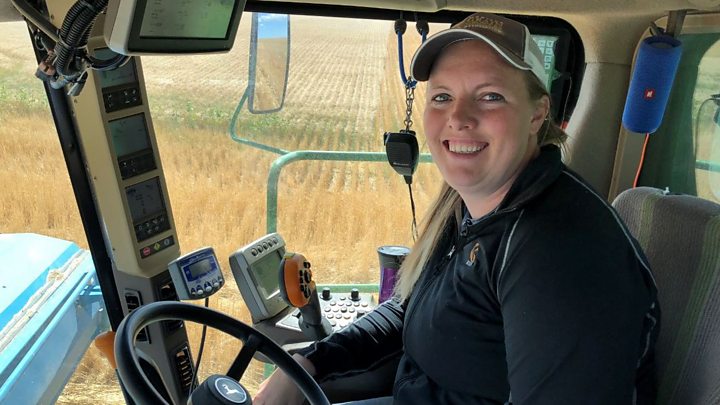
Support for President Donald Trump remains strong in the American farming heartland but, as BBC North America correspondent James Cook found in Broadview, Montana, there are also concerns about the drift away from free trade.
Michelle Erickson-Jones should be celebrating.
On the Great Plains, the harvest is coming to a close and she is cutting the very last of this year's wheat, rattling across a golden field in a combine harvester which bristles with technology.
In the cab more than half a dozen screens are pumping out data as the machine reaps, threshes and winnows. A tablet superimposes the track of the great green-and-yellow beast on a satellite image of the land.
Farming here in Montana is a hi-tech business with a global market. The most important customer for this farm is not a bakery in the nearest village but the world's third largest economy, Japan.
And that is why Ms Erickson-Jones is worried.
"We spent decades building that market," she says.
So what happened? In a word, Trump.
- The bean at the heart of America's trade war
- US-China trade row: What has happened so far?
- Trade wars, Trump tariffs and protectionism explained
The president is enormously popular in Montana. In 2016 the Republican cruised to victory, beating his Democratic Party rival Hillary Clinton here by more than 20 percentage points.
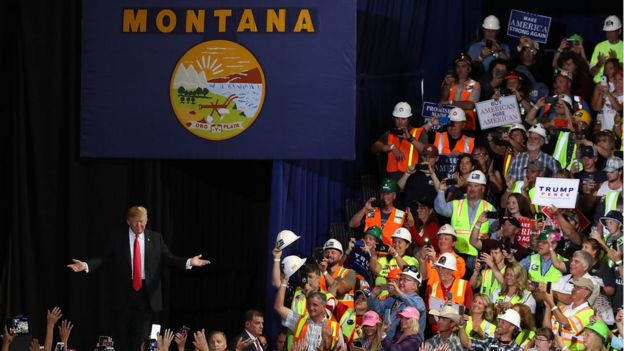
"America is tired of getting ripped off," said the president at a rally in Montana on Thursday night, showcasing the blunt language which helped him into the White House.
"We're going to get a great deal for our farmers and ranchers and factory workers," he added.
A good spot at the front of the rally was in such demand that a handful of fans had camped overnight outside the Rimrock Auto Arena in Billings.
And yet this popularity comes despite, not because of, Mr Trump's approach to trade. It is a paradox which is not easily explained in a state where agriculture is by far the leading industry.
On his third day in office, as he had promised during his campaign, Mr Trump pulled the US out of the nascent Trans-Pacific Partnership (TPP) which would have been the largest trade deal in history, covering 40% of the world's economy.
His predecessor Barack Obama had envisaged the pact as a central plank of an American "pivot to Asia" with the aim of drawing countries around the Pacific Rim together in a fair, rules-based system, a challenge to China's statist capitalism.
As a candidate Mrs Clinton also promised not to join TPP, which for a time appeared moribund until it was revived earlier this year by the remaining nations including Canada, Australia, Mexico and, crucially for Montana, Japan.
Wheat and barley farmers in Montana say the effort they put in over several decades to cultivate Japanese customers now counts for little as the US, unlike the European Union, does not have its own trade agreement with Tokyo.
 GETTY IMAGES
"We have roughly 50% of Japan's market share right now," says Ms Erickson-Jones. "It's definitely something we wanted to continue and even expand and without being involved in TPP we expect to lose about half of that market share."
Such losses will be a big blow for the rural US economy and for American prestige.
Farming is entwined in this country's identity, its spacious skies and amber waves of grain celebrated by patriots who extolled the New World as a land of plenty.
It is a description which remains rooted in truth. US crops are so plentiful that vast quantities of them are sent abroad.
Statistics from the Department of Agriculture record American farmers exporting 50% of soybeans; 46% of wheat; and 21% of corn (maize), including ethanol.
Montana is particularly dependent on such exports.
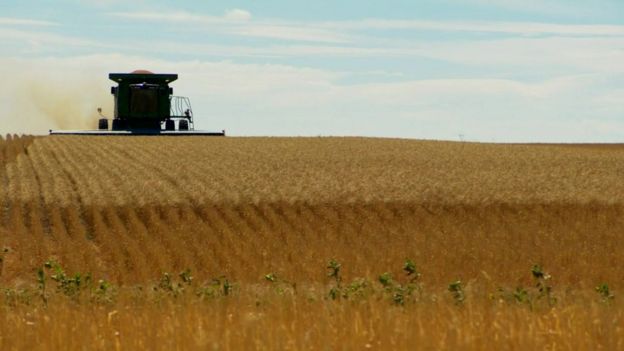
"Seventy five per cent of our wheat is exported," says Ms Erickson-Jones, the fourth generation of her family to farm land near Broadview in south central Montana.
She says the decision to abandon TPP and the subsequent loss of market share in Japan is far from the only protectionist problem in the air.
'Trade-distorting practices'
Mr Trump may have been cheered in the steel mills of Pennsylvania when he announced that he would impose tariffs on imports of metals but the decision was a double whammy for farmers and ranchers.
First it pushes up prices for agricultural equipment made using imported steel or aluminium and for the metals themselves.
Secondly, American farmers reported in March that China had responded to US tariffs by stopping purchases of American wheat.
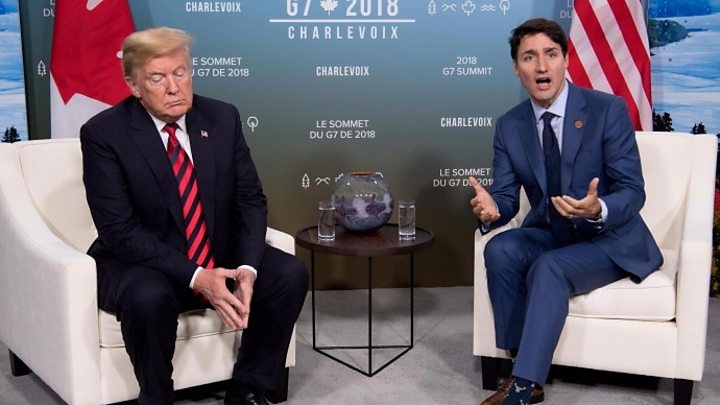
The White House denies it is protectionist, insisting instead that it is using its economic might to force China to abandon "trade-distorting practices" such as unfair state subsidies; restrictive rules for foreign companies operating in the country; and the theft of US technology.
Peter Navarro, a senior White House adviser on trade and industrial policy, wrote in April that Beijing had "broken every rule in the book" as its economy expanded at a time when the US was losing factories and jobs.
Ms Erickson-Jones, who is the first female president of the Montana Grain Growers Association, is careful not to criticise the president personally and says she understands why he took action against China.
But while she applauds the idea of taking on Beijing she would like to see an emphasis on "expanding our markets," including a plan to rejoin TPP.
And she wants a speedy conclusion to the renegotiation of the North American Free Trade Agreement (Nafta), citing Mexico as another critical market for US crops.
Mr Trump said again at his rally on Thursday that the Mexican aspect of the new Nafta deal had been struck and he hoped Canada would soon be on board too.
He has also mused in the past about trying to re-negotiate TPP but there has been little evidence that he is actually preparing to do so.
In the meantime, the administration is offering emergency bail-out payments to farmers and the US reputation as the breadbasket of the world is suffering.
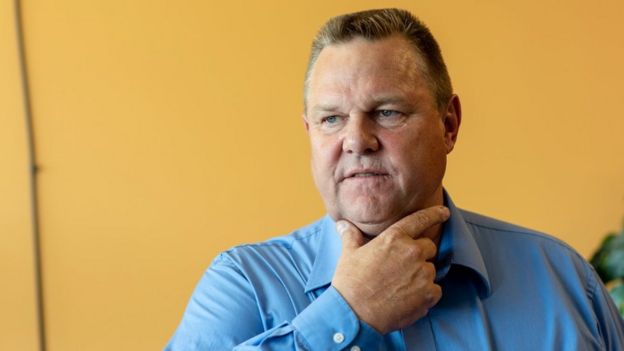
Montana's Democratic Senator Jon Tester says he too accepts the president's diagnosis of the problem with China but insists that he would have tried a different solution, forming an international coalition to put financial sanctions on Beijing, which he calls "a bad actor," which steals technology and manipulates currency.
 GETTY IMAGES
Mr Tester, a farmer himself, says he remembers with dread the early 1980s when the US government stopped its farmers from selling grain to the Soviet Union (a policy enacted by a Democrat, Jimmy Carter, in response to the USSR's invasion of Afghanistan and ended by a Republican, Ronald Reagan).
"I was on the farm in the 1980s... and I saw my neighbours leave in droves," he says. "So the tariffs scare me. They scare me bad."
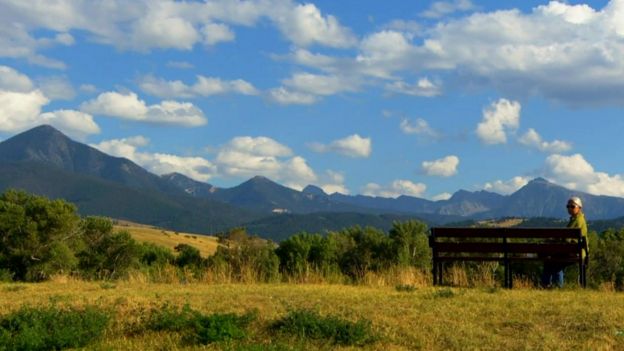
Mr Tester is campaigning for re-election in November's mid-term elections in the shadow of Yellowstone National Park - deep in Trump territory.
"If we don't have those foreign markets, we are literally dead in the water in production agriculture," he warns.
Across the state line in Wyoming there seem to be more ranchers than farmers at the Cody Rodeo.
Here in the town founded by the showman WF Cody, better known as Buffalo Bill, the crowd may not be following every twist and tweet from Washington DC but it is clear that they trust the modern day showman in the White House.
"Glad we have Trump to properly stand up for ourselves and maybe make a better deal for us," says Corey Forman, who hides a broad grin under a shaggy red beard and a black and white baseball cap which advertises farm loans.
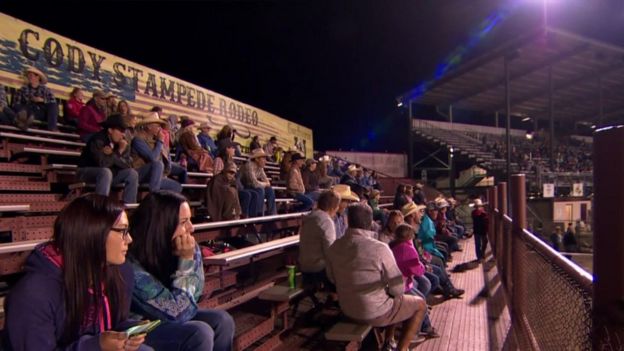
Phil McVey is also in the audience, well-prepared for the evening's entertainment in four layers of shirts and jackets topped off with a smart light-brown cowboy hat.
"American farmers need help," he admits before adding quickly "and whatever he [Trump] can do to help us, its fine."
Pressed on what exactly that should be, Mr McVey has a simple answer.
"He'll do the right thing. We like him."
There is a great divide here between the protectionism in Washington and the free trade preferred by farmers but it doesn't seem to be eroding support for the president.
Time and again in the wilds of the west we heard the same thing: voters here trust Donald Trump to do the right thing.
As autumn beckons though, concerns remain.
Back on the farm Michelle Erickson-Jones says tariffs have already pushed down profits, putting the very future of this family enterprise in doubt.
When I ask whether her farm will survive her answer - "I hope so" - is delivered with a laugh which does not sound especially reassuring.
"Nothing's certain in farming, so no, I'm not totally sure but we're OK for a couple of years," she continues.
"A lot of my concern is based on how long it's taken us to build these markets. It's easy to tear them down and tearing them down has a pretty big impact on the future of my kids' ability to farm.
"We definitely want to get back to free trade."


 Posts
Posts


No comments:
Post a Comment