Showing posts with label peace movement. Show all posts

Thursday, November 1, 2018

Can you imagine the adulation had Obama accomplished this: Moon Jae-in says North Korean leader Kim Jong Un will visit Seoul ‘soon’

Moon Jae-in says North Korean leader Kim Jong Un will visit Seoul ‘soon’

AP, REUTERS
President Moon Jae-in said Thursday that North Korean leader Kim Jong Un will “soon” visit Seoul as part of a flurry of high-profile diplomacy aimed at ridding North Korea of its nuclear weapons.
During a speech before the National Assembly, Moon said that a second North Korea-U.S. summit is “near at hand” and that Chinese President Xi Jinping is expected to visit North Korea soon. Moon also said he expects Kim to visit Russia soon and that Kim may meet with Prime Minister Shinzo Abe.
Moon has previously said that Kim told him he would visit Seoul within this year when the leaders met in Pyongyang in September. South Korea’s presidential office said later Thursday that it had nothing to add to Moon’s speech about Kim’s trip. His comments were in line with previous statements, the Blue House said. They suggest that Moon is determined to push ahead with diplomacy to resolve the nuclear issue.
“Now, based on firm trust among one another, South and North Korea and the United States will achieve complete denuclearization and lasting peace of the Korean Peninsula,” Moon said. “This is an opportunity that has come like a miracle. It’s something that we should never miss.”
The prospects for a second summit between Kim and U.S. President Donald Trump improved after U.S. Secretary of State Mike Pompeo made his fourth visit to North Korea in October. But no breakthrough has followed. U.S. officials have recently said a second Trump-Kim summit will likely happen early next year. Some experts have raised doubts over whether Kim’s Seoul trip would be realized by December.
Moon, a liberal who took office last year, favors a negotiated resolution to the decades-long international standoff over North Korea’s nuclear ambitions. He has facilitated a series of high-level U.S.-North Korea exchanges, including their first-ever summit in Singapore in June.
But Moon has faced growing outside skepticism over whether his engagement policy will eventually end the nuclear standoff amid ups and downs in his diplomatic push. Many conservatives in South Korea and the United States say North Korea has no intention of fully giving up its nuclear program and only intends to buy time to perfect its weapons program.
Since entering nuclear talks earlier this year, North Korea has halted nuclear and missile tests and dismantled its nuclear testing site. The United States suspended some of its annual military drills with South Korea, but is reluctant to provide the North with big political or economic benefits unless it takes more serious disarmament steps.
The two Koreas remain split along the world’s most heavily fortified border since the three-year Korean War ended in 1953 with an armistice. If Kim, a third-generation hereditary leader, visits Seoul, he would be the first North Korean leader to cross the border into the South since the war ended. Last year saw increased fears of a second war on the peninsula as he exchanged threats of destruction and crude insults with Trump over North Korea’s push to develop a nuclear missile capable of striking the U.S. mainland.
As the neighbors push to further defuse tensions, a no-fly zone and a ban on military drills near the border came into effect Thursday.
The measures were part of a military accord inked during the summit in Pyongyang, which includes a halt in “all hostile acts,” and a gradual removal of land mines and guard posts within the demilitarized zone.
The United States has raised concerns that the deal could undercut defense readiness amid tardy progress on North Korea’s denuclearization, though it displayed support at an annual security consultative meeting of defense ministers Wednesday in Washington.
“The South and the North completely removed dangers of military clash through the military agreement,” Moon told parliament Thursday. “The two Koreas and the United States will achieve complete denuclearization of the Korean Peninsula and lasting peace based on firm trust.”
North Korea has also taken steps toward the pact, such as covering artillery deployed along the skirmish-prone western shore, Seoul’s Defense Ministry said.
The no-fly zone extends 40 km (25 miles) north and south from the Military Demarcation Line (MDL) in the east and 20 km (12 miles) in the west for fixed-wing aircraft.
The agreement also bars live-fire drills involving fixed-wing aircraft and air-to-ground guided weapons in the no-fly area. South Korea and the United States had held such drills regularly until halting joint exercises in June.
There are different restrictions on helicopters, drones and balloons, with exemptions for commercial and nonmilitary operations such as medical, disaster and agricultural uses.
“We will thoroughly verify the North side’s implementation of the agreement, including its movement on military exercises around the MDL and whether it complies with the no-fly zone,” the Defense Ministry in Seoul said in a statement.
The no-fly zone was a key sticking point for Washington because it would effectively bar close air support drills, in which airplanes provide firepower for troops who may be operating near enemy forces.
The allies agreed to halt the Vigilant Ace air defense drills set for December in a move to spur nuclear talks with Pyongyang, while South Korea said it kicked off two military exercises on Monday outside the banned area.
South Korea’s spy agency said North Korea is preparing for international inspections at some of its nuclear and missile test sites, the Yonhap news agency said Wednesday.
Pompeo said he plans to meet his North Korean counterpart next week.

Tuesday, May 23, 2017

For the Left violence is the path to peace and if you don't agree they will kill you.

How many of those pictured here pay taxes?


You won’t believe the award Black Lives Matter is about to receive

 
You won’t believe the award Black Lives Matter is about to receive
The Sydney Peace Foundation announced that it will award its annual peace prize to Black Lives Matter. The award will be handed out Nov. 2 in Sydney's Town Hall. While a number of BLM sympathizers engage in non-peaceful protests, the organization said it does not condone violence of any kind.(Chip Somodevilla/Getty Images) 

The Sydney Peace Foundation in Australia announced Monday that it will award its 2017 peace prize to Black Lives Matter.
The group, which is known for its peaceful and non-peaceful protests in countries around the world, including Australia, will accept the award on Nov. 2 at the city of Sydney Lecture and Award Ceremony at Sydney’s Town Hall, according to the Sydney Peace Foundation’s website.
“In 2014, Black Lives Matter emerged as a global phenomenon when the hashtag #BlackLivesMatter turned into a rallying cry for a new generation of civil rights activists and organisers. A movement swept across the United States, affirming black humanity in the face of relentless police brutality, mass incarceration and racial disparity,” the foundation stated, noting that the movement’s reach extends far beyond the U.S.
“Built and sustained by many, the Black Lives Matter Global Network (BLM) has played a vital role in growing the Movement for Black Lives, and its loud calls for justice, dignity and equality have resonated around the world,” the foundation said.
The foundation’s website said that this is the first time a group has been awarded the prize and called the decision “timely”:
Climate change is escalating fast, increasing inequality and racism are feeding divisiveness, and we are in the middle of the worst refugee crisis since World War II. Yet many establishment leaders across the world stick their heads in the sand or turn their backs on justice, fairness, and equality.
Opal Tometi, who co-founded Black Lives Matter, said the award reminds the group that it is “on a righteous path,” according to the foundation.
“Accepting this award is about our people on the ground striving for justice every single day,” Tometti said. “It’s truly meaningful to be recognized in this way. We’ll continue to push forward until structural racism is dismantled and every black life matters.
“It’s our duty in times like this to keep our eyes steadfast on the freedom we deserve,” Tometti said.
While many Black Lives Matter protests have been peaceful, a number of the group’s demonstrations and the actions of their supporters have been anything but.
Just last month, for example, a group of protesters gathered at Claremont-McKenna College in Southern California where they shouted “f*** the police” and “black lives matter,” as they shut down a pro-cop speech. The protesters later pounded on building windows at the college campus.
And in January, not long after the inauguration of President Donald Trump, a pro-Black Lives Matter preschool teacher in Seattle advocated to “start killing people.”
“First off, we need to start killing the White House. The White House must die. The White House, your f***ing White House, your f***ing presidents, they must go! F** the White House!” the teacher said.
It’s important to note that while these recent instances of Black Lives Matter sympathizers engaging in non-peaceful protests, the organization  said it does not condone violence of any kind.
Black Lives Matter lists as one of it’s “guiding principles” on its website: “We are committed to embodying and practicing justice, liberation, and peace in our engagements with one another.”

Thursday, April 13, 2017

VDH: Obama Is America’s Version of Stanley Baldwin

Obama Is America’s Version of Stanley Baldwin


Obama Is America’s Version of Stanley Baldwin (Reuters photo: Jonathan Ernst) SHARE ARTICLE ON FACEBOOKSHARE TWEET ARTICLETWEET PLUS ONE ARTICLE ON GOOGLE PLUS+1 PRINT ARTICLE ADJUST FONT SIZEAA by VICTOR DAVIS HANSON April 13, 2017 12:00 AM @VDHANSON Both leaders put their successors in a dangerous geopolitical position. Last year, President Obama assured the world that “we are living in the most peaceful, prosperous, and progressive era in human history,” and that “the world has never been less violent.” Translated, those statements meant that active foreign-policy volcanoes in China, Iran, North Korea, Russia, and the Middle East would probably not blow up on what little was left of Obama’s watch.

Obama is the U.S. version of Stanley Baldwin, the suave, three-time British prime minister of the 1920s and 1930s. Baldwin’s last tenure (1935–1937) coincided with the rapid rise of aggressive German, Italian, and Japanese Fascism. Baldwin was a passionate spokesman for disarmament. He helped organize peace conferences. He tirelessly lectured on the need for pacifism. He basked in the praise of his good intentions. Baldwin assured Fascists that he was not rearming Britain. Instead, he preached that the deadly new weapons of the 20th century made war so unthinkable that it would be almost impossible for it to break out. Baldwin left office when the world was still relatively quiet. But his appeasement and pacifism had sown the seeds for a global conflagration soon to come. Obama, the Nobel peace laureate and former president, resembles Baldwin. Both seemed to believe that war breaks out only because of misunderstandings that reflect honest differences. Therefore, tensions between aggressors and their targets can be remedied by more talk, international agreements, goodwill, and concessions. Ideas such as strategic deterrence were apparently considered by both Baldwin and Obama to be Neanderthal, judging from Baldwin’s naÏve efforts to ask Hitler not to rearm or annex territory, and Obama’s “lead from behind” foreign policy and his pledge never to “do stupid sh**” abroad.

Aggressors clearly assumed that Obama’s assurances were green lights to further their own agendas without consequences. Iran routinely threatened U.S. Navy ships, even taking ten American sailors into custody early last year. Obama issued various empty deadlines to Iran to cease enriching uranium before concluding a 2015 deal that allowed the Iranians to continue working their centrifuges. Iran was freed from crippling economic sanctions. And Iran quietly received $400 million in cash (in the dead of night) for the release of American hostages. All that can be said about the Iran deal is that Obama’s concessions likely ensured he would leave office with a non-nuclear Iran soon to get nuclear weapons on someone else’s watch.  Obama green-lighted the Syrian disaster by issuing a red line over the use of chemical weapons and then not enforcing it. When Syrian strongman Bashar al-Assad called Obama’s bluff, Obama did nothing other than call on Russian president Vladimir Putin to beg Assad to stop killing civilians with chemical weapons. Nearly five years after Obama issued his 2012 red line to Syria, and roughly a half-million dead later, Assad remains in power, some 2 million Middle Eastern refugees have overrun Europe, and Assad is still gassing his own citizens with the very chemical agents that the Obama administration had boasted were removed. Obama’s reset policy with Russia advanced the idea that George W. Bush had unduly polarized Putin by overreacting to Russian aggression in the former Soviet republic of Georgia. But Obama’s concessions and promises to be flexible helped turn a wary but opportunistic Putin into a bold aggressor, assured that he would never have to account for his belligerence. Middle Eastern terrorism? Obama assured us that al-Qaeda was “on the run” and that the Islamic State was a “jayvee” organization. His policy of dismissing the phrase “radical Islamic terrorism,” along with his administration’s weird assertions that the Muslim Brotherhood in Egypt was “largely secular” and that “jihad” did not mean using force to spread Islam, earned the U.S. contempt instead of support.  Russia and China launched cyberattacks on the U.S. without worry of consequences. Both countries increased their defense budgets while ours shrank. China built artificial island bases in the South China Sea to intimidate its neighbors, while Russia absorbed Crimea. North Korea built more and better missiles. Almost weekly, it threatened its neighbors and crowed that it would soon nuke its critics, the American West Coast included. In other words, as was true of Europe between 1933 and 1939, the world grew more dangerous and reached the brink of war. And like Stanley Baldwin, Obama was never willing to make a few unpopular decisions to rearm and face down aggressors in order not to be forced to make far more dangerous and unpopular decisions later on. Baldwin was popular when he left office, largely because he had proclaimed peace, but he had helped set the table for the inevitable conflict to be inherited by his successors, Neville Chamberlain and Winston Churchill. Obama likewise ignored rumbling volcanoes, and now they are erupting on his successor’s watch. In both cases, history was kind while Baldwin and Obama were in office — but not so after they left. — 

Victor Davis Hanson is a classicist and historian at the Hoover Institution, Stanford University, and the author, most recently, of The Savior Generals. You can reach him by e-mailing author@victorhanson.com. © 2017 Tribune Media Services, Inc.

Friday, September 9, 2016

The revolutionary Communists among us.

Weekly Featured Profile – Masao Suzuki


Masao Suzuki is chair of the Joint Nationalities Commission, Freedom Road Socialist Organization/FightBack!, which is the body charged with increasing racial antagonism by the Maoist/Stalinist grouping.
He is a Professor of Economics at Skyline College in the San Francisco Bay Area.
Masao Suzuki is a former member of I Wor Kuen, an Asian American revolutionary organization. It was founded in 1969 in New York City and inspired by theBlack Panther Party. In 1979, IWK merged with theAugust 29th Movement, which “grew out of the struggles of the Chicano people” to form the pro-China League of Revolutionary Struggle.
Later, many former League of Revolutionary Struggle members joined Freedom Road Socialist Organization and some like Masao Suzuki split off into the hardline Freedom Road Socialist Organization/FightBack! faction in 1999.
Masao Suzuki worked with other League of Revolutionary Struggle members on the Japanese reparations movement, which aimed to seek government compensation for Japanese internment during WW2.
Suzuki is a 20-year member of San Jose’s Nihonmachi Outreach Committee, whose mission is “educating the public about the incarceration of Japanese Americans during World War II.” In 2008, representing NOC, Suzuki joined a coalition of peace organizations who demonstrated at the September 2008 Republican National Convention in St. Paul, Minn.
A flier promoting the protest, which proclaims “U.S. Out of Iraq Now!,” named Suzuki as the contact and included his cell phone number. This flier lists the Twin Cities Anti-War Committee and dozens of other participating organizations including CODEPINK,Veterans for Peace, the War Resisters League and dozens of Midwestern student groups, labor unions and peace centers.
This activity prompted a visit from the FBI. Suzuki says he warned his neighbors, his students and the vice president of his union — the American Federation of Teachers — that the FBI might be calling on them. He also contacted an attorney, Dan Mayfield ofSan Jose.
Mayfield is a member of the National Lawyers Guild, a pro-communist advocacy group that, along with the ACLU, works to counter the FBI’s counter-terror activities at every opportunity.
On Dec. 2nd, Suzuki and representatives from the South Bay Labor CouncilAmerican Federation of Teachers, the Muslim Brotherhood front Council on American-Islamic Relations and the San Jose Peace Center met with far left Rep. Mike Honda’s aides. They had Honda send a letter of inquiry to U.S. Attorney General Eric Holder.
Suzuki and Mayfield organized the South Bay Committee Against Political Repression counter the FBI.

Freedom Road Socialist Organization/FightBack! table at the US Social Forum – Another World is Possible in San Jose, California. — with Masao SuzukiChrisley CarpioJared Tony HamilSteff Yorek and Gregory Lucero.
(Masao Suzuki|more…)

Monday, October 6, 2014

Germany's military unable to meet NATO commitments. The suicide pact of western liberalism.


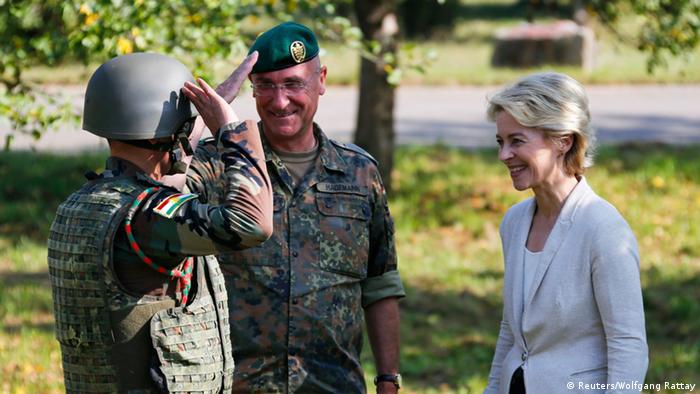
Defense Minister von der Leyen visits peshmerga training in Bavaria

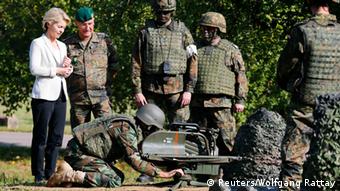
Defense Minister Ursula von der Leyen has taken a trip to see a Bundeswehr operation not currently halted by technical problems; Kurdish peshmerga fighters are being trained to use German anti-tank weapons in Hammelburg.
Ausbildung kurdischer Soldaten in Hammelburg Von der Leyen 02.10.2014


The German defense minister observed training exercises in Bavaria on Thursday where Kurdish forces are learning to operate the "Milan" anti-tank guided missile system. The Franco-German weapon was one of the products provided by Germany to help Iraqi Kurds battle the self-proclaimed "Islamic State" (IS) in northern Iraq.
"My compliments, this is impressive," von der Leyen told a training officer at the Hammelburg base, as Kurdish officers were taught to assemble and prepare the weapon to fire. Training officer Gert-Johannes Hagemann said that the drills were designed to ensure that soldiers could "accurately deploy" the Milan weaponry "by day or night." The antitank weapon, the most complex of those offered to the peshmerga by Berlin, has an effective range of up to 2,000 meters (more than a mile) against armored vehicles.
A total of 32 peshmerga fighters are currently stationed in Bavaria. 
Ausbildung kurdischer Soldaten in Hammelburg Von der Leyen 02.10.2014
Von der Leyen has a troubled week behind her
The visiting Christian Democrat defense minister also praised the security forces for Iraqi Kurdistan, saying that they had "deputized for many others in northern Iraq" by taking the fight to "IS." Iraq's military offered rather less resistance to the advancing Sunni terrorist militia than the Kurdish forces.
The Kurdish major leading the peshmerga group issued his thanks to the German Bundeswehr military for providing the weapons, ammunition and training. He said that Germany was "the first country to train us peshmerga for the fight against the IS militia." The German government has provided humanitarian and military equipment for the fight against IS, but has ruled out participation in airstrikes over Iraq or Syria.
Bundeswehr shortfalls in focus
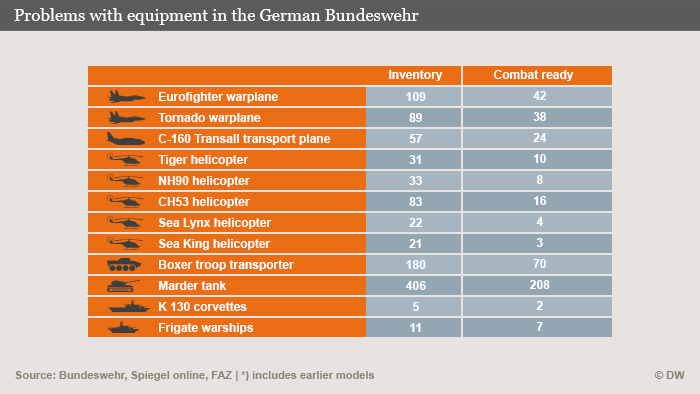
Von der Leyen also addressed the Bundeswehr's equipment problems during her trip, following days of sharp focus on the German military's various technical problems. The defense minister said a fresh discussion on bolstering Bundeswehr supplies would be necessary, before cautioning that such a move would cost money.
Germany spent 1.4 percent of its economic output on defense last year; NATO would like its members to spend at least 2 percent of GDP on their militaries.
Infografik Materialprobleme bei der Bundeswehr Englisch
A large portion of the Bundeswehr's aerial units are currently grounded, with problems affecting weapons deliveries to Iraq, the return of German soldiers from Afghanistan, and participation in the EU's anti-piracy mission off the Horn of Africa.
Von der Leyen was personally embarrassed by the delayed arrival of the first consignment of German weapons in Iraqi Kurdistan last week - she arrived in the region on schedule to meet local officials, but the German munitions were stuck in transit.
Von der Leyen on Thursday said that the problems stemmed from the Bundeswehr currently having to rely on old equipment because of delays producing new machinery. However, replacement parts for these older units were becoming scarce.
The defense minister said it had become clear "that stockpiling, but also production of replacement parts had been mistakenly wound down in the past years," pledging to "get them started again."

Thursday, October 2, 2014

Fundamental change...

For the first time, Russia has more deployed nuclear warheads than U.S.

For the first time, Russia, which is in the midst of a major strategic nuclear modernization, has more deployed nuclear warheads than the United States, according to the latest numbers released by the State Department.
Russia now has 1,643 warheads deployed on intercontinental ballistic missiles, submarine-launched ballistic missiles and heavy bombers. The United States has 1,642, said the fact sheet released Wednesday.
The warhead count for the Russians, based the Sept. 1 report required under the 2010 New Strategic Arms Reduction Treaty (START), shows an increase of 131 warheads since the last declaration on March 1. The U.S. reported a warhead increase of 57 during the same period. It is not clear why the warhead numbers increased.
The treaty limits each side to 1,550 deployed warheads, 700 deployed missiles and bombers and 800 deployed and non-deployed launchers.
On New START delivery systems, the latest fact sheet reveals that the current Russian arsenal of deployed intercontinental ballistic missiles, silo-launched ballistic missiles and heavy bombers is 528, up from 498.


Monday, September 9, 2013

Obama, Syria, the UN and being mugged


Echoes of Bush: Obama shuns U.N., seeks coalition of willing


President Obama's stated willingness to go it alone on Syria surprises those who followed him during the previous administration, when, as a senator, he derided George W. Bush's commitment to multilateralism and questioned his "coalition of the willing" in Iraq.
Now it is Mr. Obama who is chiding the United Nations for inaction and scrambling to put together a coalition of the willing, touting support from France and a few other nations as he works to convince Americans of the need for military strikes against Syrian President Bashar Assad's chemical weapons capabilities.
Conservative foreign policy analysts were bewildered recently when Mr. Obama announced that he would be "comfortable going forward without the approval" of the U.N. Security Council, which the president said "has been completely paralyzed and unwilling" to hold Mr. Assad accountable for using chemical weapons.
"Perhaps Obama has finally realized that his attachment to the U.N. has made him the world's useful idiot," quipped Michael Rubin, a resident scholar at the American Enterprise Institute, who believes the president acted naively in attempting during the past two years to overcome resistance — especially from Russian President Vladimir Putin — toward any Security Council action against Syria.
"He approached a den of snakes with the idealism of a community organizer and let Putin run roughshod over him," Mr. Rubin said.
"The phrase that leaps to my mind when I think about what's happened here is 'mugged by reality,'" said Kurt Volker, who heads the McCain Institute for International Leadership and is a former CIA analyst and career State Department officer.
With specific regard to bombing Syria, said Mr. Volker, "I think President Obama particularly took a strong position on requiring U.N. support, and this is a movement on his part from where he started. No doubt about it."
Speaking to reporters Friday at the end of the Group of 20 nations summit in Russia, Mr. Obama acknowledged that the U.N. has become an obstacle for him.
He said there are leaders who believe any military action must go through the Security Council, and those in another camp — in which he put himself — that has "given Security Council paralysis on this issue, if we are serious about upholding a ban on chemical weapons use, then an international response is required, and that will not come through Security Council action."
"I respect those who are concerned about setting precedence of action outside of a U.N. Security Council resolution. You know, I would greatly prefer working through multilateral channels and through the United Nations to get this done," he said.
But, echoing an argument Mr. Bush made in 2003 before invading Iraq, Mr. Obama said the United Nations also has a duty to back up its own resolutions or risk becoming toothless.
"If we end up using the U.N. Security Council not as a means of enforcing international norms and international law but rather as a barrier to acting on behalf of international norms and international law, then I think people rightly are going to be pretty skeptical about the system and whether it can work to protect those children that we saw in those videos," the president said.
As a state senator and later U.S. Senate candidate from Illinois, Mr. Obama opposed the Iraq invasion and mocked Mr. Bush's coalition, saying he doubted it ever existed.
As a U.S. senator, Mr. Obama pushed for the international community to take broader roles in conflicts such as the one in Sudan and in settling thorny issues such as North Korea's nuclear weapons ambitions.
He joined other Democrats on the Senate Foreign Relations Committee in resisting the Bush administration's nomination of John R. Bolton — well-known for his tireless characterizations of the U.N. as an ineffective bureaucracy — to be ambassador to the international body.
But Mr. Obama was not outwardly aggressive toward Mr. Bolton during a Senate confirmation hearing in 2005. In fact, he appeared to approve of the nominee's overall position that the United Nations was in serious need of reform.
Once in the White House, Mr. Obama's general deference toward working with the United Nations appeared to shine. During a December 2009 speech in accepting the Nobel Peace Prize, he described the international body as a mechanism "to govern the waging of war."
The Obama administration worked closely with the Security Council's permanent members, including Russia and France, on resolutions aimed at deterring North Korea from testing or developing nuclear weapons.
But Mr. Obama has not always held others to the rule of seeking Security Council approval for military interventions. He turned a blind eye, for instance, when France sent troops into Mali this year. The president even authorized U.S. military support for the mission, arguing that U.N. approval was not needed on grounds that Mali's government had invited the French troops to intervene.
That Mr. Obama had been so eager to work with the Security Council on Syria might be explained, at least in part, by presidential politics.
"In 2011 and 2012, prior to last November's elections, the U.S. was determined to avoid getting dragged into the Syrian war," said Richard Gowan, associate director for crisis diplomacy and peace operations at New York University's Center on International Cooperation.
"The Obama administration was determined to avoid an intervention and, to some extent, Russia's obstructionism at the U.N. gave the U.S. an alibi," Mr. Gowan said. "Tussling diplomatically with Russia and China was a sort of good way to avoid action. I think the Security Council did offer diplomatic cover in the run-up to the election."
But, he noted, Obama administration officials also believed that "Russia would back down or that Assad would be defeated on the battlefield."
"Until the early months of this year, there was more confidence in the West that Assad would lose the war, and one priority for the U.S. was to keep open some sort of U.N. deal at the end of the conflict," Mr. Gowan said.
With such a deal, he said, the Obama administration might have lobbied the Security Council to authorize a force of peacekeepers to enter Syria.
Analysts said Democratic and Republican administrations have a history of using — or not using — the Security Council on a case-by-case basis.
"It's true that in terms of rhetoric the Republicans are more negative toward the U.N.," he said. "But in fact, both Republican administrations often find the U.N. very useful and Democratic administrations often find it necessary to put the U.N. to one side in a crisis, so it's hard to reduce overall U.S. attitudes toward the U.N. purely to partisan positions."