
Taxing companies that use robots to help pay for the workers they’ve displaced has been floated as a theoretical solution to a post-automation world. Now San Francisco Supervisor Jane Kim is looking into whether it’s what the tech capital needs.
With fears about the job-killing effects of automation growing every day, once unthinkable ideas are starting to get an airing. A universal basic income (UBI)–where the government gives everyone enough money to live on–has lots of supporters, especially in Silicon Valley. And now some prominent individuals are calling for a tax on robots. The thinking: If you make robots more expensive, there will be more public funds to help retrain workers (or pay for that basic income)–and the higher cost might keep some companies from buying robots and quickly tanking the employment rate.
Bill Gates recently called for a robot tax in an interview with Quartz, arguing that it could slow the shift to a more robot-centric future, allowing society to catch breath. Moreover, he said, it could raise revenues to pay humans for more human types of work, like looking after children or the elderly.
Gates’s position was shocking because you don’t often hear tech executives, even ex ones, arguing with unfettered tech progress, and because, as Quartz pointed out, Microsoft is a big developer of artificial intelligence. But the CEO turned mega-philanthropist may have made the idea more acceptable for others to consider and debate. And now Jane Kim, one of 11 city supervisors in San Francisco, has begun to explore more seriously what it would look like for a city to actually implement such a tax.

[Photo: Jane Kim official Flickr]Kim says she read Gates’s interview and wondered if a robot tax might help the city deal with inequality. “We need to think about investments in our society that don’t exacerbate the wealth and income gaps that we already see today,” she tells Fast Company. “We don’t want to become a third-world country where there’s a big divide between the very rich and very poor.” San Francisco has one of the biggest income gaps in the country, according to figures from the Brookings Institution.
Kim, who represents areas like Union Square, the Tenderloin, and Civic Center, is setting up a working group to consider how an automation tax might work. She hopes it will include representatives from the tech community, academia, and unions, and that it can work through some of the practical questions. These include how much revenue the city stands to lose from lost payroll taxes due to automation, and what industries might be most affected. “It’s not only going to be manufacturing and truck drivers. It’s also going to be restaurants, hotel workers, and health care, which form a strong base of employment in the city,” she says. The tax would be paid by companies adopting robots over workers, not by robot-makers.
Kim sees revenue raised from the tax going toward education. She notes that an increasing number of jobs require a college degree, meaning that the tax could have a role in making college more affordable (the city is already taxing high-end real estate to pay for free tuition). Like Gates, she also favors exploring ways to slow the automation wave, allowing government and business to put in policies that help people transition. “It may be that government needs to play a role in regulating automation over time, so we can absorb job displacement at a rate that’s more sustainable for our country,” she says.
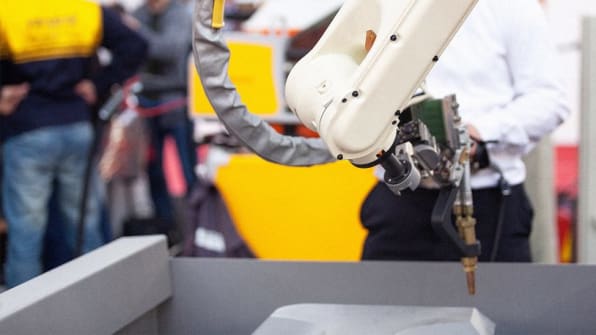
[Photo: wellphoto/iStock]Many economists are skeptical about the workability of an automation tax, not least because it’s hard to define exactly what harmful automation is. If McDonald’s replaces a server with a robot, it’s clear that a worker has lost a job to a machine. But if an office puts in an answering machine, it may be that the worker is just doing something else than answering phones all day. Automation could have positive effects, for instance allowing people to avoid dangerous work, or to retrain and move up the wage scale.
These concerns were enough to derail a robot tax proposal put forward by some European lawmakers this year. But, a report from the European Parliament did suggest other radical ideas, including requiring companies to report robot adoption, and the concept of “electronic personhood” where robots would have some of the rights and responsibilities of human beings.
Kim doesn’t claim that taxing automation is a silver bullet, only that it’s worth pursuing along with other measures, including a basic income guarantee. She supports UBI, but points out that many proposals are un-funded, unlike the robot tax, which both has a social effect (more jobs, less automation) and generates money for other things.
Most of all, Kim–possibly the first public official in America to publicly support a robot tax–is keen to experiment. “We are the center of the tech world here in San Francisco. There is a broad concern about automation and job displacement in the future,” she says. “We want to be the first to put ideas out there, so they can be explored. Then we want others to follow.”
Keep these in mind as you contemplate the direction of the American government over the past 50 years and especially since the Obama election.
The Goals of Communism
(as read into the congressional record January 10, 1963, from "The Naked Communist" by Cleon Skousen)
1. U.S. acceptance of coexistence as the only alternative to atomic war.
2. U.S. willingness to capitulate in preference to engaging in atomic war.
3. Develop the illusion that total disarmament of the United States would be a demonstration of moral strength.
4. Permit free trade between all nations regardless of Communist affiliation and regardless of whether or not items could be used for war.
5. Extension of long-term loans to Russia and Soviet satellites.
6. Provide American aid to all nations regardless of Communist domination.
7. Grant recognition of Red China. Admission of Red China to the U.N.
8. Set up East and West Germany as separate states in spite of Khrushchev's promise in 1955 to settle the German question by free elections under supervision of the U.N.
9. Prolong the conferences to ban atomic tests because the United States has agreed to suspend tests as long as negotiations are in progress.
10. Allow all Soviet satellites individual representation in the U.N.
11. Promote the U.N. as the only hope for mankind. If its charter is rewritten, demand that it be set up as a one-world government with its own independent armed forces. (Some Communist leaders believe the world can be taken over as easily by the U.N. as by Moscow. Sometimes these two centers compete with each other as they are now doing in the Congo.)
12. Resist any attempt to outlaw the Communist Party.
13. Do away with all loyalty oaths.
14. Continue giving Russia access to the U.S. Patent Office.
15. Capture one or both of the political parties in the United States.
16. Use technical decisions of the courts to weaken basic American institutions by claiming their activities violate civil rights.
17. Get control of the schools. Use them as transmission belts for socialism and current Communist propaganda. Soften the curriculum. Get control of teachers' associations. Put the party line in textbooks.
18. Gain control of all student newspapers.
19. Use student riots to foment public protests against programs or organizations which are under Communist attack.
20. Infiltrate the press. Get control of book-review assignments, editorial writing, policymaking positions.
21. Gain control of key positions in radio, TV, and motion pictures.
22. Continue discrediting American culture by degrading all forms of artistic expression. An American Communist cell was told to "eliminate all good sculpture from parks and buildings, substitute shapeless, awkward and meaningless forms."
23. Control art critics and directors of art museums. "Our plan is to promote ugliness, repulsive, meaningless art."
24. Eliminate all laws governing obscenity by calling them "censorship" and a violation of free speech and free press.
25. Break down cultural standards of morality by promoting pornography and obscenity in books, magazines, motion pictures, radio, and TV.
26. Present homosexuality, degeneracy and promiscuity as "normal, natural, healthy."
27. Infiltrate the churches and replace revealed religion with "social" religion. Discredit the Bible and emphasize the need for intellectual maturity which does not need a "religious crutch."
28. Eliminate prayer or any phase of religious expression in the schools on the ground that it violates the principle of "separation of church and state."
29. Discredit the American Constitution by calling it inadequate, old-fashioned, out of step with modern needs, a hindrance to cooperation between nations on a worldwide basis.
30. Discredit the American Founding Fathers. Present them as selfish aristocrats who had no concern for the "common man."
31. Belittle all forms of American culture and discourage the teaching of American history on the ground that it was only a minor part of the "big picture." Give more emphasis to Russian history since the Communists took over.
32. Support any socialist movement to give centralized control over any part of the culture--education, social agencies, welfare programs, mental health clinics, etc.
33. Eliminate all laws or procedures which interfere with the operation of the Communist apparatus.
34. Eliminate the House Committee on Un-American Activities.
35. Discredit and eventually dismantle the FBI.
36. Infiltrate and gain control of more unions.
37. Infiltrate and gain control of big business.
38. Transfer some of the powers of arrest from the police to social agencies. Treat all behavioral problems as psychiatric disorders which no one but psychiatrists can understand.
39. Dominate the psychiatric profession and use mental health laws as a means of gaining coercive control over those who oppose Communist goals.
40. Discredit the family as an institution. Encourage promiscuity and easy divorce.
41. Emphasize the need to raise children away from the negative influence of parents. Attribute prejudices, mental blocks and retarding of children to suppressive influence of parents.
42. Create the impression that violence and insurrection are legitimate aspects of the American tradition; that students and special-interest groups should rise up and use united force to solve economic, political or social problems.
43. Overthrow all colonial governments before native populations are ready for self-government.
44. Internationalize the Panama Canal.
45. Repeal the Connally reservation so the United States cannot prevent the World Court from seizing jurisdiction over nations and individuals alike.
No comments:
Post a Comment