Showing posts with label America's End. Show all posts

Sunday, July 26, 2020

Peace or freedom


  Quote of the Day: Peace and Freedom

 
“You can have peace or you can have freedom. You cannot get both at once.” – Robert Heinlein
Robert Heinlein made this comment during his speech at the 1976 MidAmeriCon World Science Fiction Convention, where he was guest of honor (skip to 7:40 to avoid a dull introduction). Heinlein was a cold warrior; he was a warrior, period. He understood freedom was not free, and the tree of liberty had to be renewed with the blood of patriots and tyrants. During his life, he saw the US struggle against four tyrannies: Imperial Germany, Nazi Germany, Imperial Japan, and the Soviet Union. He died before the ultimate victory against the Soviet Union, but he understood the only way to overcome tyranny was to fight it.
It occurs to me that since the fall of the Soviet Union, the United States – temporarily – achieved what Heinlein felt was impossible: simultaneous peace and freedom. The US has been enormously blessed during the last 30 years. Yet as Heinlein observed on several occasions, all bills come due. The bill for the last 30 years’ domestic peace is being presented. The question is, how do we pay it? Do we accept tyranny and resign ourselves to peaceful lives as serfs or do we take arms against it and opt for freedom?
However simple the choice, the path we choose will be difficult. On one hand, the perpetual humiliations to which a servile class is subject. On the other hand, the blood and treasure that will have to be spent — not by a nation, but by each individual in that nation — to maintain freedom.
In 1976, the choice most Americans would have made would have been for freedom. Peace without freedom is ashes. Today? Maybe it is the natural pessimism of the old (I turned 65 this month), but I wonder if most Americans would not rather have peace.
We shall see.

Sunday, July 19, 2020

Biden and Bernies 10 policies for America's fundamental transformation.

GOP gallery of nightmares: 10 policies Biden and Democrats would ram through after axing filibuster

00:3901:20
Presumptive Democratic nominee Joe Biden put Republicans on notice this week: If you use the filibuster to stymie his agenda, you’ll lose it.
“It's going to depend on how obstreperous they become,” Biden said of eliminating the 60-vote threshold to end debate. The former vice president previously resisted getting rid of the filibuster but now says, “you’re just going to have to take a look at it.” If Biden wins and Democrats capture the Senate, this would enable them to pass legislation with a simple majority, leaving Republicans powerless to stop them. 
Here are 10 liberal policies that Biden and the Democrats could enact without the filibuster that would be difficult to get through if it remained in effect:
1. Gun control: After largely abandoning the issue following election losses in the 1990s, a series of high-profile mass shootings have increased Democratic support for passing what they now describe as “commonsense gun safety legislation.” The details of the exact proposals have varied, but universal background checks and reinstating the so-called assault weapons ban, originally passed as part of Biden’s 1994 crime bill, would seem to be priorities if Democrats win in November. The Biden “plan to end our gun violence epidemic” would make gun manufacturers liable for crimes committed using their products and ban high-capacity magazines. Republicans, and a few Democrats from states with a high number of legal gun owners, would resist such efforts. Junking the filibuster would take away a tool for doing so.
2. Amnesty for illegal immigrants: There was filibuster-proof support for comprehensive immigration reform that would have legalized a large majority of the unauthorized immigrants currently residing in the United States under Presidents George W. Bush and Barack Obama, but Republican opposition stiffened after the collapse of the Gang of Eight in 2013 and the election of Donald Trump in 2016. The DREAM Act, a legislative precursor to Obama’s Deferred Action for Childhood Arrivals program, was stopped by a filibuster in 2012.
Biden has proposed a “roadmap to citizenship for the nearly 11 million people who have been living in and strengthening our country for years,” a reference to undocumented immigrants. “These are our mothers, fathers, brothers, and sisters,” says Biden’s campaign website. “They are our neighbors, co-workers, and members of our congregations and Little League teams.” Such a plan might pass simply in response to a Trump defeat. It would definitely get through the Senate without a filibuster. 
3. Taxpayer funding of abortion: Facing liberal pressure, Biden has abandoned his support for the Hyde Amendment, which bans most federal funding of abortion. Democrats frequently campaign on Hyde Amendment repeal but have not made a serious attempt to do so since 1993 because the Senate votes have not been there even when they have been in the majority. But with fewer anti-abortion Democrats in Congress than ever before and no filibuster, it would be easier to pass such legislation and restore Medicaid-funded abortions for the first time since 1976.
4. Tax increases: While most tax and spending legislation can already avoid the filibuster’s supermajority requirement through the reconciliation process, some provisions can still be blocked by the minority. Under Obama, Senate Democrats tried to improve their prospects for repealing the Bush tax cuts with legislation separating the middle-class reductions from those for upper-income earners. Both pieces of legislation were stopped by filibuster, and most of the tax cuts were extended in 2013. Democrats are likely to try something similar with the Trump tax cuts, and without the filibuster, they could. The Buffet rule, which imposed a 30% minimum tax on the wealthy, was also blocked by filibuster. So was a Democratic resolution stating, “any agreement to reduce the budget deficit should require that those earning $1,000,000 or more per year make a more meaningful contribution to the deficit reduction effort.”
5. Ending the secret ballot for unionization: Called “card check,” Democrats were unable to pass this when they held nearly 60 seats in the Senate. The policy would make it easier to unionize a workplace because it would replace most secret-ballot elections with a petition signed by a bare majority of eligible employees. It is a major priority for organized labor, as it would increase membership, but even some red-state Democrats have balked in the past. Its chances would improve without the filibuster. 
6. D.C. statehood: Democrats want to make Washington, D.C., a state. This would guarantee the Democrats an additional member of the House of Representatives and two more senators in perpetuity. Unlike even Massachusetts, the district has never voted for a Republican presidential candidate. The House recently passed a Washington, D.C., statehood measure along party lines. Without the filibuster, the same could happen in the Senate. Doing this through legislation rather than a constitutional amendment is likely unconstitutional, but that brings us to the next item on the list... 
7. Court-packing: Liberal activists have increasingly been clamoring for an expansion of the Supreme Court by Congress to undercut its current narrow conservative majority. A Democratic Senate would then be able to confirm new liberal nominees quickly who are already no longer subject to filibuster. Biden still opposes court-packing, but a few controversial conservative decisions, especially rulings against his administration, could force his hand. The mere threat of court-packing is widely believed to have persuaded the Supreme Court to uphold more of Franklin D. Roosevelt’s New Deal.
8. The public option — and maybe Medicare for All: Biden opposes expanding Medicare to cover all people and would prefer to instead create a government-run public option within Obamacare. This would also increase the federal government’s role in healthcare and make it difficult for private insurers to compete. The public option would already be part of Obamacare, but some centrist and insurance-state Democrats opposed the idea and denied it a filibuster-proof majority. Getting rid of the filibuster would make all Democratic attempts to grow the federal role in healthcare easier, as the writing of Obamacare was hampered by having to follow the reconciliation process to get around the possibility of a filibuster. If enough Democrats decided to do so, they could even decide to go all the way with Medicare for All or another government-run, single-payer plan. Would Biden really veto it? He has succumbed to liberal pressure before — such as on the filibuster. 
9. Oil company crackdowns: During the Obama administration, Democrats advanced legislation to disqualify oil companies from manufacturing tax credits. It was blocked by filibuster. Further reaching legislative efforts are sure to be revived if Democrats control a filibuster office while Biden is on the opposite end of Pennsylvania Avenue.
10. The Green New Deal: Advertised as an ambitious environmental plan by supporters of Rep. Alexandria Ocasio-Cortez, it is a grab bag of liberal policy proposals with a price tag that has been estimated at anywhere from $50 trillion to $93 trillion over 10 years. In addition to zeroing out greenhouse gas emissions, it would “create millions of good, high-paying jobs” and stop, prevent, and repair “oppression.” The only way it could ever pass is without the filibuster.

Sunday, July 5, 2020

Is this America's glide path? Sure looks like it

Katsina: The motorcycle bandits terrorising northern Nigeria

  • 5 July 2020
Illustration
Motorcycle-riding armed bandits operating out of abandoned forest reserves are ransacking communities in Nigeria's north-west.
The groups are the latest to join Nigeria's lucrative kidnap for ransom industry, and are quite brazen in their operations.
In the last decade more than 8,000 people have been killed in the states of Kebbi, Sokoto, Niger and Zamfara, according to the International Crisis Group.
But recent attacks in the president's home state of Katsina, where more than 100 people were killed in attacks between April and June, have led to protests and calls for his resignation.
A member of a local vigilante group in Zamfara stateImage copyrightGETTY IMAGES
Image captionVigilante groups have emerged in the north-west because of growing lawlessness
On two separate occasions the bandits targeted villagers who had received food handouts from the government during the coronavirus lockdown.
"They were about 200 on motorbikes, each bike rider carried a passenger and they all carried AK47 guns," Bashir Kadisau, an eyewitness, told the BBC.
He said he climbed to the top of a tree when he saw the large number of motorcycle riders coming into Kadisau village, and saw the attackers loot shops, steal cattle and grain, and shoot people who were fleeing.

Climate change fuels conflict

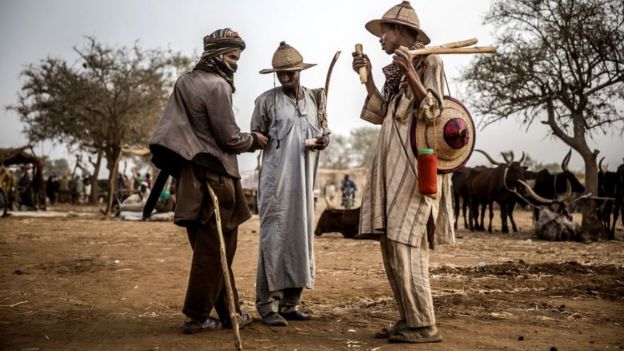
The attacks are rooted in decades-long competition over resources between ethnic Fulani herders and farming communities. 
A group of Fulani pastoralist men exchange money after cattle transactions at Illiea Cattle Market, Sokoto State, Nigeria, on April 21, 2019Image copyrightGETTY IMAGES
Image captionWater scarcity has made it more difficult for Fulani pastoralists to graze their cattle
The herders are mostly nomadic and can be found on major highways and streets across the country herding their cattle, but they have become involved in deadly clashes with farmers in Nigeria's north-western and central states.
This is because these areas have suffered massive deforestation, due to the impact of the Sahara Desert spreading south, causing arable farming land to disappear and water to become scarce. 
An oil militant in Nigeria's Niger Delta holding a machine gun
Getty Images
Nigeria's security challenges
  • Militant Islamistsin the north-east
  • Armed banditsin the north-west and centre
  • Farmers and herdersin the north-west and centre
  • Street gangsin the south-west
  • Biafra separatistsin the south-east
  • Oil militantsin the Niger Delta
Source: BBC
Presentational white space
"The persistent clashes led to the formation of armed self-help groups, called vigilantes, by both sides for protection," security analyst Kabiru Adamu told the BBC.

'Kidnapping more lucrative than herding cows'

Armed groups within Fulani communities are being accused of resorting to criminality.
"The herders now see kidnapping and pillaging as more lucrative than the herding.
"The biggest cow would go for 200,000 naira but one kidnapping would fetch millions," Dr Adamu said.
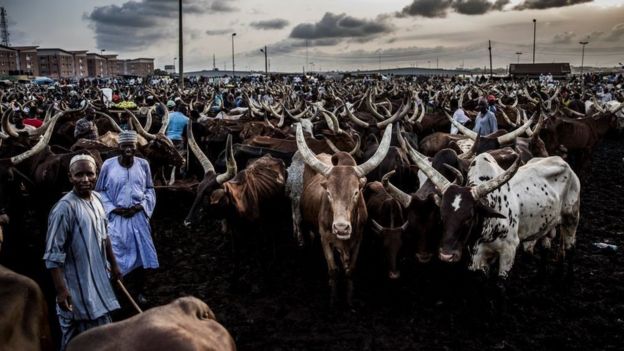
Herdsmen along with their cows wait for buyers at Kara Cattle Market in Lagos, Nigeria, on April 10, 2019. - Kara cattle market in Agege, Lagos is one of the largest of West Africa receiving thousands of cows weekly due to the massive consumption of meat in Lagos area.Image copyrightGETTY IMAGES
Image captionHerders sell their cattle in markets across Nigeria
Nigeria's Fulani herders deny the accusation.
The main Fulani cattle-breeders association, Miyetti Allah (Hausa for Thank You God), said they are the ones mostly affected by the activities of the bandits and that hundreds of their members have been kidnapped. 
"Our cows have been rustled. The bandits are a bunch of criminals comprising all sorts of groups. We have lost 30% of cattle in Nigeria to different types of crises," Miyetti Allah's national secretary Baba Othman Ngelzarma told the BBC.
He said the attackers in Nigeria's north-west were "foreign herders from neighbouring countries".
Presentational white space
Nigeria's north-west, an area almost the size of the UK, borders Niger and criminal gangs criss-cross between the two countries, evading security.

'Herders seek revenge'

The borders are porous and the vast forest reserves in the border regions have been turned into operational bases for the bandits. 
Police say the attacks in the north-west are being carried out by criminal gangs, as well as Fulani herdsmen.
"The Fulani herders suddenly realised that they now have arms to protect themselves. But they are not just protecting themselves, they are also going after those who wronged them in the past," Isah Gambo, police spokesman in Katsina state, told the BBC. 
Media captionInside Nigeria's kidnap crisis: A 2019 BBC Africa Eye investigation
Kidnapping for ransom is widespread in Nigeria, with victims forced to pay between $20 and $200,000 for their freedom.
At its height in 2017 and 2018, the major road connecting the capital Abuja in central Nigeria to Kaduna in the north-west had 10 kidnappings per day with 20 different groups operating on the route, the police head of a special unit fighting kidnappers, Abba Kyari, told the BBC.

Peace deal with bandits

The governor of Katsina state, Aminu Bello Masari, went into the forest hideout of the bandits last year, negotiating a deal that would see them escape prosecution in exchange for stopping the attacks. 
A picture taken on May 10, 2016 in Okokolo-Agatu in Benue State, north-central Nigeria shows a burnt house following attacks by Fulani herdsmen.Image copyrightGETTY IMAGES
Image captionThe conflict has caused much destruction in northern Nigeria
But he caused shock among many Nigerians when he appeared in a photo standing next to a bandit wielding an AK-47 rifle.
Businessman Nasif Ahmad, who had been kidnapped in Katsina only days before, condemned the governor for making the deal. 
"How can a state government go into a deal with bandits who have no education, have no sympathy or faith and behave like animals," he said.
Mr Ahmad said he fought off the bandits after they abducted him, and spent the night in the forest.
"I felt very, very bad when I heard about the governor going into a deal with them," he told the BBC.

Buhari targeted

The governor said at the time that the talks were aimed at ending the "incessant wanton destruction of lives and property", and were yielding positive results.
But last month, Mr Masari told journalists that the peace deal was off because of continuing attacks. 
"These bandits come to town, spray bullets, kill indiscriminately for no purpose and no reason whatsoever. How can a human being behave the way an animal cannot behave?" he asked.
line

You may also be interested in:

line
Last month's street protests in Katsina saw angry protesters burn down an old campaign billboard of President Muhammadu Buhari, the clearest indication yet that people in his home state had run out of patience.
Mr Buhari, a retired army general, was elected in 2015 on promises of solving Nigeria's various security challenges. 
But in his time, a deadly Islamic insurgency has continued to rage in the north-east, while criminal activities, along with the farmer-herder clashes, appear to have escalated in the north-west and central states. 
Aerial view of a Fulani village in Kachia Grazing Reserve, Kaduna State, Nigeria, on April 18, 2019. Kachia Grazing Reserve is an area set aside for the use of Fulani pastoralist and it is intended to be the foci of livestock developmentImage copyrightGETTY IMAGES
Image captionPresident Buhari wants to reserve grazing areas for the herdsmen
Nigeria's military is currently carrying out an operation on the orders of the president to "sweep bandits and kidnappers" out of his home state.
Mr Buhari has also attempted to solve the underlying reasons for the conflict by proposing grazing reserves for the herders. 
But in a country divided along ethnic lines, many powerful state governors refused to buy into the project, accusing the president, a Fulani, of hatching a plan to seize land for his ethnic group.
It is increasingly clear that the lines between the farmer-herder clashes and banditry are becoming more blurred in the north-west, and as the Katsina state governor learned, bandits do not keep their word.