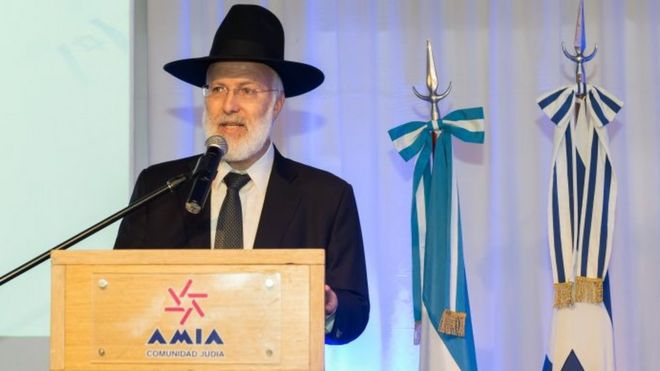
Image copyrightAMIAImage captionMr Davidovich's attackers stole money and reportedly told him "We know that you are the Amia Rabbi"
Argentina's Chief Rabbi has been taken to hospital after being beaten in a night-time attack at his home in the capital Buenos Aires.
Rabbi Gabriel Davidovich said his wife was restrained during the break-in while he was attacked.
In a statement, Amia - a Jewish cultural centre - said the attackers stole money and told Mr Davidovich: "We know that you are the Amia Rabbi."
The organisation said comments made by his attackers were "a cause for alarm".
The Israeli Prime Minister Benjamin Netanyahu condemned the attack. "Anti-Semitism must not be allowed to rear its head," he said in a statement.
Mr Davidovich, who has been Argentina's chief rabbi since 2013, was being treated for several fractured ribs and a punctured lung, according to local press reports. Police said they were investigating the incident as a robbery.
The attack came just a day after seven Jewish graves were defaced with Nazi symbols in San Luis in western Argentina. The country is home to nearly 200,000 Jews - one of the world's largest Jewish populations outside Israel.
In 1994, the Amia building was targeted in a bomb attack that killed 85 people and remains the country's deadliest terrorist incident. Much of the evidence was subsequently lost or contaminated and no-one has been convicted in connection with the bombing.
By The Washington Post | Posted February 19, 2019 at 01:54 PM | Updated February 19, 2019 at 01:55 PM
Pope Francis is caught in pensive mood during his weekly general audience at the Vatican on Aug. 22, 2018. (AP Photo/Andrew Medichini)
LUJAN DE CUYO, Argentina -When investigators swept in and raided the religious Antonio Provolo Institute for the Deaf, they uncovered one of the worst cases yet among the global abuse scandals plaguing the Catholic Church: a place of silent torment where prosecutors say pedophiles preyed on the most isolated and submissive children.
The scope of the alleged abuse was vast. Charges are pending against 13 suspects; a 14th person pleaded guilty to sexual abuse, including rape, and was sentenced to 10 years in prison. The case of the accused ringleader - an octogenarian Italian priest named Nicola Corradi - is set to go before a judge next month.
Corradi was spiritual director of the school and had a decades-long career spanning two continents. And so his arrest in late 2016 raised an immediate question: Did the Catholic Church have any sense that he could be a danger to children?
The answer, according to a Washington Post investigation that included a review of court and church documents, private letters, and dozens of interviews in Argentina and Italy, is that church officials up to and including Pope Francis were warned repeatedly and directly about a group of alleged predators that included Corradi.
Yet they took no apparent action against him.
"I want Pope Francis to come here, I want him to explain how this happened, how they knew this and did nothing," a 24-year-old alumna of the Provolo Institute said, using sign language as her hands shook in rage. She and her 22-year-old brother, who requested anonymity to share their experiences as minors, are among at least 14 former students who say they were victims of abuse at the now-shuttered boarding school in the shadow of the Andes.
'They were the perfect victims'
Vulnerable to the extreme, the deaf students tended to come from poor families that fervently believed in the sanctity of the church. Prosecutors say the children were fondled, raped, sometimes tied up and, in one instance, forced to wear a diaper to hide the bleeding. All the while, their limited ability to communicate complicated their ability to tell others what was happening to them. Students at the school were smacked if they used sign language. One of the few hand gestures used by the priests, victims say, was an index figure to lips - a demand for silence.
"They were the perfect victims," said Gustavo Stroppiana, the chief prosecutor in the case.
And yet they may not have been the first. Corradi, now 83 and under house arrest, is also under investigation for sexual crimes at a sister school in Argentina where he worked from 1970 to 1994. And alumni of a related school in Italy, where Corradi served earlier, identified him as being among a number of priests who carried out systematic abuse over five decades. The schools were all founded and staffed by priests from the Company of Mary for the Education of the Deaf, a small Catholic congregation that answers to the Vatican.
The Italian victims' efforts to sound the alarm to church authorities began in 2008 and included mailing a list of accused priests to Francis in 2014 and physically handing him the list in 2015.
It was not the church, however, but Argentine law enforcement that cut off Corradi's access to children when it shut down the Provolo school in Lujan. Argentine prosecutors say the church has not fully cooperated with their investigation.
As Francis prepares to host a historic bishops' summit this week to address clerical sexual abuse, the lapses in the case - affecting the pope's home country of Argentina and the home country of the Roman Catholic Church - illustrate the still-present failures of the church to fix a system that has allowed priests to continue to abuse children long after they were first accused.
Corradi's lawyer declined multiple interview requests for this article and did not respond to emails seeking to speak with the priest. Attempts to reach Corradi through his family were unsuccessful. The Vatican declined to comment on a detailed list of questions.
But Anne Barrett Doyle, co-director of the abuse-tracking site BishopAccountability.org, said the Provolo case "is truly emblematic."
"The church failed them abysmally. The pope ignored them, the police responded," she said. "It's a clear example of the tragedy that keeps playing out."
The city of Verona, Italy, as seen from the Castel San Pietro on Jan. 25, 2019. (Photo for The Washington Post by Emanuele Amighetti)
Abusive priests reported
As in Argentina, deaf students from the Provolo schools in Verona, Italy, kept their experiences of sexual abuse to themselves for years. But after they started opening up, they worked from bottom to top to inform the Catholic church, according to letters and other documents. They wrote to the local bishop in 2008. Soon after, they provided a list of accused priests and religious figures to the local diocese. By 2011, a list of names was with the Vatican. By 2015, a list was in the hands of the pope.
The rumblings started with Dario Laiti, a former student who came forward in 2006 after noticing a new children's facility in the town and worrying that abuse might be happening there, as well.
"I was the first," said Laiti, who for years had made excuses when his wife asked why he hadn't wanted children.
Soon, more than a dozen other former students were telling their stories, using an improvised mix of sign language and limited speech. Their accounts ranged in time between the 1950s and 1980s. As adults, they had become woodcutters, delivery men, factory workers. Some were unemployed. Few had sustained relationships. One of their schoolmates had committed suicide.
One student, Alda Franchetto, said she had tried to confide in her parents years earlier - running away from the school as a 13-year-old in a burst of euphoria and explaining to them what was happening to her there. Her parents, she said, didn't believe her and returned her to the institute.
"They said, 'You need this to learn how to speak and write,' " Franchetto said.
By the time the adult former students started reporting their abuse, it was too late to press criminal charges. But it was not too late for accountability through the church. They wrote to the local bishop in 2008, informing him of their claims. Soon after, at the request of a journalist from the Italian news magazine L'Espresso, 15 former students took another step: writing sworn statements describing sodomization, forced masturbation and other forms of abuse. The statements named 24 priests and other faculty members, including Corradi. The student association said dozens of others had experienced abuse but did not want to come forward publicly.
The Instituto Antonio Provolo in Verona, Italy, on Jan. 25, 2019. (Photo for The Washington Post by Emanuele Amighetti)
The bishop, Giuseppe Zenti, was dismissive. In a news conference, he called the allegations "a hoax, a lie, and nothing more," and he noted the association for former students was involved in a property dispute with the Provolo Institute. The former students filed defamation charges against Zenti and included their statements as part of the lawsuit - essentially handing the names of the accused priests to the diocese.
The case caught the notice of the Vatican, which in 2010 asked Zenti to look more deeply into the claims, according to church letters. The local diocese brought in a retired judge, Mario Sannite, to investigate.
"That's how I found myself in the middle of this story," Sannite said.
Sannite became the on-the-ground representative of the Holy See, asked to relay his findings - and his analysis - to the Vatican's Congregation for the Doctrine of the Faith. In December 2010 and January 2011, Sannite interviewed 17 former students from Provolo, with the help of a sign-language interpreter. He said the accounts were harrowing, and he later wrote that there was no reason to doubt the "majority" of the accusations. In the report sent to the Vatican, though, Sannite wrote that he had doubts about one former student, the only one who happened to name Corradi as an abuser - even though some of the others interviewed had overlapped with Corradi's time at the school.
Gianni Bisoli, a then-62-year-old ski instructor, accused 30 religious figures and other Provolo faculty members of abusing him - a number far beyond the others. And his allegations were particularly explosive; one of those he accused was Giuseppe Carraro, the bishop of Verona in the 1960s and 1970s, who after his death was on the path to canonization.
"Bisoli's statements were likely deemed quite dangerous," said Paolo Tacchi Venturi, a lawyer who at the time was representing the victims.
With the help of a sign-language interpreter and Tacchi Venturi, Bisoli spoke with Sannite for 12 hours, over the course of three days, according to records. Others who were in the room told The Post that Bisoli described the abuse in detail.
In interviews with The Post, Bisoli recounted that he was abused by Corradi several times, including once when he had been corralled along with two other children into a bathroom reserved for priests. In that instance, Bisoli said, he was ordered against a wall by Corradi and two other religious figures. Bisoli remembered Corradi sodomizing him with his finger.
Gianni Bisoli told a church investigator that he was abused by 30 religious figures and other Provolo faculty members, including Corradi. Bisoli is shown on Jan. 24, 2019. (Photo for The Washington Post by Emanuele Amighetti)
Sannite assessed that Bisoli was certainly a victim of abuse. But in the report he wrote, which was sent through Verona's diocese to the Vatican, the former judge said it was implausible that Bisoli could have been abused by so many - that the institute he described was akin to an "infernal circle." Sannite noted that some of Bisoli's dates did not match, and some of the accused did not appear to be at the institute in the years Bisoli described. Sannite also offered another theory: that Bisoli "repackaged his overflowing allegations by drawing from the collection of his own experiences as a homosexual" adult.
In an interview at his home last month, Sannite read from the report, though he did not share a copy with The Post. When asked why a gay man might be less likely to accurately describe abuse, Sannite said, "It's not as if I can say there are differences." Then he asked why he was being asked such a question. Later, Sannite wrote in an email that he did not mean to draw a connection between Bisoli's credibility and his sexuality.
Bisoli, in an interview, said it was "offensive" and a "provocation" that anybody's sexuality in adulthood might figure into an assessment.
Following church guidelines, Zenti wrote a letter to accompany the report to the Vatican, according to the Diocese of Verona, which declined to share it with The Post. But Zenti remained skeptical about the claims and said in 2017 testimony - conducted as part of a separate lawsuit - that even a word like sodomization would be "hard to convey for a deaf-mute." The bishop also reported hearing a theory that the Veronese victims were behind the claims in Argentina, as well, perhaps as a way to "gain possession of the nice properties of the institute in those places."
Based on the investigation in Verona, the Vatican punished only one priest, Eligio Piccoli, who was ordered to a life of prayer and penance away from minors. Three other priests were given admonitions - essentially warnings that the Vatican was watching future behavior.
A church official in Verona said the allegations against Corradi were not looked at closely in large part because of the assessment about Bisoli. "We acted on the broad premise that Bisoli wasn't deemed reliable," Monsignor Giampietro Mazzoni said. "In this case, perhaps, making a mistake - since we didn't know then what would later happen in Argentina."
One of the other former students who Bisoli said was in the priests-only bathroom, Maurizio Grotto, has offered conflicting accounts of what happened. He told Sannite he was not abused by Corradi and said in an interview with The Post that he was. Another former Provolo student, Franchetto, said in an interview that she was molested by Corradi but had tried for years, "as a measure of self-defense," to forget his face. She did not tell the Vatican investigator about her experiences. The president of the association representing the Italian victims, Giorgio Dalla Bernardina, said he knows of other Corradi victims who have been unwilling to speak publicly.
Lawyers involved in the case and experts on clerical abuse say the church failed to examine whether the pattern of abuse in Italy was playing out at the overseas Provolo locations where Italian priests had been sent. Some dioceses in the United States report abuse accusations to law enforcement no matter what - even if the accused priest is deceased or if the statute of limitations has expired - and suspend priests from ministry as accusations are being investigated. The Diocese of Verona said it did not contact law enforcement.
Tacchi Venturi, the lawyer who had represented the victims during the hearing, said the Vatican made one other error - a "logic contradiction" - by acknowledging that Bisoli was abused but not looking into who might have abused him.
"If you say he suffered abuses, and you believe he was a victim, and he says he was abused by people, then you hear them all," Tacchi Venturi said, noting that the task was easier because only some of the accused were still alive. "You go on and interrogate all of them."
Giuseppe Consiglio, the youngest of the Verona victims' group, said he wanted the Vatican to "open its eyes" and "close the schools." Consiglio is shown behind his apartment in the suburbs of Verona on Jan. 25, 2019. (Photo for The Washington Post by Emanuele Amighetti)
Victims sought help from Pope Francis
The Italian victims believed that if anybody could better handle abuse cases, it was Francis, who was selected as leader of the church in 2013 - two years after the Verona inquiry - and who announced the creation of a new commission on child protection. The former Provolo students wrote to Francis in late 2013, giving a broad timeline of their case. They said they didn't hear anything back. In 2014, according to postal receipts, they tried again, with more direct language - mailing to the pontiff's Vatican address a list of the 14 alleged abusers they felt had gone largely unpunished. They received no response from Francis or others in the Vatican.
So, in October 2015, 20 people from Verona - most of them victims of abuse - boarded a train to Rome. They had no certainty of meeting the pope, but they targeted a day the Vatican was recognizing people with disabilities. And indeed, after Francis held Mass at St. Peter's Square, a Vatican official invited two of the people from Verona to a small event with the pontiff. Paola Lodi Rizzini and Giuseppe Consiglio took their place near the stage of Paul VI Audience Hall holding a letter - later reviewed by The Post - listing the same 14 names.
Consiglio, now 29, was the youngest of the victims from Verona. He'd attended school in the late 1990s, and he had come forward in 2012 - after the Vatican's investigation. But he was upset with the Vatican's response. He said he wanted the Vatican to "open its eyes" and "close the schools." He told The Post that his own childhood had unraveled because of abuse. He said he was raped hundreds of times by a priest who was "rough" but careful not to get Consiglio's blood on his cassock. Consiglio tried to jump out a school window when he was 12 but was stopped by a nun. He was treated with antipsychotics. Into his adulthood, he lived at home, with few friends. He was so terrified of being locked into rooms that he hoarded his family's keys.
Then, inside the Vatican, he was eye to eye with Francis.
Lodi Rizzini recalls speaking first and telling the pontiff they were there representing a victims' group from Verona.
"I said, 'Giuseppe is a victim of sexual abuse, and he has a letter from all victims,' " Lodi Rizzini said.
Consiglio handed Francis the envelope. A Vatican photographer documented the moment.
The letter inside appealed to the pontiff by saying the church's behavior in their case was "absolutely not aligned with the zero tolerance of Pope Francis." It said the church had let priests and other religious figures who had abused them go on to live "normal lives."
Then a paragraph listed 14 priests and lay brothers that the victims believed were still alive. The list included Consiglio's own alleged abuser, a handful of figures who had not been punished in Italy and four said to be in Argentina - including Corradi.
Lodi Rizzini and Consiglio remember Francis receiving the letter and handing it off to a deputy without opening it. Photos show Francis blessing both Lodi Rizzini and Consiglio by touching them on the head. Both of them remember Francis, before walking away, saying, "Pray for me."
People involved in the case say the former students' plea did not appear to prompt the church to take a closer look at any of the named priests.
Four months later, in February 2016, a letter arrived in Verona from one of Francis's close lieutenants, then-Bishop Angelo Becciu, who held a key position in the Secretariat of State. Becciu wrote that His Holiness "welcomed with lively participation what you wanted to confide in Him."
"He wishes to remind you," the letter continued, "of what the Holy See has done and keeps on doing with unwavering commitment on clerical sexual abuses, operating in support of the victims' tragedies and to prevent the sad phenomenon."
A view of the mountains above Lake Garda, Italy, near the Provolo Institute's summer camp, on Jan. 24, 2019. (Photo for The Washington Post by Emanuele Amighetti)
Law enforcement responds
In the early 1960s, the Provolo Institute in Verona dismissed one priest and another faculty member for "moral inadequacy," church officials say. But there is no evidence, according to church records, that the Company of Mary knew of the allegations against Corradi when it transferred him from Italy to Argentina in 1970. Even if something had been known, "I doubt there would have been an explicit mention in the archive," said Mazzoni, the chief judicial figure in the Diocese of Verona.
In Argentina, Corradi initially taught at a Provolo Institute for the Deaf in La Plata, a provincial city an hour's drive from the belle époque buildings of Buenos Aires. Following the disclosures of widespread abuse in Lujan de Cuyo in 2016, La Plata authorities launched an investigation that has uncovered allegations of sexual abuse and mistreatment, dating back to the 1980s, against at least five men who worked at the school, including Corradi and another Italian cleric.
The other Italian - Elisio Pirmati - was also named by Verona students in the letters sent to the pope. Corfield said Pirmati has returned to Italy and is living in retirement at the Verona Provolo - which is no longer active as an institute for the deaf but rents space to another school. Efforts by The Post to contact him were unsuccessful.
Thus far, Corradi has been accused of sexual abuse by two alumni of the school in La Plata. Prosecutors received a report of another alleged Corradi victim who killed himself as an adult. While in total 10 alleged victims from the La Plata school have come forward, Corfield said she has spoken to other apparent victims who have resisted getting involved.
"They say they have families now and don't want to explain," she said.
Lisandro Borelli, now 40, entered the La Plata Provolo as a student in 1989 after becoming clinically deaf due to severe beatings from his parents. In an interview, he recalled Corradi placing him on his knee and fondling his genitals during lessons when the priest would also insert fingers into his mouth to try to teach him how to pronounce words.
Once, he said, he was punished at the school by being locked in a cage for two days without food. In a separate incident, he said he was thrown down a staircase in an act of intimidation after catching a priest at the school raping his roommate.
"When we found out this started in Italy, we were surprised," Borelli said in sign language. "Now I think about it and say, was this happening at other Provolo institutes?"
In 1994, Corradi's religious congregation sent him to set up a new Provolo Institute in western Argentina. The school - a sprawling brick compound surrounded by high walls that served as both a boarding and day school for dozens of deaf children - opened in 1998, with Corradi as spiritual director.
In the fluorescent-lit halls lined with polished tiles, Corradi first lured one boy to his room when he was around 7 years old, according to the alleged victim, who today is a shy and delicate 22-year-old. In an interview with The Post, the man recalled his confusion as Corradi undressed him, followed by the searing pain of rape. Afterward, Corradi gave him a toy - a small blue pickup truck. "I couldn't look him in the eye," the man said, using sign language. "It scared me. It disgusted me."
He said he was raped regularly for the next five years. He recalled that during the ordeals, he would stare at a statue of the Virgin Mary holding the baby Jesus not far from Corradi's bed. He said he could see Corradi speaking words he could not hear or understand.
The confessional in the Duomo Church in Verona, Italy, on Jan. 24, 2019. (Photo for The Washington Post by Emanuele Amighetti)
The school did not teach sign language - instead embracing a methodology that sought to teach deaf children to read and speak like the hearing. That system, prosecutors say, was also ideal for hiding abuse. Abused pupils say they learned sign language in secret from older students, but even that was of little help.
The 22-year-old man and his sister - the 24-year-old who wanted Francis to come to Argentina and see what happened there, and who said she was raped as a child by another Provolo employee - came from a poor family whose parents had limited knowledge of sign language.
"We didn't want to go to school, but our parents were convinced it was the best for us," said the sister. "So we were mistreated at home. We were hit because our parents just thought we didn't want to go to school."
Prosecutors say that as spiritual director of the school, Corradi not only took part in abuses, but facilitated access to children for other sexual predators working at the school.
Prosecutors and victims allege that under Corradi's direction, a Japanese nun, Kosaka Kumiko, would groom the most docile children. She would touch them, and have them touch themselves and each other. Kumiko has maintained her innocence in court.
Also among the alleged abusers in Lujan is a deaf and mentally challenged man, now in his 40s, who prosecutors say had been abandoned as a child at the Provolo Institute in La Plata. They say the man told other victims he had been abused by Corradi there. And when Corradi made him a gardener at the new Provolo school in Lujan, the man is alleged to have begun to abuse other children.
The worst cases of abuse documented by prosecutors at Lujan occurred between 2004 and 2009. During those years, Francis served as Cardinal Bergoglio in Buenos Aires, a diocese some 700 miles southeast of Lujan de Cuyo, and would not have been accountable for actions at the school. However, the allegations in Argentina of abuse and corruption of minors stretch beyond when the church was warned and well after the Italian victims sought to alert Francis directly in 2013. The most recent incident involving Corradi is alleged to have involved the distribution of pornography to children in 2013. Other suspects also allegedly touched students inappropriately in 2015 and 2016.
The church's inaction allowed the alleged abusers to remain in daily contact with children - until a distraught former student went to Argentine authorities.
The rail-thin 27-year-old, who, like other victims, spoke on the condition of anonymity, said she had been raped by an Argentine priest who served under Corradi. In an interview, she said that for years she considered killing herself - even writing a suicide note to her parents before standing on a bluff by a river and weighing whether to jump.
"I felt like water, as if I was nothing," she said in sign language in her lawyer's office in Mendoza, Argentina. "I wanted to kill myself, but I had to keep living with it, every year."
The church of Santo Stefano in Verona's city center just after sunrise on Jan. 25, 2019. (Photo for The Washington Post by Emanuele Amighetti)
A friend, she said, convinced her that what she and other victims really needed was justice. So, in November 2016, she walked into a state center for people with disabilities and requested a sign-language interpreter. They would later go together to the state parliament, where, on Nov. 24, 2016, they met with a state senator who sounded the alarm.
Rapidly acting on her testimony, prosecutors raided the school two days later - finding pornography and letters that implicated one of Corradi's associates, Father Horacio Corbacho, a 58-year-old Argentine priest. In court filings, one sexually suggestive letter, apparently written by someone familiar with the abuse, asks Corbacho "how much more silence can you ask of a deaf mute?"
Jorge Bordon, Corradi's 62-year-old driver, last year pleaded guilty to 11 counts of abuse. His confession effectively implicated some of the other defendants, though Corbacho, Kumiko and others have denied the accusations. Corradi - under house arrest at an undisclosed location in Argentina and facing six counts of aggravated abuse - has yet to enter a plea.
The Rev. Alberto Germán Bochatey, a bishop appointed by the pope to oversee the Provolo schools in the aftermath of the scandal, said Corradi believes himself to be innocent.
"He feels destroyed," said Bochatey, who last met with Corradi two months ago. "He built that school."
After Argentine authorities shut down the Lujan school in November 2016, the Vatican appointed two priests to conduct an internal investigation that is still ongoing. Prosecutors say church officials in Argentina have declined their request to share the findings.
Bochatey, who is not involved in the investigation, denied a lack of church cooperation. He said he received a request for the report and replied in a letter to prosecutors that it needed to be submitted directly to the Vatican. He said he did not forward the request. Stroppiana, the prosecutor, said he has no recollection of receiving a response from Bochatey or any other church authorities.
Bochatey blamed prosecutors and victims' lawyers for overstating the scope of the allegations. He suggested Freemasons - members of a fraternal order known for secret rituals and community service that the Catholic Church has long viewed as antagonists - were somehow behind the accusations, although he acknowledged the church had no "proof."
"We think the Masonic order was behind it," he said. "We cannot understand why [the accusations] are so direct and intense. They try to build a big case that [it was a] house of horrors, 40 or 50 cases, but there are little more than 10."
He added, "I spoke with many parents who said their kids were happy. They didn't want their school to close." He continued, "I think something happened, but not the way they're trying to show."
He defended the school's approach to teaching the deaf, saying the point was for them to read and speak. Perhaps some teachers had been too strict, he said.
"Maybe sometimes a teacher did wrong," he said.
The church, he said, has not only been forced to close the school in Lujan but also sell the land it sits on.
"We're paying expensively for our mistake," he said.
(Bloomberg) -- A chauffeur’s notes could send dozens of Argentina’s political and business elites to prison. On Aug. 1, Argentine newspaper La Nacion published an investigation that detailed alleged bribes from business executives to officials in the former governments of President Cristina Fernandez de Kirchner and her late husband, Nestor Kirchner. Evidence in the eight notebooks, kept from 2005 to 2015 by the chauffeur of a former government official, have led to the arrests of more than a dozen men. And Kirchner could be next.
1. What was in the chauffeur’s notebooks?
Oscar Centeno, the driver for former planning secretary Roberto Baratta, kept meticulous notes for 10 years with details of bribes that he delivered. His notebooks include names, amounts, addresses and dates, including bribes allegedly delivered to Kirchner’s homes in Buenos Aires. It’s not known why Centeno kept the records. The notebooks chronicled about $53 million in bribes.
2. How did they come to light?
Centeno gave the notebooks to a friend when his former boss, Baratta, was about to go to jail last year on separate charges. And the friend decided on his own in January to give copies of them to La Nacion journalist Diego Cabot, who led the investigation. After the news report came out, Centeno said he burned the notebooks on his grill.
3. Who’s implicated?
So far, a dozen men -- a mix of former government officials and business leaders -- have been detained. A handful of others have confessed to paying bribes and struck plea bargains with prosecutors. A growing list of current and former business executives, including one from engineering giant Techint, have been arrested. The broader scope of the investigation is unknown because the case is under seal and charges haven’t been formally announced.
4. What’s the economic and financial impact?
Argentine stocks and bonds have both been hit by the investigation and the uncertainty of its scope. The scandal erupted at a terrible time for the economy. Argentina suffered through a currency crisis in May and most economists expect it will be in a recession later this year.
5. What happens next?
Kirchner will appear for questioning on Aug. 13 before Claudio Bonadio, the judge overseeing the case. Bonadio has already asked that Argentina’s Senate remove Kirchner’s immunity and allow investigators to raid her properties in Buenos Aires to search for potential evidence. It’s unclear if or when those requests will be approved by the Senate, a necessary step. Plea agreements Bonadio has already obtained with other suspects may broaden the case’s scope. It’s also unclear when Bonadio will lift the seal on the case, revealing the charges he’s filed.
6. What does this mean politically?
The big question is whether the investigation leads to jail time for Kirchner, who was president from 2008 to 2015; it’s widely assumed she will seek another presidential term in the 2019 election. Kirchner is a bitter foe of current President Mauricio Macri, who saw his approval ratings tumble this year amid the economic downturn. Analysts say the investigation is good news for Macri as Kirchner’s election odds will likely decline. Fernandez’s positive image has fallen 10 percentage points to 31 percent since the probe began, while Macri’s rose to 33 percent,. according to research firm Elypsis.
7. What happened to the chauffeur?
Centeno was arrested and later freed after agreeing to cooperate with prosecutors. He is the key witness in the investigation, especially given that his notebooks no longer exist. He is currently under police guard.
8. Is this anything like Brazil’s ‘Carwash’ scandal?
Not yet. The bribe amounts revealed in Argentina so far are significantly lower than the $1.6 billion detailed so far in Brazil’s widespread corruption probe. Brazilian prosecutors also have much more legal independence than their Argentine counterparts. This means that Argentina investigations are often politicized, which undermines prosecutors’ credibility. The scope of Brazil’s probe also engulfed the entire Brazilian political class. So far, only officials from Kirchner’s government have been implicated; Macri’s government hasn’t yet been dragged in.
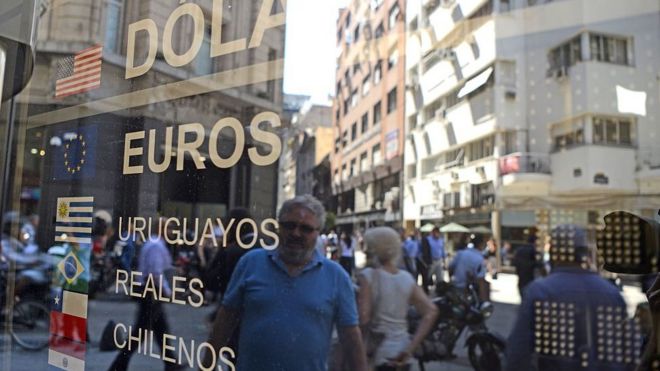
Image copyrightGETTY IMAGESImage captionThe Argentine peso is still sliding in value
Argentina's central bank has raised interest rates for the third time in eight days as the country's currency, the peso, continues to fall sharply.
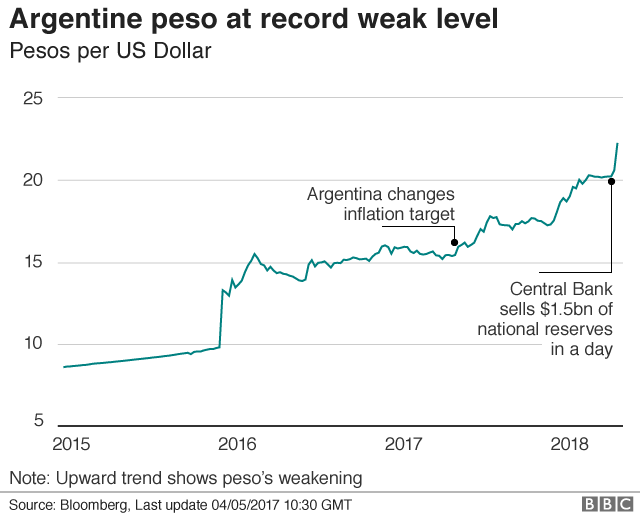
On Friday, the bank hiked rates to 40% from 33.25%, a day after they were raised from 30.25%. A week ago, they were raised from 27.25%.
The rises are aimed at supporting the peso, which has lost a quarter of its value over the past year.
Analysts say the crisis is escalating and looks set to continue.
Argentina is in the middle of a pro-market economic reform programme under President Mauricio Macri, who is seeking to reverse years of protectionism and high government spending under his predecessor, Cristina Fernandez de Kirchner.
Inflation, a perennial problem in Argentina, was at 25% in 2017, the highest rate in Latin America except for Venezuela.
This year, the central bank has set an inflation target of 15% and has said it will continue to act to enforce it.
'Aggressive steps'
Despite the twin rate rises, the peso, which was fixed by law at parity with the US dollar before Argentina's economic meltdown in 2001-02, is now trading at about 22 to the dollar.
"This crisis looks set to continue unless the government steps in to reassure investors that it will take more aggressive steps to fix Argentina's economic vulnerabilities," said Edward Glossop, Latin America economist at Capital Economics.
"Risks to the peso have been brewing for a while - large twin budget and current account deficits, a heavy dollar debt burden, entrenched high inflation and an overvalued currency.
"The real surprise is how quickly and suddenly things seem to be escalating."
Mr Glossop said "a sizeable fiscal tightening" was planned for 2018, but it might now need to be larger and prompter.
"Unless or until that happens, the peso is likely to remain under pressure, and there remains a real risk of a messy economic adjustment."
By Daniel Gallas, BBC South America Business Correspondent
Argentina's president Mauricio Macri is a controversial figure in a country that is still strongly divided ideologically.
But among international investors he is unanimously praised. Since coming to office, he moved swiftly to end capital controls and re-establish trust in economic data coming from Argentina.
However, he is not winning a crucial battle in the country - the one against inflation. Markets are taking notice and there has been a sell-off of the peso.
The opposition wants to stop Macri from removing subsidies in controlled prices, such as energy and utility tariffs, which may bring more inflation in the short term but could help bring it down from above 20% now to about 5% by 2020.
Friday was a day for emergency measures - a massive hike to 40% in interest rates and a commitment to bring down government spending.
Investors still believe Macri has a sound plan to recover Argentina, but they are not convinced he can see it through.
Keep these in mind as you contemplate the direction of the American government over the past 50 years and especially since the Obama election.
The Goals of Communism
(as read into the congressional record January 10, 1963, from "The Naked Communist" by Cleon Skousen)
1. U.S. acceptance of coexistence as the only alternative to atomic war.
2. U.S. willingness to capitulate in preference to engaging in atomic war.
3. Develop the illusion that total disarmament of the United States would be a demonstration of moral strength.
4. Permit free trade between all nations regardless of Communist affiliation and regardless of whether or not items could be used for war.
5. Extension of long-term loans to Russia and Soviet satellites.
6. Provide American aid to all nations regardless of Communist domination.
7. Grant recognition of Red China. Admission of Red China to the U.N.
8. Set up East and West Germany as separate states in spite of Khrushchev's promise in 1955 to settle the German question by free elections under supervision of the U.N.
9. Prolong the conferences to ban atomic tests because the United States has agreed to suspend tests as long as negotiations are in progress.
10. Allow all Soviet satellites individual representation in the U.N.
11. Promote the U.N. as the only hope for mankind. If its charter is rewritten, demand that it be set up as a one-world government with its own independent armed forces. (Some Communist leaders believe the world can be taken over as easily by the U.N. as by Moscow. Sometimes these two centers compete with each other as they are now doing in the Congo.)
12. Resist any attempt to outlaw the Communist Party.
13. Do away with all loyalty oaths.
14. Continue giving Russia access to the U.S. Patent Office.
15. Capture one or both of the political parties in the United States.
16. Use technical decisions of the courts to weaken basic American institutions by claiming their activities violate civil rights.
17. Get control of the schools. Use them as transmission belts for socialism and current Communist propaganda. Soften the curriculum. Get control of teachers' associations. Put the party line in textbooks.
18. Gain control of all student newspapers.
19. Use student riots to foment public protests against programs or organizations which are under Communist attack.
20. Infiltrate the press. Get control of book-review assignments, editorial writing, policymaking positions.
21. Gain control of key positions in radio, TV, and motion pictures.
22. Continue discrediting American culture by degrading all forms of artistic expression. An American Communist cell was told to "eliminate all good sculpture from parks and buildings, substitute shapeless, awkward and meaningless forms."
23. Control art critics and directors of art museums. "Our plan is to promote ugliness, repulsive, meaningless art."
24. Eliminate all laws governing obscenity by calling them "censorship" and a violation of free speech and free press.
25. Break down cultural standards of morality by promoting pornography and obscenity in books, magazines, motion pictures, radio, and TV.
26. Present homosexuality, degeneracy and promiscuity as "normal, natural, healthy."
27. Infiltrate the churches and replace revealed religion with "social" religion. Discredit the Bible and emphasize the need for intellectual maturity which does not need a "religious crutch."
28. Eliminate prayer or any phase of religious expression in the schools on the ground that it violates the principle of "separation of church and state."
29. Discredit the American Constitution by calling it inadequate, old-fashioned, out of step with modern needs, a hindrance to cooperation between nations on a worldwide basis.
30. Discredit the American Founding Fathers. Present them as selfish aristocrats who had no concern for the "common man."
31. Belittle all forms of American culture and discourage the teaching of American history on the ground that it was only a minor part of the "big picture." Give more emphasis to Russian history since the Communists took over.
32. Support any socialist movement to give centralized control over any part of the culture--education, social agencies, welfare programs, mental health clinics, etc.
33. Eliminate all laws or procedures which interfere with the operation of the Communist apparatus.
34. Eliminate the House Committee on Un-American Activities.
35. Discredit and eventually dismantle the FBI.
36. Infiltrate and gain control of more unions.
37. Infiltrate and gain control of big business.
38. Transfer some of the powers of arrest from the police to social agencies. Treat all behavioral problems as psychiatric disorders which no one but psychiatrists can understand.
39. Dominate the psychiatric profession and use mental health laws as a means of gaining coercive control over those who oppose Communist goals.
40. Discredit the family as an institution. Encourage promiscuity and easy divorce.
41. Emphasize the need to raise children away from the negative influence of parents. Attribute prejudices, mental blocks and retarding of children to suppressive influence of parents.
42. Create the impression that violence and insurrection are legitimate aspects of the American tradition; that students and special-interest groups should rise up and use united force to solve economic, political or social problems.
43. Overthrow all colonial governments before native populations are ready for self-government.
44. Internationalize the Panama Canal.
45. Repeal the Connally reservation so the United States cannot prevent the World Court from seizing jurisdiction over nations and individuals alike.
 AMIA
AMIA




 Posts
Posts

