
Showing posts with label Enviro-nuts. Show all posts

Thursday, April 23, 2020

While In his other life he's a staunch environmentalist who would gladly tell you how you must live.

Casey Affleck and Joaquin Phoenix’s old Manhattan ‘crash pad’ sells

Gulags, re education camps are the anti human currency on the environmental left. Let the infidels die!

Celebrity climate activists cheer coronavirus misery in name of environment: Devine


MORE FROM:

MIRANDA DEVINE

Miranda Devine


Greta Thunberg, Joaquin Phoenix and fellow eco-luminaries used Earth Day Wednesday to rejoice in the global economic shutdown that has led to a reduction in carbon emissions.
The pandemic has been a dream come true for climate alarmists . . . if you ignore all the misery.
They wanted us to switch off our economies to prevent a supposed climate apocalypse in 10 years and — hey, presto! — their wish was granted by a virus.
Thunberg, the 17-year-old Swedish climate evangelist, did caution her fellow warriors not to be too “optimistic” about the pause in carbon pollution because the ­so-called climate crisis “is not slowing down.”
But other activists seized the pandemic opportunity to push their agenda, as Democrats tried to shoehorn their Green New Deal into economic relief bills.
“Neither Greenpeace, nor Greta Thunberg, nor any other individual or collective organization have achieved so much in favor of the health of the planet in such a short time,” Spanish scientist Martín López Corredoira crowed on the Science 2.0 blog.
“A miracle happened . . . It is certainly not very good for the economy in general, but it is fantastic for the environment.”
It sure is a high price to pay for the dubious benefit of temporarily reducing greenhouse gas emissions.
But that is the price climate alarmists have been demanding, to slash emissions by crippling our economies in an uncertain bid to dial down Earth’s temperature. Now we see what that means.
One thing the pandemic has shown us in real time is how inaccurate computer models are and their sensitivity to variations in ­inputs.
Whether it’s the coronavirus or global warming, these models are chronically unreliable at predicting the future.
We have seen that projections of as many as 2 million American deaths from the coronavirus were wrong by orders of magnitude.
The models that were used to inform decisions to freeze the economy are being revised as new data come to hand.
At the start of this month, the president’s coronavirus task force announced that between 100,000 and 240,000 Americans likely would die from COVID-19, even with mitigation measures.
The projections led to President Trump extending the lockdown that has seen more than 20 million Americas filing for unemployment.
But the models on which the task force based its advice to the president varied widely.
One, from the University of Washington, initially projected up to 162,000 deaths over the summer, before being revised down.
The most extreme was a model from Imperial College London, which predicted a staggering 2.2 million Americans would die if there were no social-distancing measures.
Last month, the projection was downgraded to 200,000 due to successful mitigation and testing data indicating that more people have been infected than previously thought.
By Wednesday, with the rate of infection plateauing, America had suffered almost 47,000 deaths, while projections have been ­revised to around 60,000. So you can see that computer modeling is an imperfect science.
But none of this is to criticize the models used to manage the pandemic, because they are built to change as inputs change.
They are valuable, not to predict the future but to test potential scenarios.
There was so much we didn’t know at the beginning of the pandemic and there were so many variables, from the infection rate and immunity levels to the take-up of social distancing
As we learn more, the models are updated and the projected death toll falls.
That’s the way it’s meant to work. Task force expert Dr. Anthony Fauci has said a model is just a “hypothesis.”
When quizzed on Fox News two weeks ago about the reliability of the seesawing coronavirus models, he said they are “only as good as the assumptions that you put into the models.
“And those assumptions that start off when you don’t have very much data at all, or the data you have is uncertain, then you put these assumptions in and you get these wide ranges of calculations of what might happen.”
He told CNN, “I’ve never seen a model of the diseases that I’ve dealt with where the worst case actually came out. They always overshoot.”
Fauci is echoing the famous aphorism in statistics: “All models are wrong, but some are useful.”
So, having seen the fallibility of coronavirus models over the past few weeks, it stands to reason that we should treat climate models with the same skepticism, especially as the time span is so much longer.
Doomsday models predicting imminent climate calamity from the United Nations’ Intergovernmental Panel on Climate Change should not be used to remake our economies on blind faith or to terrify susceptible children like Greta Thunberg.
Computer models are not holy writ. They are just useful tools.
Demonizing legit ‘virus’ voices
An ugly demonization game is being played over the coronavirus.
Vice News has portrayed protests against the lockdown as the dastardly work of “white supremacists and neo-Nazis,” citing alarmist research by an outfit called Site Intelligence.
And Fox anchor Sean Hannity has been branded a killer by Vox news for his coverage of the coronavirus, citing a dubious study from the University of Chicago. “Why the finding that Sean Hannity killed people is disturbingly plausible,” wrote Vox.
This willful slander is pointlessly destructive.
NYCHA workers left imperiled
It’s all very well for Mayor Bill de Blasio to hand out free masks, meals, tablets and high-speed internet services to residents of New York City Housing Authority complexes.
But what about looking after the city workers risking their health to service NYCHA buildings that have become coronavirus hot spots?
Painters, plumbers, cleaners and caretakers complained for weeks about having to enter apartments without masks to make repairs.
Even after their unions intervened two weeks ago, the workers haven’t yet been provided with proper N95 masks.
Instead, they are handed a “flimsy paper mask” at the start of a shift, says one worker.
He claims his colleagues are “dropping like flies . . . More and more call out sick every day.
“Four men that I worked directly alongside, riding elevators with and inspecting stairwells with, have been hospitalized.
“I am unable to visit my family any longer for fear of exposing them.”
The city should be taking better care of these essential workers, or the problems at NYCHA will only get worse.

Friday, April 3, 2020

Milage standards are not being rolled back....

President Donald Trump’s decision to slow the huge increases in fuel-efficiency standards put in place by the Obama administration in 2012 was met with derision and scorn by green groups, the big media and others on the left. In fact, it’s a wise move, one that will save Americans money, but more importantly, will save lives.
Trump’s action is perfectly timed. With the economy in turmoil from the COVID-19 pandemic shutdowns, automakers will not have the means to retool, research and revamp their car lines to obey President Barack Obama’s absurdly stringent rules. Auto sales are now plunging.
Obama’s rules would have required automakers to push the Corporate Average Fuel Economy from 25.3 miles per gallon per vehicle in 2012 to 54.5 mpg by 2025. To do that, fuel efficiency had to increase about 5% a year.
Contrary to complaints in the media of Trump’s “rollback” of standards, all the new rules do is reduce the fuel efficiency gains required to 1.5% a year, rather than the unreachable 5%. So the U.S. fleet average will be 40 mpg, not 54.5, by 2025. Even so, that will still be 28% higher than Obama’s rules.
More importantly, automakers strained to meet the Obama requirements, forced to radically downsize cars and create a money-losing electric-car fleet that still requires subsidies even to exist.
Of course, everyone likes clean air. But our fuel-efficiency standards didn’t start out with that as their goal. In fact, America’s fuel-efficiency standards got their start in 1975 as a way to mitigate the impact of the 1973-1974 Arab oil embargo. At the time, with oil prices surging, inflation raging and increasingly worthless dollars flooding global oil markets, it seemed like a good idea.
And the truth is, even before the new regulations went into effect, automakers were already raising their fleets’ fuel efficiency in response to the market pressures brought by a flood of fuel-stingy Japanese cars into the U.S. and rising oil prices.
Even so, as with so many other “good ideas,” this one got hijacked by special interests to become something entirely different: A way to impose a costly and wealth-destroying “green agenda” on American consumers.
It was part of a two-prong war against fossil fuels that continues to this day. The idea was to fight oil drilling and fracking in the continental U.S. on the front-end, while making cars prohibitively expensive on the back-end through ever-more burdensome regulation. It became a linchpin in the left’s anti-industrial, anti-capitalist agenda. A non-stop war on cheaper energy.
The idea gathered steam during the 1990s as the debate over global warming heated up. But it really gained traction in 2007, after a Supreme Court decision declared carbon dioxide a “pollutant.” A ridiculous decision, given that CO2 is a key and necessary part of the natural life cycle for both plants and animals. That includes humans.
Using that singularly bad high-court decision as pretext, Obama imposed his sweeping new fuel-efficiency standards on the auto industry in 2012, during his re-election campaign. At the time, he vowed that his move “to improve fuel economy and reduce greenhouse gas emissions will save consumers more than $1.7 trillion at the gas pump and reduce U.S. oil consumption by 12 billion barrels.”
Of course, oil consumption did fall in the U.S., not because of Obama’s new CAFE standards but because frackers made natural gas a cheap substitute for crude oil as fuel.
Now, the media talk of Trump’s “rollbacks,” as if fuel-efficiency standards were going into reverse. As we noted above, that’s not the case.
Meanwhile, little-mentioned in news accounts is the fact that not only will consumers save billions of dollars from this move, but thousands of lives will be saved as well.
For despite what the green left and its media allies say, the extremely lighter cars that automakers are required to build to meet fuel-efficiency standards are inherently more dangerous.
The big media are in total denial about this. In fact, the leftist media watchdog MediaMatters calls it a “right-wing lie.”
Truth is, multiple studies show that decreasing the size of cars to achieve higher fuel efficiency leads to more deaths on our highways.
Start with the Environmental Protection Agency, which ran its own numbers. It found a $2,340 total reduction in car-ownership costs by 2029 as a result of Trump’s move. All told, societal costs would be diminished by $500 billion over that time.
What does that get us? About 12,000 fewer highway deaths from all the cars that are made from now until 2029. That’s more than 1,000 lives saved a year.
A study by Harvard University and the Brookings Institution, which can’t be called right-wing sources of disinformation, concluded that for each 100 pounds lighter a vehicle is to meet CAFE standards, roughly 440 to 789 more people die in car accidents. That’s a range of 2,200 to 3,900 lives a year.
As H. Sterling Burnett, writing in The Hill, memorably noted, “As a result, CAFE has resulted in more deaths than all U.S. soldiers lost in the Vietnam War and every U.S. military engagement since then.”
A study by the National Academy of Sciences in 2002 concluded that CAFE standards were responsible for 2,600 deaths in 1993 alone. With current standards much higher, there is no question that deaths will result. Lighter, less-sturdy cars are deadlier than larger ones. It’s common sense.
The Insurance Institute for Highway Safety, an industry group that actually has a serious financial interest, concluded that “Bigger, heavier vehicles are safer.” Forcing automakers to shrink cars costs lives.
That’s a big reason why a study by the National Highway Traffic Safety Administration found that the new rules would reduce fatalities by 3,000 and add 2.7 million in new-car sales.
This, by the way, is why suburbanites and others who drive a lot prefer big SUVs to small regular sedans. The SUVs are not subject to the same regulations as the smaller cars, and afford more protection for families. They’re far safer in crashes. That’s a fact, not right-wing propaganda.
The added costs of regulation tack on car costs, too. Since the end of the financial crisis, car prices have jumped 10%. Meanwhile, car sales in 2019 were less than 1% higher than they were in 2005, despite 11% growth in U.S. population.
So while new cars have nice safety features, mostly thanks to technology, fewer people can afford them as a share of the population.
Obama’s original 54.5 mpg standard was a pipe-dream at best.
“There isn’t any realistic way carmakers can meet this requirement without radically transforming their product lines, most particularly by slashing vehicle weight and going to more expensive all-electric or plug-in hybrid electric drive technologies,” wrote Larry Bell, a University of Houston professor who writes frequently on energy in Forbes. “In fact even the most efficient hybrids on the market today won’t comply.”
Bell wrote that in 2011, and he was dead-on accurate. Trump was wise to throttle back the CAFE standards. At a time of economic emergency, he will save Americans money. More importantly, he’ll save lives.

We Could Use Your Help

Issues & Insights was founded by seasoned journalists from the IBD Editorials page. Our mission is to use our decades of experience to provide timely, fact-based reporting and deeply informed analysis on the news of the day.
We’re doing this on a voluntary basis because we think our approach to commentary is sorely lacking both in today’s mainstream media and on the internet. 
You can help us keep our mission going. If you like what you see, feel free to visit our Donations Page by clicking here. And be sure to tell your friends!

Thursday, April 2, 2020

Reality kicks an environmentalist pet project in the bag

San Francisco Bans Reusable Grocery Bags, Returns to Plastic Bags  
The notoriously far-left city of San Francisco has reversed its own ban on plastic bags in response to the spread of the coronavirus, now prohibiting the use of reusable bags as a sanitary measure, according to Politico.
The push to ban plastic bags, which leftists have claimed, without evidence, are more likely to cause pollution, had been achieved in many liberal cities, from San Francisco to New York. However, with the fear of spreading the contagious coronavirus, the same bags being used multiple times are more likely to help spread the disease than single-use plastic bags.

Saturday, March 14, 2020

Using tote bags instead of plastic could help spread the coronavirus

Using tote bags instead of plastic could help spread the coronavirus


The COVID-19 outbreak is giving new meaning to those “sustainable” shopping bags that politicians and environmentalists have been so eager to impose on the public. These reusable tote bags can sustain the COVID-19 and flu viruses — and spread the viruses throughout the store.
Researchers have been warning for years about the risks of these bags spreading deadly viral and bacterial diseases, but public officials have ignored their concerns, determined to eliminate single-use bags and other plastic products despite their obvious advantages in reducing the spread of pathogens. In New York state, a new law took effect this month banning single-use plastic bags in most retail businesses, and this week Democratic state legislators advanced a bill that would force coffee shops to accept consumers’ reusable cups — a practice that Starbucks and other chains have wisely suspended to avoid spreading the COVID-19 virus.
John Flanagan, the Republican leader of the New York state Senate, has criticized the new legislation and called for a suspension of the law banning plastic bags. “Senate Democrats’ desperate need to be green is unclean during the coronavirus outbreak,” he said Tuesday, but so far he’s been a lonely voice among public officials.
Enlarge Image
The COVID-19 virus is just one of many pathogens that shoppers can spread unless they wash the bags regularly, which few people bother to do. Viruses and bacteria can survive in the tote bags up to nine days, according to one study of coronaviruses.
The risk of spreading viruses was clearly demonstrated in a 2018 study published in the Journal of Environmental Health. The researchers, led by Ryan Sinclair of the Loma Linda University School of Public Health, sent shoppers into three California grocery stores carrying polypropylene plastic tote bags that had been sprayed with a harmless surrogate of a virus.
After the shoppers bought groceries and checked out, the researchers found sufficiently high traces of the surrogate to risk transmission on the hands of the shoppers and checkout clerks, as well as on many surfaces touched by the shoppers, including packaged food, unpackaged produce, shopping carts, checkout counters, and the touch screens used to pay for groceries. The researchers said that the results warranted the adaptation of “in-store hand hygiene” and “surface disinfection” by merchants, and they also recommended educating shoppers to wash their bags.
Enlarge ImagePlastic bag trash may be unsightly but it's more sanitary.
Plastic bag trash may be unsightly but it’s more sanitary.Stephen Yang
An earlier study of supermarkets in Arizona and California found large numbers of bacteria in almost all the reusable bags — and no contamination in any of the new single-use plastic bags. When a bag with meat juice on the interior was stored in the trunk of a car, within two hours the number of bacteria multiplied tenfold.
The researchers also found that the vast majority of shoppers never followed the advice to wash their bags. One of the researchers, Charles Gerba of the University of Arizona, said that the findings “suggest a serious threat to public health,” particularly from fecal coliform bacteria, which was found in half the bags. These bacteria and other pathogens can be transferred from raw meat in the bag and also from other sources.
An outbreak of viral gastroenteritis among a girls’ soccer team in Oregon was traced to a reusable grocery bag that had sat on the floor of a hotel bathroom. In a 2012 study, researchers analyzed the effects of San Francisco’s ban on single-use plastic grocery bags by comparing emergency-room admissions in the city against those of nearby counties without the bag ban. The researchers, Jonathan Klick of the University of Pennsylvania and Joshua Wright of George Mason University, reported a 25 percent increase in bacteria-related illnesses and deaths in San Francisco relative to the other counties.
The city’s Department of Public Health disputed the findings and methodology but acknowledged that “the idea that widespread use of reusable bags may cause gastrointenstinal infections if they are not regularly cleaned is plausible.”
New York’s state officials were told of this risk before they passed the law banning plastic bags. In fact, as the Kings County Politics Web site reported, a Brooklyn activist, Allen Moses, warned that shoppers in New York City could be particularly vulnerable because they often rest their bags on the floors of subway cars containing potentially deadly bacteria from rats — and then set the bag on the supermarket checkout counter. Yet public officials remain committed to reusable bags.
Anyone who has studied consumer behavior knows that it’s hopelessly unrealistic to expect people to follow all those steps
A headline on the Web site of the New York Department of Health calls reusable grocery bags a “Smart Choice” — bizarre advice, considering all the elaborate cautions underneath that headline. The department advises grocery shoppers to segregate different foods in different bags; to package meat and fish and poultry in small disposable plastic bags inside their tote bags; to wash and dry their tote bags carefully; to store the tote bags in a cool, dry place; and never to reuse the grocery tote bags for anything but food.
How could that possibly be a “smart choice” for public health? Anyone who has studied consumer behavior knows that it’s hopelessly unrealistic to expect people to follow all those steps. If the Department of Health actually prioritized public health, it would acknowledge what food manufacturers and grocers have known for decades: Disposable plastic is the cheapest, simplest, and safest way to prevent foodborne illnesses.
Instead, leaders in New York and other states are ordering shoppers to make a more expensive, inconvenient and risky choice — all to serve a green agenda that’s actually harmful to the environment. The ban on plastic bags will mean more trash in landfills (because paper bags take up so much more space than the thin disposable bags) and more greenhouse emissions (because of the larger carbon footprints of the replacement bags). And now, probably, it will also mean more people coming down with COVID-19 and other illnesses.
John Tierney is a contributing editor of City Journal, where this piece was originally published.

Sunday, February 2, 2020

The rule of law is irrelevant to the tyrannical left

Politics

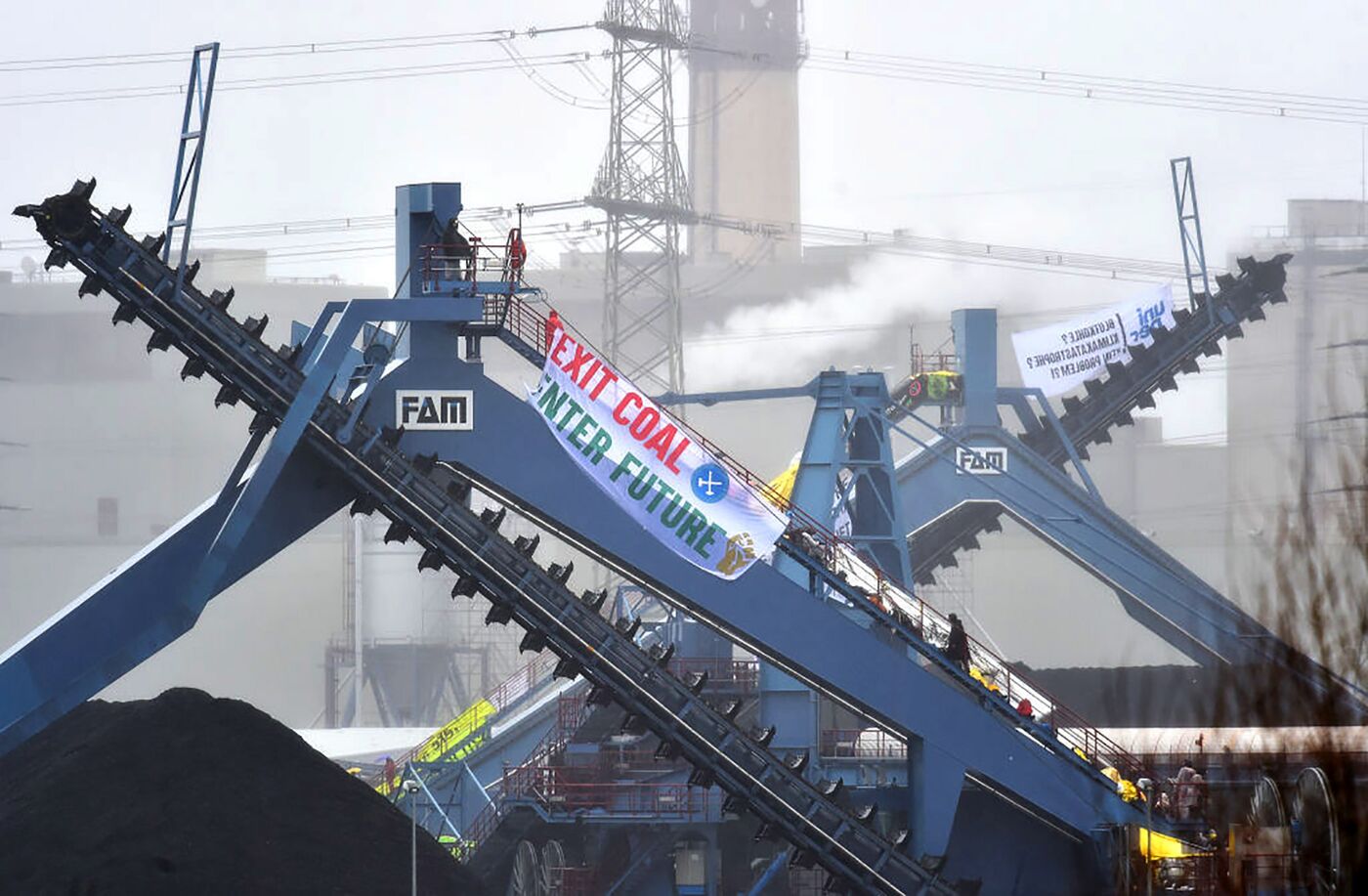
Activists Occupy German Coal Plant in Protest, Police Say

 Updated on 


Activists on the site of Datteln 4, Feb. 2.
Activists on the site of Datteln 4, Feb. 2. Photographer: Caroline Seidel/picture alliance via Getty Images


A large group of protesters broke through a gate at the Datteln-4 power station and gained access to the site, local police said Sunday in a tweet.
More than 120 people illegally entered the premises, Polizei NRW RE said. The operator of the power plant outside Dortmund in western Germany’s industrial heartland has filed criminal charges against the protesters, the police said in another tweet Sunday.
“The police in coordination with the public prosecutor’s office will initiate criminal proceedings against all persons,” authorities said.
German utility Uniper aims to close most of its coal plants by 2025, but intends to keep the Datteln-4 plant operating until 2038, Reuters reported in January, citing two people familiar with the matter. Last year anti-coal protesters in east Germany forced one of the country’s biggest plants to reduce output to the minimum.

“We cannot allow, in light of the climate crisis, for another coal power station to join the power grid,” Kathrin Henneberger of the protest movement Ende Gelaende said in a interview with Reuters Sunday. Henneberger called Datteln “a nail in the coffin for our future,” according to Reuters.


Tuesday, January 7, 2020

The Martyrdom of Saint Greta of Sweden

So Meat Loaf caused a little kerfuffle this weekend by saying he thought Greta Thunberg had been "brainwashed."
I don't know why that should be a surprise, but it got me thinking about her again. I have a lot of sympathy for the kid.
For me, it started with seeing her picture. She's small, slight, even scrawny; her head looks out of proportion to her body. She's now 17 (as of 3 January) but she still looks childlike, prepubertal, younger than her 14-year-old sister. Frankly, she looks like she's been in a concentration camp: malnourished over the long term.
By Frankie Fouganthin - Own work, CC BY-SA 4.0,
Sure enough, reading a little about her, we find that she's an Asperger's child (I guess this month that's now called "high-functioning autism"), she has obsessive-compulsive disorder, she stopped eating for months and still refuses to eat anything but certain specific things, in particular, a dish of pancakes filled with rice — but her OCD keeps her from eating if there's a sticker or label on the package. She suffers from "selective mutism," which means basically that there are situations in which she's unable to speak.
She's said that this means she only "speaks when she thinks it's necessary." This includes speaking to the UN General Assembly, but in interviews, her mother often speaks for her.
Her public career started when she took Fridays off from school to hold up a sign outside the Swedish Parliament; this grew into a movement that spread throughout Europe.
Through it all, things keep striking me as odd. I don't know what it's like in Sweden, but cutting classes one day a week isn't normally feted as heroic in the United States. And she hasn't been attending school for months as she's traveling. In the U.S., that's called "dropping out"
So, this is what we're being asked to believe: that an autistic kid with OCD who often can't speak on her own has:
  • organized a worldwide movement
  • given TED talks, spoken to the UN General Assembly, and been named Person of the Year by Time magazine
  • managed to get a ride on a multimillion-dollar racing yacht so she wouldn't have to fly (and bragged on how she wasn't releasing CO2 on the trip, although it required seven plane tickets for the crew for the boat)
There's a bucolic barnyard term for that — actually, several, depending on your choice of equine, bovine, or galline.
This isn't a neurologically atypical high school kid arranging this: there are adults, and probably a lot of adults, using her as a front. Some of them are surely her parents, but while they've been reasonably successful in music and the arts, I don't think they have the money that's obviously behind this.
Frankly, that's a tragedy. Instead of getting the treatment she needs, she's become a climate-change muppet.
It's hardly the first time a teenage girl has become the symbol of a movement. Of course, Joan of Arc was eventually burned at the stake.
I don't think that is in Greta's future. But what's happening to her looks to me like another martyrdom in pursuit of a political cause.