Showing posts with label Housing Market. Show all posts

Friday, July 24, 2020

The Left's continued push to control every aspect of your life thwarted, for now

TRUMP ENDS AFFH

The Trump administration has ditched the Obama administration’s “Affirmatively Furthering Fair Housing” rule (AFFH). As we have often reported, AFFH is a vast social engineering project that enables the federal government to order more than 1,200 cities and counties that accept any part of annual community development block grants to rezone neighborhoods along income and racial criteria. It thus allows unaccountable federal bureaucrats to dictate who lives where, in order to create racially and economically balanced neighborhoods. It effectively abolishes self-government in the suburbs.

I’m surprised that it took the Trump administration three-and-half years to revoke AFFH. To be fair, though, Ben Carson’s Department of Housing and Urban Development effectively rendered AFFH a dead letter during those three-and-half years. The important thing was to take it off the books before Trump leaves office. 

With that now accomplished, AFFH can become an important issue in the presidential election. The Biden campaign will claim that scrapping it is evidence that Trump supports housing discrimination — more evidence of his alleged racism.

But housing discrimination is the refusal to allow people, because of their race, to live in units they can afford to buy or rent. It’s not housing discrimination for a town to abstain, for example, from building low income housing in an affluent area, as has been mandated under AFFH.

That’s why, as Stanley Kurtz observes, Democrats don’t want to talk about what is actually in Obama’s AFFH. It isn’t about preventing housing discrimination, it’s about telling Americans where and how to live. 

The Trump campaign’s task will be explain this to voters. The issue is a technical one in ways that defunding the police, for example, isn’t. Even if the Democrats can’t make the racism charge stick, they can muddy the waters.

That’s why I agree with Stanley that “what’s needed now is a presidential speech explaining what Obama-Biden’s AFFH really did, why it was right to end it, and what will happen to the suburbs if Joe Biden brings his AFFH back.” The speech might also explain that Biden has embraced ideas for federal control of housing that go even further than AFFH.

For now, Trump has taken the necessary first step to make AFFH a campaign issue. America’s suburbs are thought by many to hold the key to the presidential race. Trump now has an issue that, potentially, will resonate strongly in his favor with suburban voters. 


Sunday, July 12, 2020

Fairness is the righteous path to totalitarian rule...

Biden’s 2020 Party Platform Proposal Seeks to Abolish America’s Suburban Communities


Joe Biden’s radical proposal for the Democrat Party platform for 2020 seeks to put an end to America’s suburban communities by forcing low-income housing into every neighborhood and flooding every community with immigrants, legal or otherwise.
The proposal, known as the Biden-Sanders Unity Task Force Recommendations, would provide instant amnesty and a pathway to U.S. citizenship for the 22 million illegal aliens now living in the nation. Astoundingly, it would also give legal status to all the world’s refugees regardless of the legitimacy of their claim to the status.
But on top of all that, Biden and Sanders are proposing that Barack Obama’s so-called Affirmatively Furthering Fair Housing rules will be put into full force.
For instance, in the “executive orders” section of the platform proposal, Biden/Sanders note that Biden would, “Implement the Obama-Biden Administration’s Affirmatively Furthering Fair Housing Rule requiring communities receiving certain federal funding to proactively examine housing patterns and identify and address policies that have discriminatory effects.”
The Biden/Sanders platform also scolds Trump, and says Biden would “Roll back Trump Administration policies gutting fair lending and fair housing protections.”
In another section, the platform states Biden would: “Ensure effective and rigorous enforcement of the Fair Housing Act and the Home Mortgage Disclosure Act. Hold financial institutions accountable for discriminatory practices in the housing market.”
With a longer explanation, the platform states:
Democrats will vigorously enforce the Fair Housing Act and the Home Mortgage Disclosure Act and hold lenders accountable for discriminatory practices. We will use the federal government to enforce settlements against discriminatory lenders, and require communities to proactively review housing patterns and remedy local policies that have a discriminatory effect. Democrats will give local elected officials tools and resources to combat gentrification, penalize predatory lending practices, and maintain homeownership, including exploring targeted rental relief when exorbitant rent increases force long-term residents from their communities and tackling persistent racial bias in appraisals that contributes to the racial wealth gap.
If you are unsure of what all this means, the Obama AFFH rules would force every single American city or town to add section 8 and so-called “low-income” housing in every community.
Fox News host Tucker Carlson recently explained what the outcome of such a rule would mean for America’s suburban communities.
Carlson said the Biden platform would:
…make the rest of America very much like our biggest cities have become: squalid, dangerous, chaotic and unhappy. They’d like to do to your neighborhood what they have done to New York City. The main thing they’ve done to New York is make it scary. Violent crime is surging dramatically there, as we have told you night after night. none of the main reasons for that is the elimination of cash bail — the city no longer holds the people at arrests.
The Fox host then added:
Democrats want to abolish the suburbs. They are too clean and nice, and therefore by definition, they are racist. The Biden campaign has highly specific plans on how to do this. It’s called affirmatively furthering fair housing. It’s a HUD regulation, it was written during the Obama administration. Biden’s advisors plan to enforce it. They will cut off critical federal funds for municipalities unless those municipalities submit to federal control of urban planning. Towns will be ordered to abolish zoning for single-family housing because single-family homes, needless to say, are racist. Low-income federally subsidized apartments will go up in the suburbs. It’s a good bet you won’t see any of this. You won’t see projects being built in Aspen or Martha’s Vineyard or anywhere else Eric Holder vacations but in your neighborhood? Oh, yeah.
The rules would make planning and building homes in every neighborhood the exclusive business of the federal government which would tell all of us how we are allowed to live, in what sort of homes, and where those homes are built.
That is what you will be getting if Joe Biden wins in November.
Follow Warner Todd Huston on Facebook at: facebook.com/Warner.Todd.Huston.


Friday, February 21, 2020

What the homeless are most often like and it's not housing.

Disgusting’ squatters leave behind underwear, a snake and sex toys


This landlord staged a panty raid.
A Colorado condominium owner is out hundreds of in dollars in legal and cleaning fees — and nearly two months’ worth of rent — after a battle to evict squatters who left their “disgusting” mark on her property.
When Sarah Feldman’s previous tenant broke their lease, she soon discovered an unknown woman had made herself at home.
“She was being difficult, she didn’t want to leave,” Feldman told her local Fox outlet. “There was her and two guys I’ve never seen before.”
What followed was an infuriating monthlong battle to get the uninvited guests — and their unmentionables — out of her home.
A frustrated Feldman lawyered up, went to court to have the Denver Sheriff’s Department intervene — and recruited her local TV news outlet’s “Problem Solvers” crew.
The illegal occupants finally got the boot — but left behind a pile of dirty dishes, mounds of trash, stained carpets and other, uh, items.
“There were guys underwear all over — it was just really disgusting,” Feldman said. “There were sex toys found in the condo as well that I did not want to touch.”
Also abandoned: A snake in a cage — with no lid on it.
Feldman claims she ended up shelling out hundreds in fees, between hiring an attorney and paying $150 for the sheriff department “writ” of eviction, not to mention repairing damage to her condo and lost rental income.
The Denver Sheriff Department said it’s buried under a massive backlog of “squatting eviction requests” because of limited resources.
“If we were able to add more deputies to the unit, then that could possibly speed things up,” Denver Sheriff Department Chief Elias Diggins told Fox31. “But at the current time, with 141 deputies below authorized strength, that would be a challenge for us.”
New Yorkers are certainly no stranger to squatting. Last November, three squatters were killed in a Queens fire that was later ruled an arson case. In December, Gov. Andrew Cuomo signed a law allowing the boroughs to reclaim and redevelop the nearly 2,000 abandoned “zombie properties” in New York City, where squatters often take up residence.

Monday, October 21, 2019

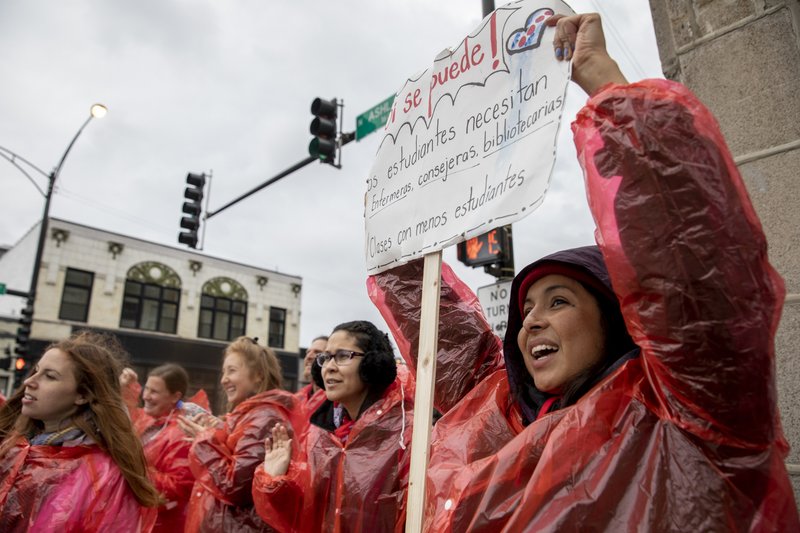
Affordable housing among striking Chicago teachers’ demands

By KATHLEEN FOODY and DON BABWIN2 hours ago
1 of 4
Faculty from Talcott Fine Arts and Museum Academy strike with the Chicago Teachers Union on the corner of N. Ashland Avenue and W. Chicago Avenue in West Town of Chicago on Monday, Oct. 21, 2019. (Camille Fine/Chicago Tribune via AP)

CHICAGO (AP) — Striking Chicago teachers who are seeking smaller class sizes and higher pay also are demanding that the nation’s third-largest city do more to lower housing costs and put more resources into helping homeless students.
The demand for affordable housing citywide — for students and their financially-strapped families as well as for school employees — stands as a dramatic example of organized labor’s effort to expand bargaining beyond bread-and-butter issues.
Full Coverage: Chicago teachers strike
The pursuit is part of the union’s “social justice” agenda and is a unique departure from standard negotiating tactics. Despite early rejection by city officials, teachers argue that the issue belongs on the bargaining table.
After months of negotiating , the Chicago Teachers Union’s 25,000 members began striking Thursday along with thousands of support staff.
Talks that continued through the weekend and into Monday made some progress but didn’t resolve key disagreements, including teachers’ demands for stricter class size limits and more support staff in schools, and classes remained canceled for more than 300,000 students.
The union on Monday also flatly rejected Mayor Lori Lightfoot’s request to return to classrooms while contract talks continue.
Neither side has spoken publicly about any discussion of the affordable housing issue during bargaining sessions. But the union has made clear that the issue is an important one for its membership.
Chicago is certainly not the only U.S. city where the issue of affordable housing for teachers and other school employees is significant. But Robert Bruno, a professor of labor and employment at the University of Illinois at Urbana-Champaign, said he doesn’t know of any other cities in which the issue has pushed its way into contract negotiations.
He said that’s because the chasm continues to grow nationwide between teachers’ salaries and the cost of affordable housing at a time when urban school districts also are having an increasingly difficult time recruiting and retaining teachers.
“Teacher unions around the country are watching this very closely,” Bruno said.
The Chicago union hasn’t released details of its housing proposal — and it’s unclear what changes, if any, such language would require of the city. But it does include a demand that the district put in writing that it supports any potential city and state policies aimed at making housing more affordable.
Union officials have noted city programs that help members of the police and fire department purchase a home. They’ve also referenced approaches to help teachers used elsewhere, including a California school district that’s building affordable housing for teachers and a Colorado program that covers a portion of teachers’ down payment for a home.
Teachers also want more staff dedicated to helping students who are homeless and working with families who are close to losing their housing.
The union announced some progress on that issue Sunday night, but exact details haven’t been released.
But there is still clear disagreement about the amount of raises for special education aides and other support staff who joined teachers on the picket lines and say they struggle to afford housing in the city.
Willie Cousins said he makes less than $30,000 working as a teacher’s aide at Bond Elementary on the South Side, while his wife works at Walmart. Cousins, 34, said they and their two children live in a two-bedroom apartment that costs about $800 a month.
Bills for electricity, gas, groceries and other necessities usually mean they have little left over, Cousins said.
“I love what I do, and I want to continue,” he said. “But it comes back to the financial piece. How long will I be able to sustain and live on this salary?”
The gap between the number of affordable rental units and the number of low- and middle-income residents searching for one in Chicago has continued growing since 2012, according to researchers at DePaul University’s Institute for Housing Studies.
Decades of segregation and disinvestment in city neighborhoods combined to make a web of housing issues that will take a long-term, concerted effort to improve, said Geoff Smith, the institute’s executive director.
“There are these parts of the city that are really strong and thriving, while others are really struggling,” Smith said. “And then you have neighborhoods in between dealing with challenges like rising rent.”
Lightfoot, a former federal prosecutor, ran for mayor on a progressive platform, including school reform and investment in poor neighborhoods, and the union has accused her of failing to follow through on those campaign promises.
Lightfoot said prior to the strike that affordable housing isn’t an issue that should be covered in contract negotiations, but that she would welcome the union’s input on broader housing policy in the city, along with other groups.
“Affordable housing is a critical issue that affects residents across Chicago, and everyone’s voices need to be heard during this process,” Lightfoot said.
One possible solution would be for the city to lift the requirement that teachers, like police officers, firefighters and other city employees, live in Chicago. But Bruno said doing that could create new problems — starting with an exodus of teachers who decide once they move to the suburbs they would rather work closer to home. Few other large districts have similar requirements.
In California, where the cost of housing in and around cities such as San Francisco is far higher than Chicago, school districts in well-to-do communities have built housing projects for teachers. California passed a law three years ago that makes it easier for school districts to create affordable housing for teachers, prompting a surge of projects.
“Teachers, because their salaries have not kept up with the price of housing, just cannot afford to live where they work,” said Sarah Chaffin, founder of SupportTeacherHousing.org. “Before, you could buy a house on a teacher’s salary (and) now you can’t do that.”
Striking teachers also argue that Chicago’s affordable housing crisis affects their students, particularly more than 16,000 who were homeless last year. The Chicago Coalition for the Homeless includes students who were living in shelters, motels, cars or “doubled-up” in other families’ homes in that count.
Barbara Duffield, executive director of a national nonprofit called SchoolHouse Connection that focuses on students who are homeless, said teachers and other staff are often in the best position to sense a change in a student’s life outside school.
“They are the first to notice, for example, a child falling asleep in class or hoarding food,” she said. “They have a kind of oversight, every single day, that nobody else does.”

Wednesday, August 21, 2019

Illegal immigrants will be eligible for city’s affordable housing lotteries...the left's nullification of citizenship.

Illegal immigrants will be eligible for city’s affordable housing lotteries

Illegal immigrants will be able to jump into New York City’s highly competitive lotteries for affordable housing as part of a broader rules changes announced by City Hall on Wednesday meant to expand eligibility.
The new rules will allow applicants to provide proof they pay their rent on time instead of submitting for a formal credit check, which required prospective tenants to put down their Social Security or taxpayer-identification numbers — documents only provided to citizens and naturalized citizens.
“For too long, families without access to credit have faced barriers to the affordable housing they need,” said Mayor Bill de Blasio in a statement. “By allowing New Yorkers to submit rental history instead of credit checks, we are creating a fairer system for all New Yorkers.”
Under the new rules, tenants can bypass the credit check requirement by providing evidence they are current on a year’s worth of rent.
Officials defended the rule change by claiming that credit checks requirements often adversely impact African American and Latino applicants — but acknowledged the change would allow undocumented immigrants to also apply.
“These new changes are a step towards promoting greater racial equity in our housing market and greater access to affordable housing, regardless of immigration status,” said Bitta Mostofi, who runs the Mayor’s Office of Immigrant AffairsJ.A. HAPP’S AGONY AND WHERE YANKEES GO 
A top de Blasio critic on the City Council quickly slammed the idea.
“It’s just the latest idiotic idea to come out of this administration,” said Councilman Eric Ulrich (R-Queens). “The mayor is setting up people to fail and is doing a disservice to New Yorkers who desperately need affordable housing.”
Additionally, the city’s housing agencies are also dropping the charges for a credit check to $20 to comply with the state’s new rent laws. And City Hall is loosening the rules on household size to allow more people to cram into smaller apartments.
“By addressing the challenges many low-income New Yorkers face in the rental application process, we are creating more options for those in need of an affordable home,” said Eric Enderlin, president of the city’s Housing Development Corp.

Here's how much Los Angeles is spending to house the homeless — each unit costs more than buying a home


"This kind of cost is utterly unacceptable..."


A government program in Los Angeles aims to house the homeless by building apartments, and the cost has now exceeded simply buying a home at the median price in L.A. County.
According to the city controller's office, Los Angeles is completing a project to provide just 72 new apartments in the middle of Koreatown, and each unit is costing the taxpayer approximately $690,000.
That is far more than the median price of a home in Los Angeles County, which is $618,000.
"This kind of cost is utterly unacceptable," said L.A. Controller Ron Galperin.
"I believe we need a fundamental course correction," he added.
Los Angeles is grappling with a worsening homeless crisis that threatens to endanger the health of its residents. Homeless encampments riddle the city, adding to garbage and vermin infestation woes.
Some experts are predicting that the city will face a disease epidemic if actions aren't taken to change the conditions from the crisis.

Despite a report in June that there were at least 59,000 homeless persons in Los Angeles County, the very expensive apartment program will only provide 71 units. Another two projects with equally expensive price tags are planned.
A spokesperson for Los Angeles Mayor Eric Garcetti denied the criticism that taxpayer money was being used unwisely.
"Mayor Garcetti is leveraging every available dollar – as efficiently as possible – to confront our region's homelessness and affordability crisis," said Alex Comisar.
"Mayor Garcetti recognizes the immediacy of this crisis," he added, "and is working with a diverse coalition of partners to find innovative solutions that can be scaled up quickly."
Garcetti is facing a recall effort from L.A. residents who are sick of the homeless problem.


Monday, August 12, 2019

Nearly 90 percent of NYCHA apartments lost heat, hot water during winter

Nearly 90 percent of NYCHA apartments lost heat, hot water during winter


NYCHA developments suffered heat and hot-water outages more than 3,500 times this past winter, leaving 339,000 public-housing residents — or four out of five — in the cold, troubling new statistics show.
The outages struck 259 of the embattled New York City Housing Authority’s 326 developments between Oct. 1, 2018, and May 31, 2019, according to data obtained through a Freedom of Information Law request.
Nearly 400,000 New Yorkers live in NYCHA’s 174,000 apartments and more than 150,000 of those homes — or 87% — lost heat or hot water at some point during the winter season.
“This data again demonstrates NYCHA’s daily struggle to ensure that public-housing residents have access to working heat and hot water,” said Lucy Newman, a lawyer with the Civil Law Reform Unit at The Legal Aid Society, which filed the FOIL request.
“As the landlord, NYCHA has a legal and moral obligation to ensure that these necessary utilities are functioning properly.”
The figures show there were 3,559 outages of heat and hot water at NYCHA developments during the winter: 2,341 outages that nixed hot water and 1,218 instances where the heat stopped working.
More than half of the outages, 1,934, were unplanned, the data shows. Even those that were planned are supposed to occur during warmer months.
NYCHA’s records show the outages were most frequent at the Baruch Houses on the Lower East Side, where heat or hot water went out 186 times for at least some residents during the winter.
“We had heaters we’d be forced to buy,” said 72-year-old resident Tomasita Santapau. “If I would be in the living room, I would leave the stove on in the kitchen.”
Zandalee Gonzalez, a 22-year-old resident, said the situation cost her work and time away from school.
“I’m not going to work without taking a bath. I’m a barback, I have to serve people, I have to be clean and smell good,’’ she said.
“I missed my college speech class because of it,” the young woman added. “We have to do presentations, they ask us to wear suits and ties. I can’t present if I’m not clean.”
At the Justice Sonia Sotomayor Houses in Soundview in The Bronx, the heat and hot water was affected 178 times this past winter.
“Most of the time I slept right there on my couch. I got extra blankets,” said resident Blanche Best, 79. “When I went to the back of the apartment, it was like going into a walk-in freezer!”
NYCHA has until October 2024 to reduce heating outages to just 15 percent of apartments during the winter under the agreement City Hall signed with the federal Department of Housing and Urban Development in January.
The agency is under a partial federal takeover because of city mismanagement, including a lead-paint debacle.
NYCHA’s top brass defended their performance in a statement — by pointing out that the agency suffered a thousand fewer outages this winter than the same period the year before.
Additionally, NYCHA bigs claimed they slashed the average length of the outage by half — though that still amounted to nine hours this past winter.
“We’re proud of that progress and are already working through this summer to build on those improvements for the coming winter,” said NYCHA General Manager Vito Mustaciuolo.
Additional reporting by Khristina Narizhnaya and Georgett Roberts