A Florida teenager was arrested over a video of a gun being pulled out and pointed at students in a classroom, WSVN-TV reported.
Hollywood Police arrested Wilmer Guerrero Martinez, 16, Wednesday after several people alerted authorities of the video the night before, the station said.
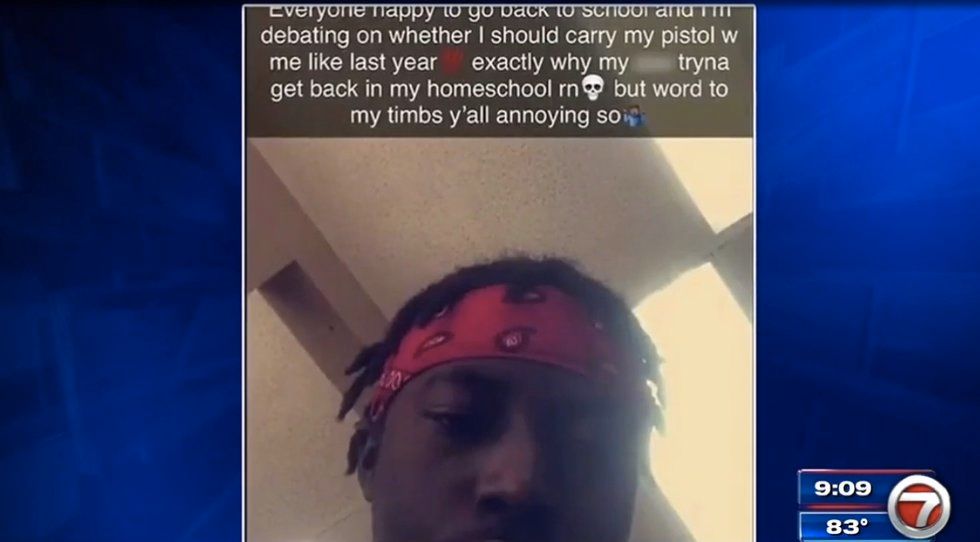
The post uploaded to his social media account was followed by a photo accompanied by text reading in part: "Everyone happy to go back to school, and I'm debating on whether I should carry my pistol with me like last year," WSVN said.
Image source: WSVN-TV video screenshot
Martinez was expelled from McArthur High School in 2018 after he brought ammunition into the school, the station said, adding that police believe the video may have been taken during the 2017-18 school year.
WSVN cameras captured Martinez — who faces a felony charge of electronic threat to kill — walking into the Juvenile Assessment Center, the station said.
It's frightening'
"It's disturbing. It's frightening, especially during the first week of school," Hollywood Police Public Information Officer Miranda Grossman told WSVN.
Hollywood Police Chief Chris O'Brien added to the station that "because of the courage of citizens to call the police, along with our proactive policing enforcement of the MSDHS Public Safety Act, we were able to take him into custody and stop a potentially dangerous situation."
A family member of the teen, Elba Bermudez-Martinez, also was arrested for obstructing the investigation, WSVN reported, adding that her relationship to Martinez is unknown.
Healthcare authorities in Cuba blamed a “complex situation” Tuesday for growing shortages of basic medicines that many in the country need to stay alive, stating that as many as 44 key medications will remain elusive nationwide throughout August.
The drugs listed as at risk for the greatest shortages include beta blockers for high blood pressure, hypertension medications, and antipsychotics.
Locals on the island have complained in recent months that some drugs are so difficult to find that patients and their families are forced to camp out overnight at their local pharmacy, hoping to secure a prime place in line to purchase some of the small shipments when they arrive. The shortage is part of a larger economic crisis on the island that has forced Cubans to stand on lines for hours to buy basic goods like chicken, cooking oil, and flour.
Cuba’s repressive communist regime controls the nation’s dilapidated healthcare system, which invests heavily in sending doctors abroad on what survivors of the system call slave missions in exchange for lucrative contracts that fuel the central government in Havana. The Cuban slave doctor system – which provides healthcare throughout Latin America, Africa, and Asia – also functions as a propaganda campaign, successfully earning the praise of global institutions and leftist American celebrities.
At home, the Cuban regime actively manipulates health statistics to make the communist system appear more successful than it is.
Quoted in the Communist Party’s official newspaper, Granma, on Tuesday, the head of operations at Cuba’s largest medical supplier, BioCubaFarma, blamed the shortages on suppliers of the raw materials necessary to manufacture the drugs.
“We still have struggles for prime materials due to different causes related to the providers and banking problems,” Rita María García Almaguer said. “We have contracted for raw materials and, from one moment to the next, they have informed us that they cannot continue the contract for the product. So we have to go out then and find a new provider.”
García promised a “gradual response” to the raw material shortages using unspecified government resources, blaming a “complex situation” economically for the problem.
Diario de Cuba, which highlighted García’s remarks, notes that Cuba was experiencing shortages of 47 basic medications in June 2019. In July, that number dropped to between 40 and 44 drugs and officials are hoping the stabilize the shortage at that number, though “complications” could result in more shortages.
The affected drugs are all controlled through a tight rationing system, making the shortages even more impressive given that the government prevents Cubans from buying as much of any given drug as they wish. Diario de Cuba notes that among the drugs Cubans are struggling to purchase are clonazepam, a sedative used to treat anxiety; risperidone, used to treat autism and schizophrenia; and atenolol, a beta blocker used to treat chest pain and high blood pressure.
The shortages are forcing Cubans with chronic medical conditions into hours of standing on line at pharmacies, often without guarantees that the pharmacy will be stocking the drug they need.
Speaking to the U.S.-based Radio Martí this month, a local in Santa Clara identified as Joel Espinosa Medrano called his experience at local pharmacies “lamentable.”
“It is very lamentable to see people lying down in the pharmacy, on cardboard, to see if a shipment of their medicine is coming the next day, because when it does arrive there isn’t enough for everyone,” Espinosa said. “Many times, they spend the night there and get their medicine the next day.”
Granma this month that Cuba’s government health workers must face the shortages by offering “love and tenderness” to patients who will now go untreated thanks to the government’s inability to stock their medications. He also blamed pharmacies for having “only one person at the cash register” when a long line forms, stating that the line problems could be solved by more workers at the pharmacy regardless of medical supplies.
In addition to prescription medications, Cuba is facing shortages of “aspirin, bandages, thermometers, hydration salts, rubbing alcohol, and glucose testing strips,” according to the independent media outlet 14 y Medio.
Medical shortages in general are not new to Cuba, though the current scale of the problem has grown to a size unseen since the 1990s “Special Period.” Despite the shortages at home, Cuba has exported $2 billion in medications to Venezuela in the past 15 years – money likely invested in stabilizing the regime’s stranglehold on power, not the economy. Cuba still imported over 30 percent of its medications despite the large exports to Venezuela in 2015, when Cubans began complaining of growing shortages and long lines at the pharmacy.
Cuba’s communist economy is by its nature parasitic, unable to function without fueling itself off of the riches of a host. In the 1990s, its original host, the Soviet Union, collapsed, leaving Cubans with little access to food and basic goods. Cuba survived through the charity of late Venezuelan dictator Hugo Chávez, who took office in the late 1990s. With Venezuela collapsing under current socialist dictator Nicolás Maduro, Cuba’s economy is failing to stabilize.
Despite the Cuban imports, Venezuela has suffered critical shortages of 95 percent of the basic medicines the World Health Organization (WHO) lists as necessary to run a functional healthcare system since at least 2017. Hospitals in Venezuela request that patients bring their own medicine, as they can no longer stock them.
Cuba’s healthcare system, in large part due to the doctor slave trade, has long garnered praise from the international left and global academia. The current top search result on Google for the phrase “Cuba healthcare system” is an article claiming the system “has been there for its people.”
“The Cuban healthcare system, borne out of its revolutionary socialist ideology, regards accessibility to healthcare as a fundamental right of its citizens. It focuses heavily on a preventative approach to medicine and offering the simplest check-up to the most complex surgery, free of charge,” the article claims.
Celebrities like Sean Penn, Aubrey O’Day, and, perhaps most famously, Michael Moorehave applauded Cuba’s healthcare. Former United Nations Secretary-General Ban Ki-Moon called Cuba’s healthcare system “a model for many countries around the world” and claimed it “yielded outstanding results — lower infant mortality, higher life expectancies, universal coverage” in 2014. The pro-communist newspaper New York Timesrepeated the lower infant mortality rate claim at the beginning of this year, praising the “impressive job” the system does and suggesting the United States “could learn” from it.
Studies published by the National Institutes of Health found that Cuba manipulates its healthcare statistics to make them more favorable, incorrectly labeling infant deaths as “eugenic abortions” by claiming the dead person was a fetus rather than an infant.
Shop owners look up and down the empty sidewalk along Montego Bay’s popular “Hip Strip,” wondering where the tourists looking to buy T-shirts, sip rum punch and dine on authentic Jamaican jerk chicken have gone.
“You see the road?” Gary Verma, 24, a local businessman asked, pointing to the strip, now renamed Jimmy Cliff Boulevard after the reggae music icon. “It is dry now. There is only one tour bus, and no customers are walking in.”
Five months after the government lifted a state of emergency here, Montego Bay is back under the watchful glare of military troops after the high security alert was reimposed April 30 following what officials say was an unacceptable spike in shootings and murders. Soldiers brandishing high-powered rifles are back patrolling the streets alongside police. Together, they are staffing checkpoints, imposing curfews, searching residents and arresting suspects.
“The aim is not to disrupt normal lives unnecessarily,” said Dahlia Garrick, the police spokesperson with the Jamaica Constabulary Force. “The aim is to interrupt violence and to save lives.”
And it is working, Garrick said. Since the state of emergency was reintroduced by Jamaican Prime Minister Andrew Holness and extended for 90 days after an initial 14-day period, crime is trending down and security forces have collected eight illegal firearms and 1,900 rounds of ammunition from the three parishes that are under the crime-fighting plan.
The parishes are St. James, where Montego Bay is located, and nearby Westmoreland and Hanover, where Negril, another popular resort community, is located.
“We have seen where it has interrupted the level of violence in the areas,” Garrick said. “There were several murders in the parishes prior to that and that has significantly slowed since the [state of emergency] was launched. The police and military are working and respecting the rights of citizens. We haven’t had any complaints about that. Yes, there are some inconveniences, like with the checkpoints. But overall, citizens are exercising patience and tolerance. People are complying because they see the benefit and know all of this is creating safer communities.”
Though highly unusual, the high alert illustrates the challenge Jamaica and other tourist-dependent Caribbean countries like the Bahamas are facing as home invasions, robberies and murder rates spike and local police find themselves unable to manage on their own.
Still, in trying to tackle the nagging problem of violent crime, countries are finding that there is no one-size-fits-all solution. Even though some business owners understand why the state of emergency was reintroduced here, they say it’s hard to embrace it when it’s having a negative effect on sales.
“If foreign [embassies] are going to tell [tourists] not to go out, then obviously, they will listen to them. They are not going to follow what the taxi drivers and tour guides tell them,” store owner Sam Chhugani said, lamenting about the heightened Level 2 travel advisory the U.S. State Department issued on the heels of the state of emergency, warning American travelers to exercise extreme caution when visiting.
“Tourists have never been caught up in the domestic issues of Jamaica,” Chhugani said. “People come here to enjoy themselves, they never get caught up. Everybody loves Jamaica and the best thing is they are still coming. They just aren’t coming out of the hotels.”
Jamaica Tourism Minister Edmund Bartlett said the country hasn’t “seen any fall” in tourism earnings since the alert was reintroduced. In fact, revenues are up by 8.4 percent over last year, while the number of visitors are already about 2 million, he said.
“We are enjoying record arrival throughout the destination,” Bartlett said. “We are always conscious of when there is a spike in criminal activity. We have to move quickly to deal with it. People recognize that the state of emergency is not a statement of a society out of control, but rather it’s a proactive move to ensure that the visitors’ safety record Jamaica has is maintained.”
According to crime statistics from the Jamaica Constabulary Force, shootings in Montego Bay and its surrounding communities are up 32 percent over last year, and murders 45 percent. But over in Westmoreland, homicides and shootings are trending down. In fact, the parish, described as “the most murder-dense” place in Jamaica last year, had no killings in May, Garrick said.
Still, robberies and home invasions are out of control. They’ve gone up 213 percent and 106 percent respectively over last year.
“This is something we are actively tackling,” Garrick said.
Police and residents say a lot of what’s fueling the violence in St. James and other parishes in western Jamaica is gang conflict. Some of it is reprisal shootings, while some of it involves the notorious “Jamaica lottery scam.”
With the scam, unsuspecting individuals, usually Americans, receive a phone call from someone with a Jamaican accent saying they won the lottery. To get the earnings, victims are told they have to send money in order to pay the taxes or fees. It’s estimated that lottery scamming brings at least $100 million a year into Jamaica, where the money is then used by gangs to finance the purchase of illegal arms, drugs and other criminal enterprise.
“Montego Bay is a very volatile area,” said Junior Fields, 28, who works as a body shop technician. “When the state of emergency isn’t in, you have a lot of criminals. The state of emergency lets the typical person who goes to work from 9 to 5 p.m. have a peace of mind.”
It also gives tourists, he said, “a level of reassurance that the state is protecting them.”
Montego Bay repair shop owner Delroy Williams said he feels safer since the government reimposed a state of emergency for the parish and two other nearby parishes due to spiraling crime. Jacqueline CharlesJCHRLES@MIAMIHERALD.COM
Delroy Williams, who owns a vehicle repair garage, said he understands some locals, especially those dependent on tourism and nightlife activities, may not like the new heightened security.
“It has slowed up some businesses like the bars, the small markets and sellers on the streets,” he said. “But I feel safer because I know that the army and the police are out there protecting me. I like what’s going on.”.
A 2017 study on violence in the Caribbean by the Inter-American Development Bank, “Restoring Paradise in the Caribbean: Combatting Violence with Numbers,” said about 40 percent of the population in the Caribbean believes crime and security-related issues are the main problems facing their countries, even more so than poverty, the economy or inequality.
Mark Shields, former deputy commissioner of police with the Jamaica Constabulary Force, said “there is no doubt at all that communities feel safer when they see increased presence of police and soldiers on the streets.”
“People,” Shields said, “generally live in fear when they are not there.”
But the state of emergency can’t be the only solution to tackling Jamaica’s crime problems, said Shields, who believes that the lottery scamming is contributing to the rise in violence in St. James and elsewhere around the country.
“It’s not sustainable,” Shields, who now works as a crime and security consultant, said about the state of emergency. “So much work needs to be done: improving education, employment and opportunities in these communities. All of that is needed to support the work of the state of the emergency.”
Still, Shields said he believes that the suspension of the state of emergency earlier this year under pressure from the opposition was premature.
“I’ve made no secret about that,” he said. “We went from a reduction in murders... to many more people being killed. And now the state of emergency is back on.... It’s been a month but we have already seen reductions in murders since it was reimposed on a wider area.”
As for those business owners complaining about the financial loss due to the state of high alert, Shields said they should see the upside.
“Businesses do suffer, but they have to look at the balance and try to adopt the view that businesses are safer.”
Jacqueline Charles has reported on Haiti and the English-speaking Caribbean for the Miami Herald for over a decade. A Pulitzer Prize finalist for her coverage of the 2010 Haiti earthquake, she was awarded a 2018 Maria Moors Cabot Prize — the most prestigious award for coverage of the Americas.
Five months after the government lifted a state of emergency here, Montego Bay is back under the watchful glare of military troops after the high security alert was reimposed April 30 following what officials say was an unacceptable spike in shootings and murders. Soldiers brandishing high-powered rifles are back patrolling the streets alongside police. Together, they are staffing checkpoints, imposing curfews, searching residents and arresting suspects.
Shop owners look up and down the empty sidewalk along Montego Bay’s popular “Hip Strip,” wondering where the tourists looking to buy T-shirts, sip rum punch and dine on authentic Jamaican jerk chicken have gone.
“You see the road?” Gary Verma, 24, a local businessman asked, pointing to the strip, now renamed Jimmy Cliff Boulevard after the reggae music icon. “It is dry now. There is only one tour bus, and no customers are walking in.”
Five months after the government lifted a state of emergency here, Montego Bay is back under the watchful glare of military troops after the high security alert was reimposed April 30 following what officials say was an unacceptable spike in shootings and murders. Soldiers brandishing high-powered rifles are back patrolling the streets alongside police. Together, they are staffing checkpoints, imposing curfews, searching residents and arresting suspects.
ADVERTISING
Read more here: https://www.miamiherald.com/news/nation-world/world/americas/article231159468.html#storylink=cpy
Read more here: https://www.miamiherald.com/news/nation-world/world/americas/article231159468.html#storylink=cpy
Citing the ongoing internal investigation of FBI leaks to media, from the 2018 OIG report on FBI conduct, today the Office of Inspector General outlined a preponderance of evidence against a corrupt FBI Deputy Asst. Director. However, the DOJ is refusing to prosecute:
The most alarming aspect is the OIG finding of the Deputy Asst. Director leaking grand jury information to the media, and yet the DOJ is declining to prosecute.
Incredibly, the inspector general (IG) indicated, without explanation, that “prosecution of the DAD [deputy assistant director] was declined.” Instead, the investigation’s findings will be referred to the FBI for “appropriate action”. What the hell is going on?
Unfortunately this is a pattern; and bears striking similarities to the FBI finding clear evidence of former Senate Intelligence Committee Security head James Wolfe leaking the classified FISA application on Carter Page, and yet never facing charges for those leaks.
From the 2018 OIG report, here is how Michael Horowitz explained the media leaking:
What do the following four points have in common?
The manipulated DC legal case surrounding the Awan brothers; and how they escaped full accountability, likely due to need to protect politicians. (House of Representatives) The sweetheart plea deal.
The manipulated DC legal case surrounding SSCI Security Director James Wolfe; and how he was allowed to plea only to lying to investigators when the evidence was clearfrom the outset how he leaked classified information to his journalist concubine. Again, likely due to the need to protect politicians. (SSCI, Senate) The sweetheart plea deal.
The manipulated DC legal case surrounding Obama lawyer Greg Craig; and how he escaped accountability for FARA violations by running out the statute of limitations and burying Mueller’s evidence for 18 months. Again, likely due to the need to protect politicians (Obama White House). Sweetheart double standards.
The manipulated DC legal case, a non-filing, surrounding former FBI Deputy Director Andrew McCabe for lying to INSD investigators about his media leaks. Again, likely due to the need to protect the administrative state. Criminal referral (April 19, 2018); grand jury (Approx. July 2018); Status?… Oh, wait for it….
If you note the common thread is: U.S. Attorney for DC, Jessie K Liu, well, you would be entirely accurate. Oh, but wait, we’ve only just begun.
Pay attention to the timelines.
While newly confirmed Attorney General William Barr was “getting his arms” around ongoing corruption within the organization he is now attempting to lead, there was an announcement on March 5th, about U.S. Attorney Jessie Liu becoming the #3 official at the DOJ.
Three weeks later, on March 28th, there was an announcement about a change of plans, and U.S. Attorney Jessie Liu’s name was withdrawn from consideration.
In addition to AG Bill Barr “getting his arms around” issues within the department, what else happened between March 5th and March 28th that would so drastically change plans for Ms. Liu?:
On March 21st Representatives Jim Jordan and Mark Meadows send a letter (full pdf available here) to Attorney General William Barr wanting to know what is the status of the year-old (April 19th, 2018) criminal referral for fired FBI Deputy Director Andrew McCabe. (link)
Answering the letter from Jordan and Meadows would be easy. The AG picks up the phone, calls Ms. Liu, asks the question and then sends back a response. Except, well, there was no response. Instead, a week after receiving the letter Ms. Liu’s name is withdrawn from consideration for promotion…. and later AG Barr admits there was ‘spying’.
Keep in mind Meadows and Jordan obviously suspected –as did we– that no DOJ case against McCabe was being pursued; after all, the evidence was previously gathered, it doesn’t take a year. Additionally, when Mark Meadows is directly asked about the status of this specific issue today with Maria Bartiromo what does he answer? He doesn’t… [watch the interview] he avoids the question completely.
Put it all together and be intellectually honest…. McCabe’s current non-worried book-tour status is directly in-line with the politically convenient Awan, Wolfe and Craig approach.
See the picture?
Obviously we don’t yet have a solid history to reference AG Barr’s motive and intentions (cautious optimism). However, granting benefit of doubt, CTH can imagine an eyes-wide-open diplomatic response from any Bill Barr ‘hands-around-it‘ line of inquiry….
Hence, Liu withdrawn.
Now some might ask why Barr would simultaneously make Jessie Liu the chair of the Attorney General Advisory Committee on the same day her name is withdrawn (March 28th announcement); however, Barr doesn’t have a choice about the DC U.S. Attorney sitting on the AGAC. By law [28 CFR § 0.10] the Attorney General can pick all of the AGAC members, with one exception. The DC U.S. Attorney is required to be a member.
[Nice little deep state continuity trick]
Given that Barr is bringing in people from outside the DOJ –specifically from his prior law practice- that he knows he can trust, CTH suspects Barr made Liu Chairwoman of the AGAC for two reasons: (1) keep eyes on her; and (2) busy her with administrative work.
But wait…. it gets better.
Accepting that Ms. Jessie Liu is a career participant in the DOJ aspects of deep state preservation; even acting in a role as Deputy Chief of Staff for the DOJ National Security Division (yes, the DOJ-NSD division at the heart of the FISA issues); and remembering that Ms. Liu was also a member of the Trump transition team…. well, who the hell recommended her for those roles?
Someone ‘inside’ the Trump operation had to recommend Jessie Liu as a member of the transition team knowing full well her ideology would protect the administrative state. Who was that person who recommended her, and brought her in?
Additionally, regarding the recent March 5th, 2019, recommendation for Associate Attorney General (position #3), there has to be a point-of-contact between the DOJ and the inner circle of the White House. A person who would carry a recommendation from the DOJ institution, internally, to President Trump. Who was/is that person specifically?
If the 2016/2017 recommending transition member is the same as the 2019 recommending administration member… well, that’s the person who is directly working to the detriment of President Trump’s agenda.
Again, for those who might prefer to look-away from cold data, go back to the four points of specific reference we started with and research:
The manipulated DC legal case surrounding the Awan brothers; and how they escaped full accountability, likely due to need to protect politicians. (House of Representatives) The sweetheart plea deal.
The manipulated DC legal case surrounding SSCI Security Director James Wolfe; and how he was allowed to plea only to lying to investigators when the evidence was clearfrom the outset how he leaked classified information to his journalist concubine. Again, likely due to the need to protect politicians. (SSCI, Senate) The sweetheart plea deal.
The manipulated DC legal case surrounding Obama lawyer Greg Craig; and how he escaped accountability for FARA violations by running out the statute of limitations and burying Mueller’s evidence for 18 months. Again, likely due to the need to protect politicians (Obama White House). Sweetheart double standards.
The manipulated DC legal case, a non-filing, surrounding former FBI Deputy Director Andrew McCabe for lying to INSD investigators about his media leaks. Again, likely due to the need to protect the administrative state. Criminal referral (April 19, 2018); grand jury (Approx. July 2018); Status?…
Look up those specific backstories.
Right there, in combination with the non-accountability outcomes of the two previous inspector general reports, is a big part of the corruption problem. If AG Bill Barr intends to save these institutions, he has his work cut out for him.
When we overlay a day when corrupt special prosecutor Robert Mueller takes to the podium to state prosecutors cannot prove guilt, but rather President Trump must prove his innocence; and simultaneously the DOJ refuses to prosecute a demonstrably corrupt Deputy Asst. Director…. Well, things are beyond FUBAR.
When we see that justice is measured, not by due process, but by compulsion; when we see that in order to invoke our sixth amendment right to due process, we need to obtain permission from men who rebuke the constitution; when we see that justice is determined by those who leverage, not in law, but in politics; when we see that men get power over individual liberty by graft and by scheme, and our representatives don’t protect us against them, but protect them against us; when we see corruption holding influence and individual liberty so easily dispatched and nullified – we may well know that our freedom too is soon to perish…
Keep these in mind as you contemplate the direction of the American government over the past 50 years and especially since the Obama election.
The Goals of Communism
(as read into the congressional record January 10, 1963, from "The Naked Communist" by Cleon Skousen)
1. U.S. acceptance of coexistence as the only alternative to atomic war.
2. U.S. willingness to capitulate in preference to engaging in atomic war.
3. Develop the illusion that total disarmament of the United States would be a demonstration of moral strength.
4. Permit free trade between all nations regardless of Communist affiliation and regardless of whether or not items could be used for war.
5. Extension of long-term loans to Russia and Soviet satellites.
6. Provide American aid to all nations regardless of Communist domination.
7. Grant recognition of Red China. Admission of Red China to the U.N.
8. Set up East and West Germany as separate states in spite of Khrushchev's promise in 1955 to settle the German question by free elections under supervision of the U.N.
9. Prolong the conferences to ban atomic tests because the United States has agreed to suspend tests as long as negotiations are in progress.
10. Allow all Soviet satellites individual representation in the U.N.
11. Promote the U.N. as the only hope for mankind. If its charter is rewritten, demand that it be set up as a one-world government with its own independent armed forces. (Some Communist leaders believe the world can be taken over as easily by the U.N. as by Moscow. Sometimes these two centers compete with each other as they are now doing in the Congo.)
12. Resist any attempt to outlaw the Communist Party.
13. Do away with all loyalty oaths.
14. Continue giving Russia access to the U.S. Patent Office.
15. Capture one or both of the political parties in the United States.
16. Use technical decisions of the courts to weaken basic American institutions by claiming their activities violate civil rights.
17. Get control of the schools. Use them as transmission belts for socialism and current Communist propaganda. Soften the curriculum. Get control of teachers' associations. Put the party line in textbooks.
18. Gain control of all student newspapers.
19. Use student riots to foment public protests against programs or organizations which are under Communist attack.
20. Infiltrate the press. Get control of book-review assignments, editorial writing, policymaking positions.
21. Gain control of key positions in radio, TV, and motion pictures.
22. Continue discrediting American culture by degrading all forms of artistic expression. An American Communist cell was told to "eliminate all good sculpture from parks and buildings, substitute shapeless, awkward and meaningless forms."
23. Control art critics and directors of art museums. "Our plan is to promote ugliness, repulsive, meaningless art."
24. Eliminate all laws governing obscenity by calling them "censorship" and a violation of free speech and free press.
25. Break down cultural standards of morality by promoting pornography and obscenity in books, magazines, motion pictures, radio, and TV.
26. Present homosexuality, degeneracy and promiscuity as "normal, natural, healthy."
27. Infiltrate the churches and replace revealed religion with "social" religion. Discredit the Bible and emphasize the need for intellectual maturity which does not need a "religious crutch."
28. Eliminate prayer or any phase of religious expression in the schools on the ground that it violates the principle of "separation of church and state."
29. Discredit the American Constitution by calling it inadequate, old-fashioned, out of step with modern needs, a hindrance to cooperation between nations on a worldwide basis.
30. Discredit the American Founding Fathers. Present them as selfish aristocrats who had no concern for the "common man."
31. Belittle all forms of American culture and discourage the teaching of American history on the ground that it was only a minor part of the "big picture." Give more emphasis to Russian history since the Communists took over.
32. Support any socialist movement to give centralized control over any part of the culture--education, social agencies, welfare programs, mental health clinics, etc.
33. Eliminate all laws or procedures which interfere with the operation of the Communist apparatus.
34. Eliminate the House Committee on Un-American Activities.
35. Discredit and eventually dismantle the FBI.
36. Infiltrate and gain control of more unions.
37. Infiltrate and gain control of big business.
38. Transfer some of the powers of arrest from the police to social agencies. Treat all behavioral problems as psychiatric disorders which no one but psychiatrists can understand.
39. Dominate the psychiatric profession and use mental health laws as a means of gaining coercive control over those who oppose Communist goals.
40. Discredit the family as an institution. Encourage promiscuity and easy divorce.
41. Emphasize the need to raise children away from the negative influence of parents. Attribute prejudices, mental blocks and retarding of children to suppressive influence of parents.
42. Create the impression that violence and insurrection are legitimate aspects of the American tradition; that students and special-interest groups should rise up and use united force to solve economic, political or social problems.
43. Overthrow all colonial governments before native populations are ready for self-government.
44. Internationalize the Panama Canal.
45. Repeal the Connally reservation so the United States cannot prevent the World Court from seizing jurisdiction over nations and individuals alike.



 Posts


