Showing posts with label tyranny. Show all posts

Sunday, August 2, 2020

White biggoted anarcho-terrorists in Portland....a city that is all of 6% black and 77% white.


Image via Twitter @stillgray screenshot
 

Protests and riots have been waged in Portland for over two months since the death of George Floyd in Minneapolis in late May. During Friday night's protests, demonstrators exhibited their rage by burning Bibles and American flags in the street outside of the Mark O. Hatfield U.S. Courthouse.

Video shows demonstrators create a bonfire in the street, and protesters with Black Lives Matter signs toss Bibles into the inferno.

Sen. Ted Cruz (R-Texas) retweeted the Bible-burning video with the caption, "This is who they are."

Donald Trump Jr., the president's son, commented on the video of Bibles being set on fire. 

"Now we move to the book burning phase," he wrote on Twitter. "I'm pretty sure ANTIFA doesn't actually stand for what they say it stands for. Maybe just remove the anti part of them name and it's perfect."

Conservative activist Mindy Robinson said, "They've finally gone full Gestapo, never go full Gestapo."

Besides burning Bibles, the demonstrators also set American flags on fire, some demonstrators chant: "F*** Trump!"


Protesters dumped garbage in front of the Justice Center and battered the garage door of the courthouse to agitate federal officers. Rioters also set large fires around downtown Portland. 


One rioter nearly burned his own face after igniting a firework. 

There was a shooting in Portland on Friday night where more than 150 rounds were fired, one hitting a woman. 

"East Precinct officers have secured the crime scene and determined that more that 150 rounds were fired outside of an apartment building," the Portland Police Bureau stated. "One round struck an adult female victim in an arm. Responding officers applied a tourniquet and she was transported to the hospital by ambulance with what are believed to be non-life threatening injuries. No other injuries have been reported to police, however bullets struck at least 8 occupied apartments and 7 vehicles (unknown if occupied)."

During Thursday night's demonstrations, agitators set fire to a severed pig's head that was wearing a police officer hat outside the Justice Center in downtown Portland.

Last weekend, the violence was much more intense, and the Portland Police Department declared a riot by early Sunday morning. Rioters tore down the fence outside of the Mark O. Hatfield Courthouse. "The violent conduct of people downtown is creating grave risk of public alarm," the Portland Police Department stated.

Fox News reporter William La Jeunesse was embedded with federal officers in Portland for 12 hours this week. He witnessed officers get attacked with lasers and fireworks. 

"It's really loud and very disconcerting when you're on the inside," he said. "And these things, when they burn up in front of you, they burn agents' legs and arms and neck, stuff like that. They've got to go in for treatment."

Wednesday, July 15, 2020

The Bari Weiss letter: A must read

Dear A.G.,
It is with sadness that I write to tell you that I am resigning from The New York Times. 
I joined the paper with gratitude and optimism three years ago. I was hired with the goal of bringing in voices that would not otherwise appear in your pages: first-time writers, centrists, conservatives and others who would not naturally think of The Times as their home. The reason for this effort was clear: The paper’s failure to anticipate the outcome of the 2016 election meant that it didn’t have a firm grasp of the country it covers. Dean Baquet and others have admitted as much on various occasions. The priority in Opinion was to help redress that critical shortcoming.
I was honored to be part of that effort, led by James Bennet. I am proud of my work as a writer and as an editor. Among those I helped bring to our pages: the Venezuelan dissident Wuilly Arteaga; the Iranian chess champion Dorsa Derakhshani; and the Hong Kong Christian democrat Derek Lam. Also: Ayaan Hirsi Ali, Masih Alinejad, Zaina Arafat, Elna Baker, Rachael Denhollander, Matti Friedman, Nick Gillespie, Heather Heying, Randall Kennedy, Julius Krein, Monica Lewinsky, Glenn Loury, Jesse Singal, Ali Soufan, Chloe Valdary, Thomas Chatterton Williams, Wesley Yang, and many others.
But the lessons that ought to have followed the election—lessons about the importance of understanding other Americans, the necessity of resisting tribalism, and the centrality of the free exchange of ideas to a democratic society—have not been learned. Instead, a new consensus has emerged in the press, but perhaps especially at this paper: that truth isn’t a process of collective discovery, but an orthodoxy already known to an enlightened few whose job is to inform everyone else.
Twitter is not on the masthead of The New York Times. But Twitter has become its ultimate editor. As the ethics and mores of that platform have become those of the paper, the paper itself has increasingly become a kind of performance space. Stories are chosen and told in a way to satisfy the narrowest of audiences, rather than to allow a curious public to read about the world and then draw their own conclusions. I was always taught that journalists were charged with writing the first rough draft of history. Now, history itself is one more ephemeral thing molded to fit the needs of a predetermined narrative.
My own forays into Wrongthink have made me the subject of constant bullying by colleagues who disagree with my views. They have called me a Nazi and a racist; I have learned to brush off comments about how I’m “writing about the Jews again.” Several colleagues perceived to be friendly with me were badgered by coworkers. My work and my character are openly demeaned on company-wide Slack channels where masthead editors regularly weigh in. There, some coworkers insist I need to be rooted out if this company is to be a truly “inclusive” one, while others post ax emojis next to my name. Still other New York Times employees publicly smear me as a liar and a bigot on Twitter with no fear that harassing me will be met with appropriate action. They never are.
There are terms for all of this: unlawful discrimination, hostile work environment, and constructive discharge. I’m no legal expert. But I know that this is wrong. 
I do not understand how you have allowed this kind of behavior to go on inside your company in full view of the paper’s entire staff and the public. And I certainly can’t square how you and other Times leaders have stood by while simultaneously praising me in private for my courage. Showing up for work as a centrist at an American newspaper should not require bravery.
Part of me wishes I could say that my experience was unique. But the truth is that intellectual curiosity—let alone risk-taking—is now a liability at The Times. Why edit something challenging to our readers, or write something bold only to go through the numbing process of making it ideologically kosher, when we can assure ourselves of job security (and clicks) by publishing our 4000th op-ed arguing that Donald Trump is a unique danger to the country and the world? And so self-censorship has become the norm.
What rules that remain at The Times are applied with extreme selectivity. If a person’s ideology is in keeping with the new orthodoxy, they and their work remain unscrutinized. Everyone else lives in fear of the digital thunderdome. Online venom is excused so long as it is directed at the proper targets. 
Op-eds that would have easily been published just two years ago would now get an editor or a writer in serious trouble, if not fired. If a piece is perceived as likely to inspire backlash internally or on social media, the editor or writer avoids pitching it. If she feels strongly enough to suggest it, she is quickly steered to safer ground. And if, every now and then, she succeeds in getting a piece published that does not explicitly promote progressive causes, it happens only after every line is carefully massaged, negotiated and caveated.
It took the paper two days and two jobs to say that the Tom Cotton op-ed “fell short of our standards.” We attached an editor’s note on a travel story about Jaffa shortly after it was published because it “failed to touch on important aspects of Jaffa’s makeup and its history.” But there is still none appended to Cheryl Strayed’s fawning interview with the writer Alice Walker, a proud anti-Semite who believes in lizard Illuminati. 
The paper of record is, more and more, the record of those living in a distant galaxy, one whose concerns are profoundly removed from the lives of most people. This is a galaxy in which, to choose just a few recent examples, the Soviet space program is lauded for its “diversity”; the doxxing of teenagers in the name of justice is condoned; and the worst caste systems in human history includes the United States alongside Nazi Germany.
Even now, I am confident that most people at The Times do not hold these views. Yet they are cowed by those who do. Why? Perhaps because they believe the ultimate goal is righteous. Perhaps because they believe that they will be granted protection if they nod along as the coin of our realm—language—is degraded in service to an ever-shifting laundry list of right causes. Perhaps because there are millions of unemployed people in this country and they feel lucky to have a job in a contracting industry. 
Or perhaps it is because they know that, nowadays, standing up for principle at the paper does not win plaudits. It puts a target on your back. Too wise to post on Slack, they write to me privately about the “new McCarthyism” that has taken root at the paper of record.
All this bodes ill, especially for independent-minded young writers and editors paying close attention to what they’ll have to do to advance in their careers. Rule One: Speak your mind at your own peril. Rule Two: Never risk commissioning a story that goes against the narrative. Rule Three: Never believe an editor or publisher who urges you to go against the grain. Eventually, the publisher will cave to the mob, the editor will get fired or reassigned, and you’ll be hung out to dry.
For these young writers and editors, there is one consolation. As places like The Times and other once-great journalistic institutions betray their standards and lose sight of their principles, Americans still hunger for news that is accurate, opinions that are vital, and debate that is sincere. I hear from these people every day. “An independent press is not a liberal ideal or a progressive ideal or a democratic ideal. It’s an American ideal,” you said a few years ago. I couldn’t agree more. America is a great country that deserves a great newspaper. 
None of this means that some of the most talented journalists in the world don’t still labor for this newspaper. They do, which is what makes the illiberal environment especially heartbreaking. I will be, as ever, a dedicated reader of their work. But I can no longer do the work that you brought me here to do—the work that Adolph Ochs described in that famous 1896 statement: “to make of the columns of The New York Times a forum for the consideration of all questions of public importance, and to that end to invite intelligent discussion from all shades of opinion.”
Ochs’s idea is one of the best I’ve encountered. And I’ve always comforted myself with the notion that the best ideas win out. But ideas cannot win on their own. They need a voice. They need a hearing. Above all, they must be backed by people willing to live by them. 
Sincerely,
Bari

Sunday, June 28, 2020

More restrictive technocrat administrative rules with no public vote! What will happen to out of state non compliant trucks crossing the border?

By  on June 26, 2020 
The California Air Resource Board (CARB) just passed a mandate that will require manufacturers of big rigs, heavy duty pickups, and some construction equipment to adhere to new zero-emission quotas and a carbon-credit system.
As all-electric 18-wheelers are in short supply, California wants to wait a few years to put the new rules into play. Still, it’s eager to get the ball rolling so it can start replacing diesel-driven transport with something from the battery-electric section. It also gives the state another opportunity to pat itself on the back despite not having any clue whether or not the strategy is economically sustainable. Even with battery technology moving at a fair clip, there’s a lot of engineering left to be done before these types of vehicles can become commonplace. 
The energy grid needs to be bolstered to support higher loads as more EVs plug into it, requiring local storage centers and more facilities that produce power overall. Energy density is another serious issue that must be sorted out, otherwise the brunt of these vehicles’ payload will be sacrificed for gigantic battery packs. That’s to say nothing of waste management. Eventually, these colossal batteries will need to be disposed of in a way that doesn’t contaminate soil and water.
No matter, those particulars are of little concern when you’re living in the most futuristic state in the nation. “California is once again leading the nation in the fight to make our air cleaner,” Governor Gavin Newsom said in a statement following the vote.
According to Reuters, the mandate was passed unanimously by CARB and was hailed by all those voting on it “as a major step toward reducing climate-warming emissions and improving public health for low-income communities near busy highway corridors and ports.”
From Reuters:
Environmentalists say the mandate, which applies to medium-duty and large trucks, will put an estimated 300,000 zero-emission trucks on the road by 2035.
The proposed mandate is expected to start in the 2024 model year and initially require [5-9 percent] zero emission vehicles (ZEV) based on class, rising to [30-50 percent] by 2030. By 2045, all vehicles should be ZEVs “where feasible.”
The regulation would apply to pickup trucks weighing 8,500 pounds or more, but not to light-duty trucks, which are covered by separate zero emission regulations.
CARB plans a separate rule in early 2021 that will require large fleet owners to buy some ZEVs.
California has more electric vehicle startups than anywhere else in the nation, so it has probably the best chance of making something like this work. It’s also had historic smog problems in some areas, making its desire to eliminate diesel-powered vehicles a little easier to understand. That said, its leadership has clearly gone overboard with the recreational marijuana (speaking as someone who has been there, brah) because these targets look untenable — unless alien technology arrives within the next few years.
We might be able to hang in there on the HD pickup front if battery tech maintains good progress — especially since it seems that segment’s being cut a break, and mainstream manufacturers are already working on them — but the rest sounds fairly fantastical.
“For decades, while the automobile has grown cleaner and more efficient, the other half of our transportation system has barely moved the needle on clean air,” said CARB Chair Mary D. Nichols said in a statement. “Diesel vehicles are the workhorses of the economy, and we need them to be part of the solution to persistent pockets of dirty air in some of our most disadvantaged communities. Now is the time — the technology is here and so is the need for investment.”
The California Air Resources Board has an impressively long document outlining the new regulations from a public hearing in 2019 — if you’re interested. Most of the data focuses on the environmental impact of the changes and how to implement them. We’ve only given you the broadest brush stokes here, but there are inclusions for construction equipment and the obligatory carbon credit system green manufacturers can use to make money off those producing too many diesel-burners. It does offer some flexibility to all companies, however, by allowing them to focus on electrifying one segment and and having those credits carry over to another.

Friday, June 19, 2020

Secret Detentions Become A Common Tool Of Repression Under Maduro.


Secret Detentions Become A Common Tool Of Repression Under Maduro


A crush of Venezuelan authorities brokers entered the house brandishing weapons however not a warrant, and took Ariana Granadillo away. Over the following week, they confined, beat, interrogated and almost suffocated her, then let her go as abruptly as they’d taken her in.
While her sister looked for her for days, unable to pry any phrase from officers, her captors advised Ms. Granadillo, then 21, that they have been counterintelligence brokers. She had “never, ever, ever, ever been involved in politics,” she mentioned in an interview, however she quickly realized that her ordeal was common.
Secret detentions, recognized underneath worldwide legislation as “forced disappearances,” are taking part in a essential function within the Venezuelan authorities’s more and more authoritarian efforts to manage its inhabitants, discourage dissent and punish opponents, According To A New Report by two human rights teams, supplied completely to The New York Times.
The report, made public on Friday, paperwork 200 such circumstances in 2018 and 524 final 12 months, a soar it attributed to elevated protests as Venezuela endured Successive Political and Economic Crises, and the federal government’s repressive responses. It was produced by Foro Penal, a Venezuelan group that meticulously tracks the circumstances and Robert F. Kennedy Human Rights, a nonprofit group primarily based in Washington, D.C.

Investigators documented many kidnappings by which authorities arrived in unmarked vehicles, offered neither identification nor warrants, confiscated cellphones and computer systems, and mentioned little as they cuffed and hooded folks. More than 20 % of the victims reported being tortured whereas held captive.
Using International Law as a information, the teams outlined pressured disappearance as a detention lasting two days or extra that, not like an peculiar arrest, included state denial of any details about a particular person’s whereabouts.

The report provides to an already massive physique of proof of human rights violations dedicated by President Nicolás Maduro and his allies, together with widespread experiences of Torture and an evaluation by the United Nations that Venezuelan safety forces have dedicated Thousands Of Extrajudicial Killings.
The authorities didn’t reply to a letter looking for remark.
Forced disappearances are thought-about by worldwide legislation to be a crime in opposition to humanity if they’re confirmed to be systematic. The authors of the Venezuela report name the observe “one of the most serious and cruel violations of human rights” as a result of it locations victims “in a state of absolute helplessness.”

The tactic is reminiscent of the right-wing Latin American dictatorships that Mr. Maduro and his predecessor, Hugo Chávez, lengthy opposed. Argentina and Chile have been notorious for secretly detaining — and sometimes murdering — folks within the 1970s and 1980s.
In Venezuela, the brand new evaluation discovered, the typical disappearance lasted simply over 5 days, suggesting the federal government sought to instill concern whereas avoiding the scrutiny which may accompany large-scale, long-term detentions.
The motives behind disappearances appeared to fluctuate, in accordance with interviews performed by Foro Penal, together with extraction of data, silencing dissidents or quickly eradicating political opponents from the general public sphere. Last 12 months, 49 folks disappeared following what the report referred to as “protests due to failures in basic services,” like water or electrical energy.
The Maduro authorities may be utilizing ladies like Ms. Granadillo as bargaining chips, generally seizing feminine family members in an try and terrorize male targets.

Her solely obvious offense, Ms. Granadillo mentioned, was that her father’s second cousin was a colonel whom the federal government seen as a political opponent.
Ms. Granadillo, a medical scholar, was kidnapped for the primary time in February 2018, when she was residing on the colonel’s residence outdoors Caracas, close to the hospital the place she was about to start an internship.

The brokers who burst in demanded that she and a cousin go together with them for questioning, loaded her into a white automotive, handcuffed her and “let us know that from that point they were the owners of our lives,” she mentioned.
They led her, blinded by a hood, into a constructing pulsing with loud music, pushed her into a rest room and threatened her with a knife, questioning her in regards to the colonel’s location. She and her cousin spent the night time there, pressured to alleviate themselves in entrance of a captor.
“At some points,” she mentioned, “we could hear the screams of other people who were evidently being tortured.”
The subsequent day, brokers pressured her to signal a doc “where we promised not to divulge all the abuse” and let her go. Two days later, she started her internship, decided to complete medical faculty.

Credit…NC
But three months later, the brokers returned — this time within the morning, whereas she lay in mattress. They loaded Ms. Granadillo and her dad and mom into a plate-less taxi with darkened home windows, tied their arms, pulled the hoods over their faces and took them to a different home.
After being interrogated and struck, she mentioned, she spent the night time in a cell under the steps. The subsequent day, brokers gave her water and a bit of meals and “stressed that no one even knew that we had been kidnapped,” she mentioned. Then a feminine agent got here shut.

“She looked me in the eyes and without a word took a bag from her fist and placed it over my face, covering it completely,” she mentioned. “One of the men held my legs and my hands were tied behind my back.”
Unable to breathe underneath the plastic, she recalled, “I became desperate so fast that in seconds I felt asphyxiated.”
At occasions she may hear the brokers beating and questioning her father.
After a week, officers dropped Ms. Granadillo and her dad and mom on a roadside in Caracas, the capital, she mentioned. They ultimately fled the nation and now stay in a small city in Colombia.
Without her educational data, she has not been capable of resume her medical coaching. Many of her mates in Venezuela have distanced themselves, fearful of authorities retaliation. She is 23 and endlessly modified, she mentioned, scared of door knocks, always anxious, preventing a deep melancholy.
She misses “the innocence I had before all this happened,” she mentioned. “Because I discovered an evil in human beings that I did not know existed.”

Mr. Maduro has come full circle from his scholar days as an activist denouncing human rights violations by Venezuela’s pro-American governments through the Cold War.

When his mentor, Mr. Chávez, swept to energy in 1999, the brand new left-wing authorities promised to cast off the abuses of the earlier system and create an equal and democratic society. Instead, Mr. Chávez jailed opponents selectively to neutralize rivals and consolidate energy.
This focused persecution gave technique to systematic use of repression and concern, human rights advocates say, after Mr. Chávez died in 2013 and Mr. Maduro took energy.
And, in accordance with the brand new report, pressured disappearances turned instruments to weaken rivals like Gilber Caro, a charismatic opposition lawmaker. Security forces have jailed him 3 times since early 2017, regardless of his parliamentary immunity.
Mr. Caro has been held for a complete of almost two years in jail, usually in areas unknown to his household or attorneys, with out being convicted of any crime.

Credit…Reuters
In the temporary intervals of freedom between disappearances, Mr. Caro advised mates in regards to the torture and abuse by the hands of safety forces, and carried on along with his social work and parliamentary duties.
But folks near him say the torture, jail deprivations and ache of residing underneath the fixed risk of abduction have traumatized Mr. Caro. By final 12 months he had turn into a quiet, introspective man who struggled to take care of a dialog at public occasions.

He was final detained by particular operations police in December. His whereabouts was unknown till a month later, when he was charged with terrorism in a closed court docket with out a authorized counsel.
He stays in jail pending trial.
The United Nations Working Group on Enforced or Involuntary Disappearances has requested the Venezuelan authorities to permit its members to go to and assess the nation’s use of the observe.
“We’re waiting,” mentioned Bernard Duhaime, a member of the group, “for them to let us in.”
Julie Turkewitz reported from Bogotá, Colombia, and Anatoly Kurmanaev from Caracas, Venezuela.


Thursday, June 11, 2020

What is this journalism school teaching? The Party line!


Incoming ASU Journalism Dean Out After Microaggression Complaints

Public university revokes job offer after prof called some cops 'good'

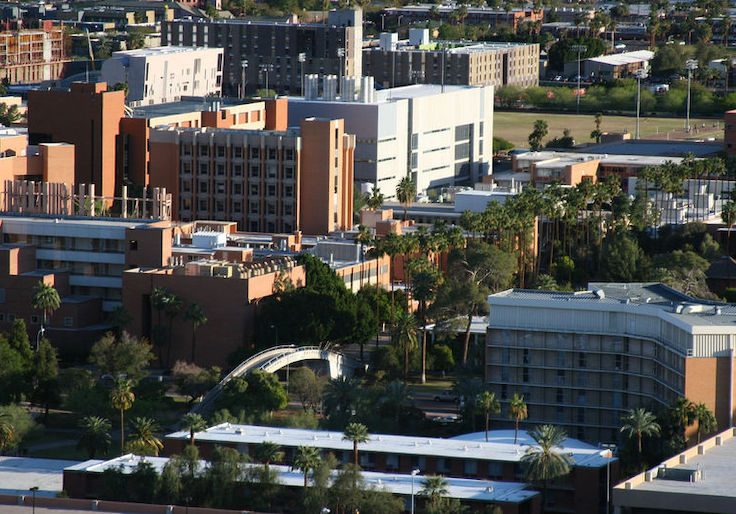
Arizona State University campus / Wikimedia Commons

Arizona State University revoked a job offer from its incoming journalism school dean after students and faculty accused her of "microaggressions," including a tweet that called some police officers "good."
Sonya Forte Duhé was due to take over as dean of ASU's Walter Cronkite School of Journalism and Mass Communication on July 1, but her offer was revoked on Monday after former students lodged complaints about comments they perceived as rude. Duhé was also criticized for her #BlackOutTuesday post that called some police officers good, in light of the George Floyd protests.
In a since-deleted tweet, Duhé wrote, "for the family of George Floyd, the good police officers who keep us safe, my students, faculty and staff. Praying for peace on this #BlackOutTuesday." One of Duhé's former students, Whitney Woods, responded by calling the professor racist. "There is no way in hell that black lives matter to you," Woods tweeted. "You are one of, if not, THE most racist human that I have ever encountered in a professional setting." After the tweet, Woods, a black woman, claimed that the former Loyola University-New Orleans (LOYNO) professor told her that her hair was too messy for television.
In an article for the State Press, ASU's student newspaper, 23 LOYNO students alleged that Duhé discouraged black students from pursuing television careers because of their appearances. One student, Andrew Ketchum, claimed Duhé criticized his voice because he is gay. Ketchum could not be reached for comment.
Duhé did not respond to a request for comment.
According to a report from AZ Central, prominent faculty members—including veterans of the Washington Post and New York Times—sent a letter to university president Michael Crow saying that hiring a dean accused of racism and mistreatment would harm the journalism school's reputation and finances. Several faculty members threatened to leave if Duhé became dean. Faculty who signed the letter either did not respond or declined requests for comment.
The Arizona State standoff emerged as prestige newsrooms have faced upheaval from young journalists and activists. Liberal New York Times staff members launched an open revolt against management after the newspaper published an op-ed from Sen. Tom Cotton (R., Ark.)—a conflict that led to a public apology from newspaper executives and the resignation of opinion page editor James Bennet. ASU administrators bowed to similar demands from students and professors.
Students from minority journalism coalitions issued a joint statement calling on the university to revoke Duhé's offer. The letter said Duhé has a history of making racist, homophobic, and bodyshaming comments. "The student leaders are demanding ASU retract its current offer of her incoming position as Dean," the letter reads. "We refuse to let minority voices go unheard, especially those of the Black community."

The student-led coalition started a Change.org petition calling for Duhé's offer to be rescinded. The petition garnered more than 4,000 signatures.
"I really believe that ASU did the right thing," said National Association of Hispanic Journalists president Marco Peralta. "For a journalism school such as Cronkite, it is important to be respectful of every ethnicity, race, and sexual orientation.… We felt, as students and leaders of ethnicity student organizations at Cronkite, Sonya Duhé was not the right person for the job. Racism and homophobia have no place."
A spokesman for ASU provost Mark Searle's office told the Washington Free Beacon that the school and television station "will be better served by not advancing with Dr. Duhé as their leader." The decision came after ASU president Michael Crow publicly called on the university to accelerate "the rate of enhanced social justice."
"The development regarding the Cronkite Dean is most unfortunate, but we now must turn our attention to meeting that challenge and ensuring we offer the highest level of journalism education," the spokesman said.
Woods said she was empowered by ASU's decision but wished LOYNO faculty and staff had made the same decision years ago.
"The real victory here is that people finally had a space to speak their truth and to finally feel like that truth was heard," Woods said. "What the ASU faculty and staff did is what we wish Loyola faculty and staff did while we were in school."

Saturday, May 16, 2020

Gov. Jay Inslee retracts requirement that diners provide contact info when restaurants reopen 

When dining rooms in Washington start to reopen in the coming months, restaurants will not be required to record customers’ contact information after all.
In a walk-back of a controversial component of the restaurant reopening guidance issued earlier this week, Gov. Jay Inslee’s office issued a statementon Friday evening “clarifying” that the state will not require customers to provide their contact information when they go out to eat.
Instead, businesses are asked to maintain a list of customers who voluntarily do so.
“We are asking visitors to voluntarily provide contact information in case of COVID-19 exposure. We only need information for one person per household. If we learn you may have been exposed to COVID-19 during your visit, the information will only be shared with public health officials,” Inslee’s news release said. “They will contact you to explain the risk, answer questions and provide resources. This information will not be used for any other purpose, including sales or marketing. If this list is not used within 30 days, it will be destroyed.”
 To reopen, Washington state restaurants will have to keep log of customers to aid in contact tracing
Inslee had said Monday that businesses were required to collect the name, contact information and time of visit for every diner who entered their premises. This, the initial guidelines stated, was to aid in contact tracing should any patron test positive for coronavirus. Restaurants that wanted to move to the second phase of the governor’s four-phase plan to reopen the state — allowing them to open their dining rooms at 50% capacity — were required to maintain those records for a month.
That data collection requirement caused an uproar this week, at a time when the governor wanted to focus on his four-phase plan to restart the economy.
The American Civil Liberties Union (ACLU) of Washington criticized the data gathering as a risk “ to people’s fundamental rights to privacy and association.”
Many restaurant owners were also skeptical of the requirement.
Eric Banh who owns the critically acclaimed Ba Bar and Monsoon restaurants, worried that his staff would have to deal with customers who refuse to disclose personal data or who might turn belligerent if the host logs their visits. Likewise, in Skamania County, which has already been given the green light to move to the second phase and reopen their dining rooms, not all restaurants jumped on board, saying they worried about backlash.
To quell those fears, Inslee issued the statement Friday night, saying “I am no longer requiring customers to provide a business with contact information, and businesses should not condition service on a customer’s unwillingness to do so.”
The restaurant industry has been one of the hardest hit by the coronavirus pandemic, with more than 120,000 hospitality workers filing for unemployment benefits statewide, according to the Washington Hospitality Association.
In Western Washington, the restaurant industry is a major economic engine. In King County alone, restaurants and bars accounted for 105,600 jobs and $6.3 billion in taxable revenues in 2019, according to King County.
A Seattle Times analysis of data from the state Employment Security Department (ESD) found that nearly every bartender in the state has filed for unemployment.
In hope of putting bars back in business, The Washington State Liquor and Cannabis Board earlier this month allowed bars and other establishments with liquor licenses to sell cocktails to-go as long as food is purchased with the drink order.
According to Inslee’s plan, when King County is cleared to move to the second phase and Seattle-area restaurants reopen — perhaps as soon as early June — dining rooms can open at 50% capacity, and party sizes will be capped at five.