
Showing posts with label Nuclear Power. Show all posts

Tuesday, October 22, 2019

Where are the environmental activists?


African countries mull nuclear energy as Russia extends offers 

Moscow is sure to tout nuclear energy at the Russia-Africa Summit, selling it as a solution for the continent's power supply woes. So just how concerned should we be about its intentions and Africa's readiness? 
    
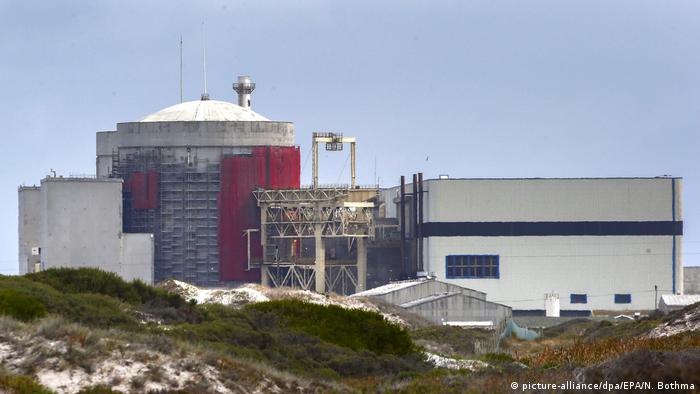
Südafrika Atomkraftwerk Koeberg nahe Kapstadt (picture-alliance/dpa/EPA/N. Bothma)
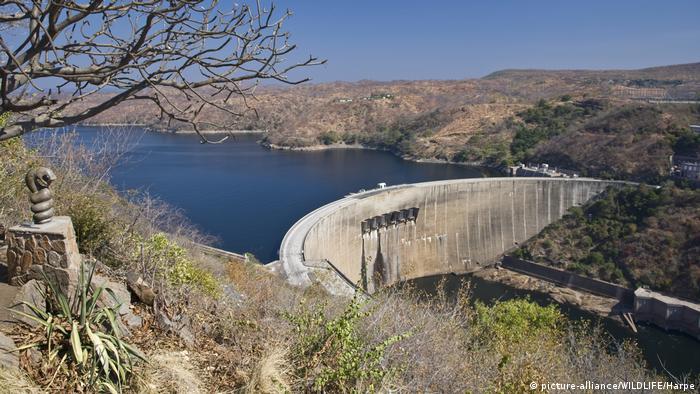
Southern Africa's ongoing drought has had a devastating impact on the region's power supply. Water levels at Kariba Dam, which straddles Zimbabwe and Zambia and generates significant amounts of electricity, are at the lowest in years.
Both countries have now turned to South Africa to import power, even though the region's biggest country and the continent's most industrialized nation, South Africa, is unable to meet its own energy needs.
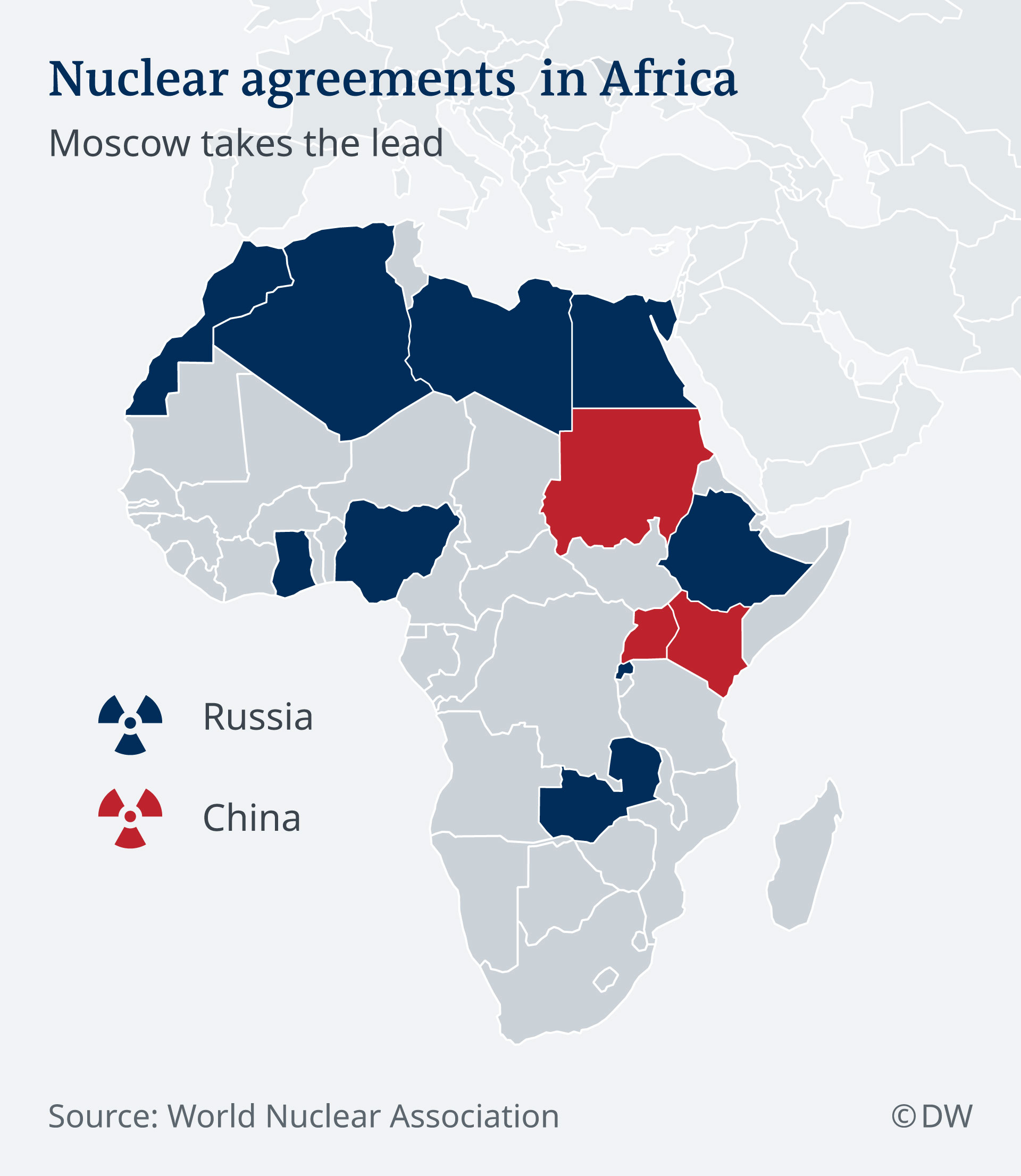
Nearly 600 million Africans do not have access to electricity. With growing populations and rising demand for power, African governments are desperate for solutions. In 2016, the Zambian government signed an agreement with Moscow to support it as it explores nuclear technology. And the energy-hungry country isn't the only one.
A map of Africa, with countries that have signed nuclear technology framework agreements with Africa highlighted
Nuclear technology and know-how will be high on the agenda at the Russia-Africa Summit in Sochi. There's a whole panel discussion on how it could contribute to development in Afric. The discussion will feature the CEO of Rosatom, Russia's state-backed nuclear energy company, and the head of the Zambia Atomic Energy Agency, Roland Msiska.
The ongoing drought has provided Msiska with an opportunity to promote nuclear energy as an alternative to hydropower in the country. And African proponents of the technology could be just what Moscow needs.
Moscow seeks new partners 
Two years ago, Rosatom's CEO reportedly said the state-backed entity needed to start earning more money through commercial projects abroad. Russia is one of the countries taking the lead in forming these partnerships exploring nuclear energy with African countries because it is one of the main exporters of nuclear energy, says the World Nuclear Association's Jonathan Cobb.
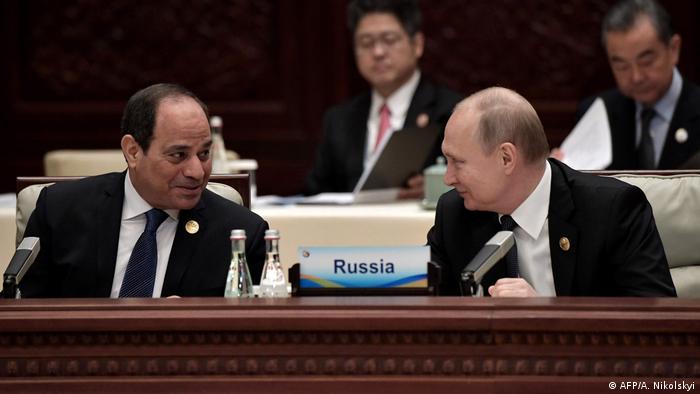
Egyptian President El-Sissi and Russian President Putin
Egyptian President El-Sissi, as African Union chairperson, and Russian President Putin are the co-chairs of the Russia-Africa Summit 
Shifts in the world's geopolitical dynamics may also have given Moscow more reason to look for new markets for nuclear technology.
"The Russian Federation is under European Union and US sanctions still, so it is trying to diversify its economic partnerships," says Chatham House's Alex Vines.
And African countries offer that opportunity, partly due to the lack of infrastructure.
"It would be an entry point for a very long partnership with an African government because of the scale of the infrastructure that would be necessary for a nuclear facility," Vines explains.
Russian expertise and technology could potentially be needed at every stage: from educating engineers and technicians to construction, operation and decommissioning of the nuclear reactors.
This looks like a long-term project, and could take several years for other countries to be ready.
"This is an initial relationship that [Russia, China] are building up," says Jonathan Cobb.
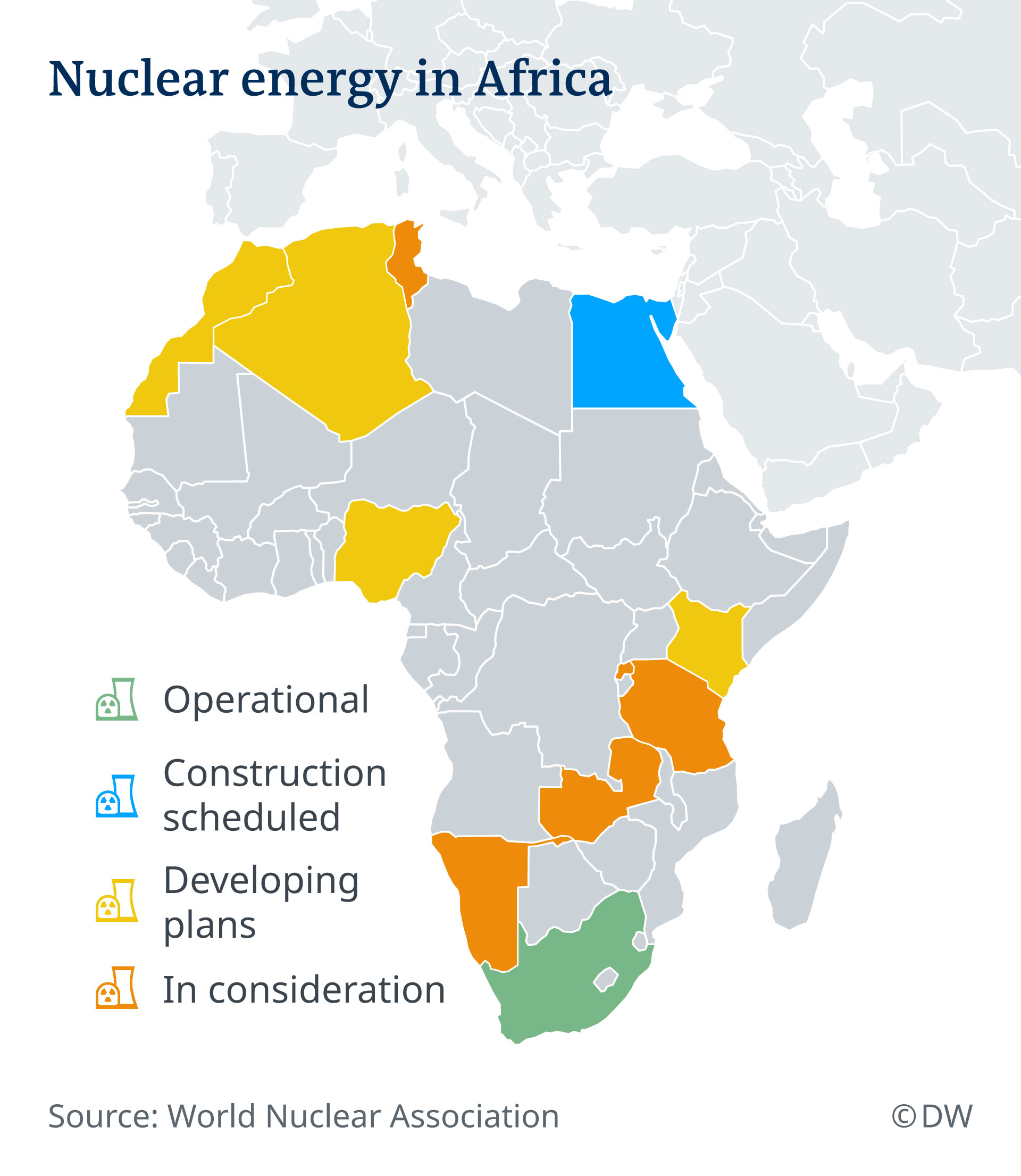
Different stages of nuclear energy in Africa, based on information from the World Nuclear Association
"They may be the vendors for reactor technology at a later date, but we are talking several decades into the future," Cobb adds.
Egypt could become the next country after South Africa to launch a nuclear power reactor, but even that could take years despite the fact that construction begins next year.
Nuclear energy investment expensive
Many experts believe that nuclear technology doesn't make sense for African countries because of the amount of investments required. Alex Vines points to the lack of regulatory bodies and challenges regarding maintenance and inspection of infrastructure — issues also raised by the International Atomic Energy Agency's assessments of some countries in Africa.
The decisive factor for many African governments could be cost. Many of them already have high debt burdens. Building nuclear power plants is expensive and unpredictable, says Hartmut Winkler, a professor of physics at the University of Johannesburg.
"There's plenty of examples around the world where construction [for nuclear plants] just keeps dragging on and on," he explains. "The worst thing is that the cost could balloon and that the time period for completion could be underestimated."
Karim
Low water levels at the Kariba Dam have led to widespread power outages in Zambia and Zimbabwe 
Perhaps these concerns played a role in the cash-strapped South African government's recent decision to scrap plans for Russia to help it build another nuclear power plant. Vines says the project's link to the corrupt government of former President Zuma may also have contributed. The South African government canceled the plan because it was too expensive. But other African countries may be enticed by Russia's offers
"There may be a number of elites, particularly host governments, that may be very interested in the incentives that the Russians provide in the short- to mid-term, without really considering the long-term implications," Vines explains.  
Russia is already backing providing more than 80% of the funds needed to build the continent's second nuclear power plant (worth more than $25 billion=€22.5 billion) for which construction will begin next year in Egypt. And if other African governments sign up for nuclear reactors, they may very well find themselves tied into a very long-term relationship with Moscow. 
*Rosatom did not respond to questions on the plans for nuclear energy in Southern Africa. And the Zambian goverment was not forthcoming with information. 

Sunday, February 10, 2019

A timely recap of Democrat involvement with bad Russian actors. Democrats makes their crimes by projecting them on others...

The case for Russia collusion … against the Democrats

As secretary of State, Hillary Clinton worked with Russian leaders, including Foreign Minister Sergey Lavrov and then-President Dmitri Medvedev, to create U.S. technology partnerships with Moscow’s version of Silicon Valley, a sprawling high-tech campus known as Skolkovo.
Clinton’s handprint was everywhere on the 2009-2010 project, the tip of a diplomatic spear to reboot U.S.-Russian relations after years of hostility prompted by Vladimir Putin’s military action against the former Soviet republic and now U.S. ally, Georgia.
A donor to the Clinton Foundation, Russian oligarch Viktor Vekselberg, led the Russian side of the effort, and several American donors to the Clinton charity got involved. Clinton’s State Department facilitated U.S. companies working with the Russian project, and she personally invited Medvedev to visit Silicon Valley.
The collaboration occurred at the exact same time Bill Clinton made his now infamous trip to Russia to pick up a jaw-dropping $500,000 check for a single speech.
The former president’s trip secretly raised eyebrows inside his wife’s State Department, internal emails show.
That’s because he asked permission to meet Vekselberg, the head of Skolkovo, and Arkady Dvorkovich, a senior official of Rosatom, the Russian nuclear giant seeking State’s permission to buy Uranium One, a U.S. company with massive uranium reserves.
Years later, intelligence documents show, both the Skolkovo and Uranium One projects raised serious security concerns.
In 2013, the U.S. military’s leading intelligence think tank in Europe sounded alarm that the Skolkovo project might be a front for economic and military espionage.
“Skolkovo is an ambitious enterprise, aiming to promote technology transfer generally, by inbound direct investment, and occasionally, through selected acquisitions. As such, Skolkovo is arguably an overt alternative to clandestine industrial espionage — with the additional distinction that it can achieve such a transfer on a much larger scale and more efficiently,” EUCOM’s intelligence bulletin wrote in 2013.
“Implicit in Russia’s development of Skolkovo is a critical question — a question that Russia may be asking itself — why bother spying on foreign companies and government laboratories if they will voluntarily hand over all the expertise Russia seeks?”
A year later, the FBI went further and sent letters warning several U.S. technology companies that had become entangled with Skolkovo that they risked possible espionage. And an agent in the bureau’s Boston office wrote an extraordinary op-ed to publicize the alarm.
Skolkovo “may be a means for the Russian government to access our nation’s sensitive or classified research development facilities and dual-use technologies with military and commercial application,”Assistant Special Agent in Charge Lucia Ziobro wrote in the Boston Business Journal.
The FBI had equal concern about Rosatom’s acquisition of Uranium One. An informer named William Douglas Campbell had gotten inside the Russian nuclear giant in 2009 and gathered evidence that Rosatom’s agents in the United States were engaged in a racketeering scheme involving kickbacks, extortion and bribery.
Campbell also obtained written evidence that Putin wanted to buy Uranium One as part of a strategy to obtain monopolistic domination of the global uranium markets, including leverage over the U.S.
Campbell also warned a major in-kind donor to the Clinton Global Initiative was simultaneously working for Rosatom while the decision for U.S. approval was pending before Hillary Clinton’s department. Ultimately, her department and the Obama administration approved the transaction.
The evidence shows the Clintons financially benefited from Russia — personally and inside their charity — at the same time they were involved in U.S. government actions that rewarded Moscow and increased U.S. security risks.
The intersections between the Clintons, the Democrats and Russia carried into 2016, when a major political opposition research project designed to portray GOP rival Donald Trump as compromised by Moscow was launched by Clinton’s presidential campaign and brought to the FBI.
Glenn Simpson’s Fusion GPS research firm was secretly hired by the Clinton campaign and Democratic Party through their law firm, Perkins Coie.
Simpson then hired retired British intelligence operative Christopher Steele — whom the FBI learned was “desperate” to defeat Trump — to write an unverified dossier suggesting that Trump’s campaign was colluding with Russia to hijack the election.
Simpson, Steele and Perkins Coie all walked Trump-Russia related allegations into the FBI the summer before the election, prompting agents who openly disliked Trump to launch a counterintelligence probe of the GOP nominee shortly before Election Day.
Simpson and Steele also went to the news media to air the allegations in what senior Justice Department official Bruce Ohr would later write was a “Hail Mary” effort to influence the election.
Congressional investigators have painstakingly pieced together evidence that shows the Clinton research project had extensive contact with Russians.
Ohr’s notes show that Steele’s main source of uncorroborated allegationsagainst Trump came from an ex-Russian intelligence officer. “Much of the collection about the Trump campaign ties to Russia comes from a former Russian intelligence officer (? not entirely clear) who lives in the U.S.,” Ohr scribbled.
Steele’s dossier also relied on information from a Belarus-born Russian businessman, according to numerous reports and a book on the Russia scandal.
Steele and Simpson had Russian-tied business connections, too, while they formulated the dossier.
Steele worked for the lawyers for Russian oligarch Oleg Deripaska and tried to leverage those connections to help the FBI get evidence from the Russian aluminum magnate against Trump campaign chairman Paul Manafort.
The effort resulted in FBI agents visiting Deripaska in fall 2016. Deripaska told the agents that no collusion existed.
Likewise, Simpson worked in 2016 for the Russian company Prevezon — which was trying to escape U.S. government penalties — and one of its Russian lawyers, Natalia Veselnitskaya. In sworn testimony before the Senate Judiciary Committee, Simpson admitted he dined with Veselnitskaya both the night before and the night after her infamous meeting with Donald Trump Jr. at Trump Tower in June 2016.
Simpson insists the two dinners sandwiching one of the seminal events in the Trump collusion narrative had nothing to do with the Trump Tower meeting, a claim many Republicans distrust.
Whatever the case, there’s little doubt the main instigators of the Clinton-inspired allegations against Trump got information from Russians and were consorting with them during the political opposition project.
This past week, we learned from Senate Intelligence Committee Chairman Richard Burr (R-N.C.) that his committee came to the same conclusion as the House: There is no evidence of collusion between the Trump campaign and Russia.
But now there is growing evidence — of Democratic connections to Russia. It’s enough that former House Intelligence Committee Chairman Devin Nunes (R-Calif.) believes a probe should be opened.
There is “obvious collusion the Democrats had through Glenn Simpson and through Fusion GPS, that they were talking directly to Russia,” Nunes told Hill.TV’s "Rising" in an interview to be aired Monday.
Collusion can be criminal if it involves conspiracy to break federal laws, or it can involve perfectly legal, unwitting actions that still jeopardize America’s security against a “frenemy” like Russia.
There is clear evidence now that shows Hillary Clinton’s family and charity profited from Moscow and simultaneously facilitated official government actions benefiting Russia that have raised security concerns.
And there’s irrefutable evidence that her opposition research effort on Trump — one that inspired an FBI probe — was carried out by people who got information from Russia and were consorting with Russians.
It would seem those questions deserve at least some of the scrutiny afforded the Trump-Russia collusion inquiry that is now two-plus years old.
John Solomon is an award-winning investigative journalist whose work over the years has exposed U.S. and FBI intelligence failures before the Sept. 11 attacks, federal scientists’ misuse of foster children and veterans in drug experiments, and numerous cases of political corruption. He is The Hill’s executive vice president for video.

Friday, February 9, 2018

Russians Lobbied Clinton on Uranium One as Spies Infiltrated Her Inner Circle

U.S. Democratic presidential nominee Hillary Clinton waves as she arrives at the airport in White Plains, New York, U.S. October 11, 2016. REUTERS/Lucy Nicholson - RTSRSH4
On Wednesday, a former FBI informant testified to three different congressional committees that Russian officials paid a lobbying firm to convince then-Secretary of State Hillary Clinton to approve the Uranium One deal. The effort came at a time when Russian nuclear executives were still working with Iran, and as Russian spies infiltrated Clinton's inner circle.
The informant, William Campbell, worked with Russian nuclear executives and provided extensive information to the FBI and the CIA for decades. His testimony led to the arrest and conviction of Vadim Mikerin —a top official of the Russian nuclear arms subsidiary Tenex and later president of Tenam, the American subsidiary of the Russian government-owned firm Rosatom.
Campbell claimed that Mikerin and other executives lobbied Clinton, who served on the Committee on Foreign Investment in the United States (CFIUS), to approve Rosatom's partial purchase of Uranium One, a Canadian mining company with rights to 20 percent of U.S. uranium. At the time, Bill Clinton was paid $500,000 for a speech at the Kremlin-connected investment bank Renaissance Capital, which was promoting Uranium One stock.
In a statement obtained by The Hill, Campbell claimed that the Russian government had hired the American lobbying firm APCO Worldwide because it could influence the Obama administration, and Hillary Clinton specifically. Nuclear officials told Campbell "that they expected APCO to apply a portion of the $3 million annual lobbying fee it was receiving from the Russians to provide in-kind support for the Clintons' Global Initiative."
The specific contract "called for four payments of $750,000 over twelve months," Campbell wrote. "APCO was expected to give assistance free of charge to the Clinton Global Initiative as part of their effort to create a favorable environment to ensure the Obama administration made affirmative decisions on everything from Uranium One to the U.S.-Russia Civilian Nuclear Cooperation agreement."
APCO Worldwide emphatically denied Campbell's report, saying its work "on behalf of Tenex and The Clinton Global Initiative were totally separate and unconnected in any way."
SPONSORED
Nick Merrill, a spokesman for Clinton, also dismissed the informant's account. “Just yesterday the committee made clear that this secret informant charade was just that, a charade," he insisted. "Along with the widely debunked text- message-gate and Nunes' embarrassing memo episode, we have a trifecta of GOP-manufactured scandals designed to distract from their own President's problems and the threat to democracy he poses."
Campbell's story went beyond APCO Worldwide, however. He wrote that Russian nuclear executives “boasted” about “how weak the U.S. government was in giving away uranium business and were confident that Russia would secure the strategic advantage it was seeking in the U.S. uranium market.”
According to U.S. government figures from 2016, the U.S. imports more than 90 percent of the uranium for nuclear reactors. Campbell testified that he was bothered by the Russian attempts to infiltrate the U.S. uranium market.
“I expressed these concerns repeatedly to my FBI handlers. The response I got was that politics was somehow involved,” he stated.
“In 2010, officials inside Tenex became interested in helping another Rosatom subsidiary, ARMZ, win Obama administration approval to purchase Uranium One, a Canadian company,” Campbell testified. “Although Tenex and ARMZ are separate subsidiaries, Tenex had its own interest in Uranium One. Tenex would become responsible for finding commercial markets and revenue for those uranium assets once they were mined."
“The emails and documents I intercepted during 2010 made clear that Rosatom’s purchase of Uranium One — for both its Kazakh and American assets — was part of Russia’s geopolitical strategy to gain leverage in global energy markets,” he testified. “I obtained documentary proof that Tenex was helping Rosatom win CFIUS approval, including an October 6, 2010 email … asking me specifically to help overcome opposition to the Uranium One deal.”
Campbell described these efforts as part of the "Russian uranium dominance strategy."
Before the Uranium One deal, the FBI had already gathered evidence of Russian corruption in U.S. uranium — through Campbell — but the agency kept that investigation secret.
At the same time, the FBI acted quickly to arrest ten Russian spies as part of "Operation Ghost Stories." According to a top FBI official, the agency acted quickly because the "deep cover" agents had come very close to "a sitting US cabinet member." Who, specifically? Why, Hillary Clinton.
In June 2010, Barbara Morea, president of Morea Financial Services in Manhattan, confirmed that "Cynthia Murphy," Russian External Intelligence Service (SVR) spy Lidiya Guryeva, was a longtime employee and vice president at the company, which managed the finances of Alan Patricof, a top Democratic donor who fundraised for Clinton's Senate and presidential campaigns.
Federal court documents confirmed the connection between Guryeva and Patricof, suggesting Clinton was the official the FBI attempted to protect.
The FBI arrested the Russian spies on June 28, 2010, one day before Bill Clinton's speech at Renaissance Capital.
Despite the FBI investigation into Rosatom, CFIUS fast-tracked the Uranium One approval, finishing it in 52 days, rather than the mandatory 75-day review process. To make matters worse, Uranium One's chairman directed $2.35 million in contributions to the Clinton Foundation.
Clinton's ties to Russia might explain why she would be a tempting target for Russian spies, and for Russian nuclear executives. As secretary of State, she pledged to "reset" relations with Russia. She opposed the Magnitsy Act to sanction Russian oligarchs, and told Russian television that "our goal is to help strengthen Russia."
The Obama administration wasted no time in sending the ten spies back to Russia. The U.S. exchanged them for four Russian nationals on July 10, less than two weeks after their arrest. This was remarkably fast for a Russia-U.S. spy swap.
Finally, Campbell had reported in April 2010 that Russia had been providing uranium to Iran, in support of the Islamic Republic's nuclear program. "Tenex continues to supply Iran fuel through their Russian company," Campbell wrote in that 2010 report. "They continue to assist with construction consult [sic] and fabricated assemblies to supply the reactor. Fabricated assemblies require sophisticated engineering and are arranged inside the reactor with the help and consult" of Russians.
By approving the Uranium One deal through CFIUS, Clinton may have unwittingly aided Iran, despite American sanctions on the Islamic Republic. As with each step of this tragic story, it seems an FBI memorandum with Campbell's information to Congress or to other members of CFIUS could have prevented the Uranium One Deal.
“I was speechless and angry in October 2010 when CFIUS approved the Uranium One sale to Rosatom. I was deeply worried that TLI continued to transport sensitive uranium despite the fact that it had been compromised by the bribery scheme,” stated Campbell in his testimony to lawmakers.
“I expressed these concerns repeatedly to my FBI handlers. The response I got was that 'politics' was somehow involved. I remember one response I got from an agent when I asked how it was possible CFIUS would approve the Uranium One sale when the FBI could prove Rosatom was engaged in criminal conduct. His answer: 'Ask your politics.'"
What could be more political than the influence of Hillary Clinton — a woman of considerable influence who almost became Obama's successor as president? No wonder her spokesman is so quick to deny everything.
Contrary to Democrat claims that Campbell is not reliable, the FBI paid $50,000 for his services, and based their case against Vadim Mikerin on his reports.
Interestingly, one man connects the Uranium One scandal to the current Russia investigation. Jonathan Winer, onetime registered foreign agent and Senate staffer for John Kerry, served as senior vice president at APCO Worldwide during the Uranium One scandal. Winer, as a member of Obama's State Department in 2016, fed information to former British spy Christopher Steele as he compiled the infamous Clinton campaign-funded Trump-Russia dossier.

Sunday, September 3, 2017

Thanks to the Left's appeasement we will soon have a nuclear weapon equipped, Japan, South Korea and in the Middle East or one hell of a blowup..

(AP Photo/Eugene Hoshiko)
The likelihood that North Korea will soon have a thermonuclear weapon and long range delivery system may have started the countdown to a nuclear armed Japan and South Korea. Seismographic evidence of a powerful subterranean nuclear test blast suggests that Pyongyang is not bluffing when it says it can rain down fire of great capitals. "Hours before North Korea announced it had tested a hydrogen bomb, its state-run news agency had a stark message for the world: We've developed a more powerful nuclear weapon and we can make as many of them as we want."
As this article on US missile defense options notes, the ICBM threat from Iran and North Korea is not only real, but even the defense of the North American continent against them is by no means assured. A "hypothetical Iranian ICBM (based on the North-Korean Unha-3 space launcher) heading towards the Northwestern United States" will be vulnerable in a window only 300 seconds wide to interceptors in Poland.
The intercept timing for Japan or South Korea for a shot aimed at Guam, for example, is even tighter due to their proximity to the missile launch sites.
Based on the time/distance envelopes for SM-2 and SM-3 missile intercepts calculated from Joan Johnson-Freese (a professor at the Naval War College and a lecturer at Harvard University) and Ralph Savelsberg (an assistant professor at the Netherlands Defence Academy), an Aegis defender [of Japan] would only have a few minutes to get off a shot at an ICBM launch from North Korea. Aegis-equipped destroyers and cruisers would have to be dangerously close to the North Korean coast to get a chance to strike an ICBM in "boost" phase as it rose and could be vulnerable to North Korean submarines if an actual attack were planned.
The entire core Western world: Japan, South Korea, Western Europe and the North American continent itself; the great gleaming capitals of Tokyo, Seoul, Paris and London now lie under the gun of potentially sacrificial launch sites. Whether they are secretly supported by great powers; whether Iran and North Korea have cooperated to jointly create a WMD system is not openly known.  But it is fairly certain that with  preemption not an effective option and defense at best uncertain nuclear weapons containment may finally be dead.
The road that led to the funeral was paved with good intentions. Robert Litwak, who served on the National Security Council staff as director for nonproliferation in the first Clinton administration, explained what Barack Obama was trying -- and ultimately failed -- to achieve in a 2013 interview.
SPONSORED
Obama came to office with a commitment to engage "rogue" states, which he repositioned by referring to them as "outliers" and offered them a structured choice with a significant upside and penalties for noncompliance. And that engagement strategy, the hand that Obama extended to North Korea and Iran in his first inaugural address, was rebuffed. That is the situation that we’re in right now.
That approach was still being advocated as late as April, 2017.  An article in the Atlantic hopefully declared: "we are now at an existential moment, where North Korea must be confronted with a fundamental choice: Either it will face crippling global economic sanctions (including a Chinese oil embargo) that could trigger the collapse of the regime, or it will negotiate a verifiable end to its nuclear weapons development program."
But Kim picked what the negotiators believed was an irrational option, perhaps not for the last time.  Even the Obama administration must have guessed that failure was not only possible but likely for they left an epic "by the way" note to the next administration.
When President Barack Obama’s term ended in January, he left a momentous decision to the Trump administration: whether to continue a 30-year, $1 trillion program to remake America’s atomic weapons, as well as its bombers, submarines and land-based missiles. ...
“This is why there is no real five-year plan for the defense budget,” said Representative Adam Smith, Democrat of Washington and a member of the House Armed Services Committee, who has asked whether the United States needs all of the 1,550 nuclear weapons it can deploy under a 2010 treaty with Russia. “No one wants to face these numbers.”
PS you have to refurbish 1,550 weapons under the treaty with the ex-reset partner Russia.  That won't go down well in Washington nor in allied capitals all over the world.

Friday, August 12, 2016

Will Iran erect statures of Obama and Valerie Jarrett in Tehran? Iran to build two new nuclear facilities


Nuclear power for everyone but us!


Obama Admin Gives Green Light for Iran to Build Two New Nuclear Plants

New Iranian nuclear plants will not violate nuclear deal, officials say

Iranian Vice President and head of the Atomic Energy Organization of Iran Ali Akbar Salehi / AP
BY: 
Iran is permitted to pursue the construction of two newly announced nuclear plants under the parameters of last summer’s nuclear agreement, Obama administration officials informed the Washington Free Beacon, setting the stage for Tehran to move forward with construction following orders from President Hassan Rouhani.
Ali Salehi, Iran’s top nuclear official, announced on Thursday that Iran has invested $10 billion into the construction of two new nuclear plants after receiving orders from Rouhani, according to reports in Iran’s state-controlled media.
A State Department official said to the Free Beacon following the announcement that Iran is allowed to move forward with this venture under the nuclear agreement, which does not prohibit this type of nuclear construction.
“The [nuclear deal] does not prevent Iran from pursuing new light-water reactors,” a State Department official not authorized to speak on record said to the Free Beacon in response to questions about Iran’s latest announcement. “Any new nuclear reactors in Iran will be subject to its safeguards obligations.”
Critics in Congress of the Obama administration’s diplomacy with Iran condemned the new nuclear reactors, telling the Free Beacon that the administration is turning a blind eye to the Islamic Republic’s continued pursuit of illicit nuclear technology, including the know-how to build a nuclear weapon.
“Nothing in the behavior of the Iranian regime in the year since the JCPOA went into effect should give us any confidence that they will be confining their nuclear program to peaceful activities,” Sen. Ted Cruz (R., Texas) said to the Free Beacon, using the official acronym for the nuclear deal. “Secretary Kerry seems to think that the mullahs are interested in curing cancer and civilian energy production, but their rapid progress in ballistic missile technology suggests they are far more determined to develop the nuclear weapons these projectiles are designed to deliver.”
“This is just the most recent confirmation of how misguided, shortsighted, and downright dangerous the Obama administration’s nuclear deal with the Islamic Republic truly is,” Cruz added.
Congressional sources familiar with the matter said the administration’s lack of concern about the new nuclear reactors is adding fuel to a growing scandal surrounding White House efforts to grant Iranian demands.
Republican lawmakers have been investigating for months information detailing what they say is an Obama administration effort to pay Iran $400 million in cash and another $1.3 billion as part of a ransom payment to free U.S. hostages from Iran earlier this year.
Rep. Mike Pompeo (R., Kan.), who has led multiple efforts to compel the administration to come clean about the cash deal, said to the Free Beacon that the White House appears more concerned about bending over backwards for Iran.
“While the Iranians complain that the U.S. is not allowing enough investment into Iran, when investments do occur, Tehran continues to focus on its nuclear program. The Iranian regime’s priorities are clear,” Pompeo said. “The Ayatollah is more concerned with strengthening Iran’s nuclear infrastructure than providing for the Iranian people. Unfortunately, President Obama’s failed nuclear deal with Iran does little to protect the United States from an eventual Iranian nuclear weapon.”
In announcing construction of the two new nuclear plants, Iran’s Salehi took aim at the United States, blasting it for combating the Islamic Republic’s efforts to become a nuclear power.
“The U.S. has settled its scores with its potential rivals but Iran has stood up against it,” Salehi was quoted as saying. “This is a serious political challenge that does not form in vacuum and requires producing content and ideologies.”
Salehi also said Iran would continue to produce excess heavy water, a nuclear byproduct that can provide the material for a nuclear weapon.
The United States committed to purchasing more than 30 tons of this material from Iran earlier this year in order to keep it in line with restrictions imposed by the nuclear deal.
“Iran’s heavy water production surplus is currently on a sale agenda and our nuclear industry is functioning well,” Salehi said.
One senior congressional adviser who works with a range of key offices on the issue said to the Free Beacon that all of this is part of an Obama administration effort to help Iran become a legitimate player in the global nuclear trade.
“The Obama administration seems committed to making Iran into a nuclear power,” the source said. “They’ve purchased heavy water from the Iranians, as if the Iranians were legitimate nuclear suppliers, which they’re not. They’ve made excuses for Iran seeking to procure nuclear parts from Germany and elsewhere. And now they’re celebrating Iran building full-blown reactors.”
“All of this is the exact opposite of what they promised Congress, and for good reason, since Congress is committed to ensuring Iran never gets the infrastructure to be a screw turn away from a nuke,” the source said.

Friday, July 1, 2016

Schadenfreude from the people who invented the word. When fantasy meets reality guess which one wins?

ENERGIEWOOPSIE, OR, WHAT HAPPENS WHEN YOU DUMP NUCLEAR POWER

The greens have been aflutter for years about Germany’s energiewende, or “energy revolution,” partly because it involves a lot of their sacred windmills and solar panels and partly because it’s a revolution man, so dig it!
Better put the patchouli-infused hemp robes away for the moment, because Germany is backpedalling fast. From Reuters yesterday:
Germany has abandoned plans to set out a timetable to exit coal-fired power production and scrapped C02 emissions reduction goals for individual sectors, according to the latest draft of an environment ministry document seen by Reuters on Wednesday.
An earlier version of the draft document that was leaked in May had suggested that Germany should phase out coal-fired power production “well before 2050” as part of a package of measures to help Berlin achieve its climate goals.
The new version, which was revised following consultation with the economy and energy ministry, has also deleted specific concrete C02 emissions savings targets for the energy, industry, transport and agriculture sectors.
The document forms the government’s national climate action plan for 2050 and lays out how it plans to move away from fossil fuels and achieve its goal of cutting CO2 emissions by up to 95 percent compared to 1990 levels by the middle of the century.
The original proposals met with hefty opposition from unions, coal-producing regions and business groups who said it would cost jobs and damage industry.
Christoph Bals, policy director at environmental NGO Germanwatch, criticized the changes.
“Seven months after the successful climate summit in Paris the government is capitulating to the interests of the fossil fuel industry and missing the chance to give the economy a modernization impulse by presenting clear plans,” he said.
Meanwhile, on a related front, more sensible fallout from Brexit:
Siemens is putting new wind power investment plans in the UK on hold due to uncertainty caused by last week’s Brexit vote, the Germany energy company has told the Guardian.
Siemens, one of the few firms to openly back a Remain vote, will not be making new investments until the future of the UK’s relationship with Europe becomes clearer.
Maybe we should call Germany’s energy policy something like schadenfreudewende instead.