Showing posts with label immigration. Show all posts

Thursday, April 2, 2020

What it's like to be governed from afar

Czech Republic, Hungary and Poland failed to comply with 2015 programme, ECJ says

Poland, Hungary and the Czech Republic broke European law when they failed to give refuge to asylum seekers arriving in southern Europe, often having fled war in Syria and Iraq, the EU’s top court has ruled.
The three central European countries now face possible fines for refusing to take a share of refugees, after EU leaders forced through mandatory quotas to relocate up to 160,000 asylum seekers at the height of the 2015 migration crisis.
Issuing its judgment on Thursday, the European court of justice said the three member states “had failed to fulfil their obligations under European Union law”. The Czech Republic took in just 12 asylum seekers, while Hungary and Poland refused to take a single person.
The court rejected the legal argument that Hungary, Poland and the Czech Republic were entitled to disregard EU law in order to maintain public safety, law and order. None of the countries had proved it was necessary to invoke that opt-out clause in the EU treaties, the court concluded.
The European commission is now entitled to embark on legal action to impose fines on the three member states.
The decision to impose mandatory quotas of asylum seekers was taken in the teeth of fierce opposition from Hungary and the Czech Republic. After the nationalist Law and Justice party was elected in October 2015, Poland joined its neighbours in opposing the scheme.
The quotas have come to be seen as one of the modern EU’s defining moments, which poisoned relations between central Europe and western member states, leaving divisions that continue to thwart a common EU asylum policy.
The previous head of the European council, Donald Tusk, said the scheme had been “divisive and ineffective”, but countries, such as Germany and Sweden, which took in large numbers of refugees, have argued it is unacceptable for member states to shirk the task of easing the strain on the most-affected EU countries.
In September 2015, EU leaders took two decisions to relocate 40,000, then 120,000 asylum seekers from Greece and Italy to other EU countries. More than 1 million migrants and refugees arrived on Europe’s shores in 2015, triggering a political crisis that continues to haunt the union.
When the scheme closed, only 34,712 people had been relocated: 21,999 from Greece and 12,713 from Italy. The European commission claimed that the EU’s deal with Turkey meant the original number of places were no longer needed, because migrant arrivals fell sharply from March 2016.
The UN refugee agency reported last month that more than 36,000 asylum seekers were living in desperate conditions on five Greek islands in squalid camps originally designed for 5,400 people.
Greece’s minister for migration, Notis Mitarachi, told members of the European parliament’s home affairs committee on Thursday that 20 asylum seekers living at a camp near Athens had been confirmed as having coronavirus.
He said no cases had been confirmed on the Greek islands and urged other EU countries to take in people on the islands.
Responding to widespread concern about filthy camp conditions, he said: “Some have argued to transfer people to the mainland – that is from non-infected areas to infected areas – but we do not have empty spaces to do that. We will require additional funding for additional spaces, but these spaces cannot be ready within a few days.
“We will strongly welcome any offers of relocation from member states that have capacity because we cannot resolve this crisis instantly and alone.”
The EU home affairs commissioner, Ylva Johansson, told MEPs that some unaccompanied children on the islands would be relocated from next week. Eight EU countries have volunteered to take in 1,600 lone children.


Tuesday, January 28, 2020

SCOTUS rules in Trump's favor


In June 2018, following endless litigation against President Trump's "travel ban," the Supreme Court stated the obvious: The president has full authority to regulate and deny entry to foreign nationals at will. Yet the lower courts continue to come back for more and are even demanding that the Trump administration hand over more information to these same litigants who should not have standing to sue, per the Supreme Court decision.
Will Trump's victory Monday at the Supreme Court for his enforcement of public charge laws have any greater success than the travel ban has had in the courts? It's up to the president and Congress to check these rogue judges.
By a vote of 5-4, the Supreme Court agreed to stay the injunction placed on Trump's public charge law by a New York district judge. It's not a surprise that five justices understand the absurdity of a lower court enjoining a modest enforcement of a long-standing law against prospective immigrants accessing welfare and then receiving a green card.

What is more important, however, is the concurrence written by Justice Neil Gorsuch, joined by Justice Clarence Thomas, because it gets to the heart of the judicial insanity grinding our sovereignty to a halt and hampering any effort by President Trump to enforce unambiguous statutes on the books.
No matter how many times these lower courts get slapped down by the Supreme Court, they feel they can still come back for another round, even on the same issue, and halt an entire policy, beyond legitimate litigants with standing before the court. Gorsuch wrote, "It would be delusional to think that one stay today suffices to remedy the problem." Clearly observing this illegitimate trend of nationwide injunctions issued by forum-shopped judges in numerous other cases, Gorsuch called on his colleagues to "at some point, confront these important objections to this increasingly widespread practice."
Much as in Justice Thomas' concurrence in Trump v. Hawaii, Gorsuch observed that universal injunctions, used as ad hoc judicial vetoes on broad presidential authorities or statutes, clearly violates the limited scope of judicial power.
"When a court goes further than that, ordering the government to take (or not take) some action with respect to those who are strangers to the suit, it is hard to see how the court could still be acting in the judicial role of resolving cases and controversies," wrote Gorsuch in his concurrence.
Gorsuch went even further to illustrate some of the political chaos, absurdities, and undemocratic outcomes that are resulting from this unconstitutional practice. "As the brief and furious history of the regulation before us illustrates, the routine issuance of universal injunctions is patently unworkable, sowing chaos for litigants, the government, courts, and all those affected by these conflicting decisions."
Finally, Gorsuch took it to the next step and explained, as I've been warning for two years, that once you legitimize this game of forum-shopping and judicial vetoes, there's nothing stopping the Democrats from coming back for endless rounds of this:
There are currently more than 1,000 active and senior district court judges, sitting across 94 judicial districts, and subject to review in 12 regional courts of appeal. Because plaintiffs generally are not bound by adverse decisions in cases to which they were not a party, there is a nearly boundless opportunity to shop for a friendly forum to secure a win nationwide. The risk of winning conflicting nationwide injunctions is real too.

And the stakes are asymmetric. If a single successful challenge is enough to stay the challenged rule across the country, the government's hope of implementing any new policy could face the long odds of a straight sweep, parlaying a 94-to-0 win in the district courts into a 12-to-0 victory in the courts of appeal. A single loss and the policy goes on ice—possibly for good, or just as possibly for some indeterminate period of time until another court jumps in to grant a stay. And all that can repeat, ad infinitum, until either one side gives up or this Court grants certiorari. What in this gamesmanship and chaos can we be proud of?
This is certainly refreshing. But too many supporters of the president will take this as a win and go home, simply hoping that three other justices join Gorsuch and Thomas in "overturning" the concept of universal injunctions. However, not only is that unlikely to happen, we shouldn't have to wait for the Supreme Court to "allow" us to function as a constitutional republic. The other branches of government need to put these judges in their place and refuse to give effect to their civil disobedience.
Throughout the day Monday, there were numerous headlines exclaiming how the Supreme Court "allowed" the public charge rule to go forward. Such language should give any constitutionalist heartburn. Courts do not stand above the other branches of government, and they do not veto or ratify policies. If that were the case, we would cease to have three co-equal, independent branches of government.

Monday, January 6, 2020

Nearly 400K Anchor Babies Born in 2019, Exceeding U.S. Births in 48 States

Nearly 400K Anchor Babies Born in 2019, Exceeding U.S. Births in 48 States


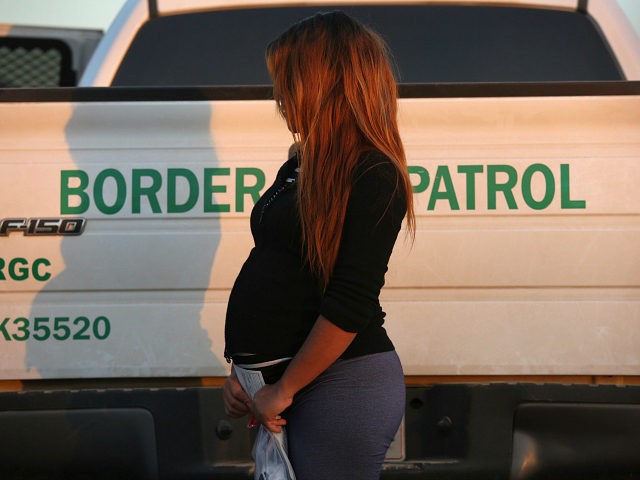
RIO GRANDE CITY, TX - DECEMBER 07: An immigrant from El Salvador, seven months pregnant, she said, stands next to a U.S. Border Patrol truck after turning herself in to border agents on December 7, 2015 near Rio Grande City, Texas. Many pregnant women, according to Border Patrol agents, cross …
John Moore/Getty Images
2:52
Close to 400,000 anchor babies were born in the United States in 2019 as an executive order to end birthright citizenship gets kicked down the road for another year by President Donald Trump’s administration.
Analysis conducted by the Center for Immigration Studies revealed in 2018 that about 300,000 U.S.-born children of illegal aliens are born every year. These children, often referred to as “anchor babies,” immediately obtain American citizenship and anchor their illegal or foreign parents in the country.
In addition, about 72,000 anchor babies are born to foreign tourists, foreign visa workers, and foreign students every year — all of whom obtain immediate American citizenship simply for being born within the parameters of the country.
Altogether, about 372,000 anchor babies are estimated to have been born last year despite a commitment by Trump to sign an executive order ending the nation’s “anchor baby policy” that incentivizes pregnant migrant women to cross the U.S.-Mexico border in the hopes of securing American citizenship for their children.
This indicates that there were more anchor babies born in 2019 than births in each of the 50 states except California and Texas. California residents deliver about 455,000 babies a year, while Texans deliver about 379,000 babies a year, just slightly more than the total annual number of anchor babies born.
For example, there were more than 34 times as many anchor babies born nationwide than American children born in the state of Delaware and nearly five times as many anchor babies born nationwide than the American children born in Arizona.
To date, the U.S. Supreme Court has never explicitly ruled that the U.S.-born children of illegal aliens must be granted automatic American citizenship, and a number of legal scholars dispute the idea.
Many leading conservative scholars argue the Citizenship Clause of the 14th Amendment does not provide mandatory birthright citizenship to the U.S.-born children of illegal aliens or noncitizens, as these children are not subject to U.S. jurisdiction as that language was understood when the 14th Amendment was ratified.
For more than a year, Trump has signaled that he has reviewed signing an executive order to end birthright citizenship, otherwise known as the “anchor baby policy.”
Today, there are at least 4.5 million anchor babies in the U.S. under 18-years-old, exceeding the annual roughly four million American babies born every year and costing American taxpayers about $2.4 billion every year to subsidize hospital costs.
John Binder is a reporter for Breitbart News. Follow him on Twitter at @JxhnBinder.

Sunday, September 15, 2019

Poll: Majority of Hispanics Support Ending Welfare-Dependent Immigration

Poll: Majority of Hispanics Support Ending Welfare-Dependent Immigration


immigrants, welfare
Getty Images
3:22

A majority of Hispanic Americans support President Trump’s seeking to prevent welfare-dependent legal immigrants from permanently resettling in the United States, a new poll finds.

In August, the Trump administration published a regulation that ensures legal immigrants would be less likely to secure permanent residency in the U.S. if they have used any forms of welfare in the past, including using subsidized healthcare services, food stamps, and public housing — saving American taxpayers billions.
The latest Harvard/Harris Poll finds Hispanic Americans, by a majority of 56 percent, support denying permanent residency to immigrants who are known to have used welfare or are likely to use welfare. Likewise, a majority of 65 percent of Hispanic Americans said illegal aliens should not be allowed to draw from taxpayer-funded welfare programs, as well as 71 percent of black Americans.
Overall, six-in-ten American voters support preventing welfare-dependent legal immigrants from permanently resettling in the U.S., including 62 percent of swing voters, 77 percent of Republicans, 60 percent of moderate voters, and 64 percent of white Americans.
The regulation, known as the “public charge” rule, is particularly popular among working and middle-class Americans who have no college degree. More than six-in-ten of these voters support the public charge rule, along with 65 percent of rural voters and 60 percent of suburban voters.
Almost eight-in-ten American voters, including 80 percent of swing voters, said illegal aliens should not be allowed to use taxpayer-funded welfare benefits, such as free public housing, food stamps, disability checks, and subsidized healthcare.
Even among Democrats and liberals, allowing illegal aliens to draw from public social programs is hugely unpopular. For example, about seven-in-ten Democrat voters said they opposed illegal aliens taking from taxpayer-funded welfare programs. More than six-in-ten liberal voters said the same.

Saturday, August 31, 2019

The Swedish municipality of Hässleholm, which took in nearly 3,000 asylum seekers in three years, faces an economic crisis as up to 80 per cent remain on welfare.

Another Swedish Municipality That Took In Migrants Faces Economic Crisis578

Sweden
JONATHAN NACKSTRAND/AFP/Getty
2:40

The Swedish municipality of Hässleholm, which took in nearly 3,000 asylum seekers in three years, faces an economic crisis as up to 80 per cent remain on welfare.

Hässleholm City Council chairman Lars Johnsson, a member of the centre-right Moderate Party, said that the Swedish municipality has at least 100 migrants who are illiterate and another 200 with very poor educational backgrounds, saying, “It will in principle be impossible to get them to work,” Kristianstadsbladet reports.
Social assistance costs have drastically increased since 2012, rising from 32 million Swedish krona ($3,259,680/£2,680,320) to 54 million ($5,501,124/£4,523,310) this year. They are predicted to increase by another six million each year.

The municipality says they put away around 30 million krona to cope with the projected costs but already half of that has been spent.
“We would need 100 million krona from the state to go injury-free, to keep our noses above the surface,” Johnsson said.