Showing posts with label Out-of-Control Govt Spending. Show all posts

Friday, January 31, 2020

Republicans Demand Information From IRS After Finding Millions In EV Tax Credit Abuse


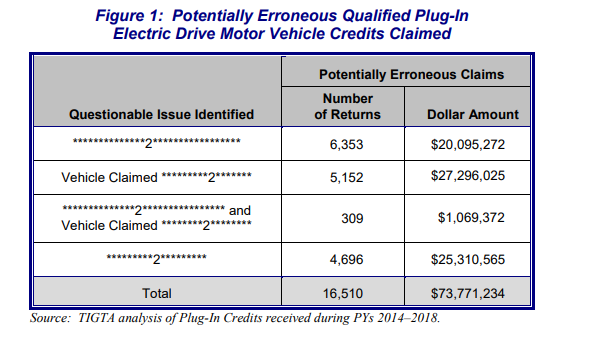
Republican senators are demanding answers from the IRS about how it enforces its EV tax credits after a watchdog for the Treasury Department found millions of dollars in "erroneously claimed" credits.
IRS Commissioner Charles Retting received a letter on Monday from senators who want information about "what appear to be systemic problems," according to The Hill
Fifteen senators signed the letter, including Senate Finance Committee Chariman Chuck Grassley and Senate Homeland Security and Governmental Affairs Committee Chairman Ron Johnson.
In September, the Treasury inspector general for tax administration (TIGTA) released a heavily redacted report finding that "the IRS has taken steps to address some of TIGTA’s previous recommendations to improve the identification and prevention of erroneous credit claims, many of the deficiencies previously identified still exist." 
It claimed there were more than $70 million worth of potentially erroneous plug-in credits claimed between 2014 and 2018. Back in 2011, the same watchdog found $33 million worth of plug-in and alternative vehicle credits that were claimed erroneously. 
The GOP senators said in their letter: "...it is troubling that these improper payments continue and have more than doubled in size in the eight years since they were first reported." 
The letter comes amidst a debate about expanding EV credits. Democrats have been pushing for the expansion while Republicans have largely pushed back. GOP senators say the program "overwhelmingly benefits wealthy electric vehicle owners in one state" and cited a WSJ article that showed about half of all EV sales occur in California.
The senators demanded information about the amount of credits erroneously claimed and whether or not the IRS has conducted their own internal audit. 

Monday, December 5, 2016

Obama family travel, vacations, cross $85 million mark.


The first family has spent over $10 million a year on travel and vacations, and the still growing bill has crossed over $85 million in eight years, according to a watchdog group.

Judicial Watch, (http://www.judicialwatch.org/press-room/press- releases/obama-familys-2015-hawaii-vacation-cost-taxpayers-4823206- 88/) which has charted the travel of presidents for years, on Monday said that it has received a new batch of bills for the first family's Christmas break in Hawaii, bringing that trip to nearly $5 million. The Obama's are expected to return to Hawaii this Christmas.
The expenses cover items such as security, flights and hotel rooms for staff and U.S. Secret Service. They do not include the price of prepositioning ships and aircraft in the area or much of the communications costs.
From Judicial Watch:

Judicial Watch announced today that it obtained records from the U.S. Secret Service revealing that its travel expenses for the First Family's 2015 Hawaiian vacation cost taxpayers $1.2 million, which bring the total cost of the vacation trip to at least $4.8 million. This was the Obamas' eighth Hawaiian family vacation. The trip has become an annual event for the Obamas. To date, Obama's and his family's travel expenses total at least $85,029,819.
The records obtained by Judicial Watch for Obama's Secret Service travel to Hawaii reveal the following expenses totaling $1,234,316.67:

Hotel and lodging costs totaled $1,000,458.63.
The Secret Service spent $165,893.88 on car rentals. Air and rail expenses totaled $67,964.16.

Although the vacation officially lasted from December 18, 2015, to January 3, 2016, the Secret Service rented several Kailua homes for 19 nights, starting from December 16. The total for the rentals, located near the Marine Corps base at Kaneohe Bay was $245,993.12.

According to bills obtained by Judicial Watch through the Freedom of Information Act (FOIA), the Secret Service also paid for rooms at the Hawaii Prince Hotel Waikiki and Golf Club. The Secret Service also reserved rooms at the Moana Surfrider resort on Waikiki Beach, and the Ala Moana Hotel, which cost a total of $40,249.48 and $671,895.99, respectively.

The Secret Service rented cars from Avis, Alamo, and Hertz – 103 cars for the two-week vacation, totaling $165,893.88 in taxpayer money.

Paul Bedard, the Washington Examiner's "Washington Secrets" columnist, can be contacted at pbedard@washingtonexaminer.com 

Saturday, April 30, 2016

Out of control bureaucracies: EPA hides $6.3 billion

Posted By Ethan Barton On 10:40 PM 04/29/2016 
Environmental Protection Agency (EPA) officials have accumulated at least $6.3 billion in more than 1,300 obscure spending accounts akin to slush funds that are essentially beyond congressional, media and public scrutiny.
The accounts – which were created through EPA’s Superfund program – are not technically secret because the agency officially acknowledges their existence. But getting concrete details about deposits and expenditures is extremely difficult.
The EPA deposited more than $6.3 billion into an estimated 1,308 special accounts between 1990 and 2015, according to the agency’s website, and has spent more than half of the total. The agency doesn’t publicly report individual special account balances or expenses.
The “special accounts” are financed by legal settlements between the agency and parties responsible for polluting Superfund sites. Funds are deposited and spent without prior congressional approval.
“This is the very definition of an out-of-control agency, if they can raise their own money and not have to go to Congress to have it appropriated,” Myron Ebell, director of the Competitive Enterprise Institute’s Center for Energy and Environment told TheDCNF.
An EPA spokeswoman told TheDCNF the agency manages the accounts “in accordance with the law, congressional intent, and EPA policy and guidance.”
“In fact, EPA management of Superfund special accounts has been reviewed periodically,” she told TheDCNF. “EPA has responded to [Government Accountability Office], [inspector general (IG)], congressional, public and press inquiries regarding special accounts.”
But those reviews are neither regular nor recent.
“EPA lacks transparency in its public reporting of special accounts,” the EPA’s IG wrote in 2009, the last year in which the accounts were reviewed by the independent watchdog. “Such transparency is needed to understand how special account funds are being utilized.”
Two years before the IG comment, the Center for Public Integrity reported reported that “there are hundreds of these accounts, and the EPA doesn’t need congressional approval to spend the money in them, unlike the Superfund trust fund.” The CPI has not returned to the special accounts in the years since.
“EPA generally does not report financial information on individual special accounts due to potential enforcement and/or procurement activities at individual sites,” an agency spokesman admitted, adding that “aggregate information on special accounts, beginning in [fiscal year] 2011, can be found … within the congressional justification document.”
That disclosure is limited in scope and is buried in the document.
Special accounts are necessary to ensure settlement money is only spent on the site a funding party polluted, Mark Schneider, a partner with Perkins Coie who has practiced environmental law for 25 years, told TheDCNF. He also noted that an interested party would need to file a Freedom of Information Act request for additional details. (RELATED: EPA Will Take 100 Years To Fulfill Conservative Group’s FOIA Request)
Congress has annually appropriated an estimated $1 billion for Superfund activities in recent years. The special accounts also annually accumulate millions of dollars from interest.
The accounts also diminish money from a Superfund trust fund financed by congressional appropriations and reserved for orphan sites – places where polluters either can’t be found or can’t pay.
The EPA often begins spending trust fund dollars on Superfund sites, before securing funds from the responsible polluters. But the agency will deposit all settlement money into a special account instead of first reimbursing the trust fund.
That means trust fund money EPA doesn’t immediately replace is unavailable for its congressionally approved purpose of cleaning orphan sites. The EPA keeps such funds in special accounts for years, or sometimes decades, according to the IG.
The process also decreases the trust fund’s end-of-year balance, which could be used to request more congressional funding.
Nearly $28 million, however, was eventually transferred from special accounts to the trust fund, which would ultimately face Congress, according to EPA data. Yet that money came from private parties who were paying to cleanup their own pollution and doesn’t necessarily reflect trust fund reimbursements.
Consequently, polluters could be indirectly helping fund cleanup operations at unrelated Superfund sites.
TheDCNF investigation also found that funds deposited in special accounts skyrocketed after Congress allowed a tax that primarily financed Superfund activities to expire in 1995. The EPA also began heavily stripping appropriated funds previously promised to Superfund sites and began settling more cases with polluters around the same time.
“Increases in de-obligations reflect maturity of the superfund program,” the EPA spokeswoman told TheDCNF. “Factors such as completion of construction projects and enforcement settlements have allowed the agency to appropriately de-obligate funds so they can be used on other projects.”
“The polluter-pays policy is a long-standing policy for EPA and has no relationship with the lapse of Superfund taxing authority,” she said.
An estimated 80 percent of EPA’s enforcement actions ended in settlements through 2007, according to a 2009 Government Accountability Office report, and lawsuits decreased by nearly 50 percent.
“Some attorneys said their clients tend to settle with EPA because responsible parties are unlikely to succeed in avoiding liability in litigation against the federal government,” the report said.

Overall, the Superfund’s performance record is debatable. The EPA claims cleanup construction has been completed at nearly 1,200 sites and that 752 sites are ready for new uses.
But less than one-quarter of all superfund sites have been completely cleaned over the program’s 35-year history, and dangerous substances that endanger humans could remain at as many as 319 sites, TheDCNF previously reported. (RELATED: Fed Superfund Gets Billions To Clean Up Pollution — Doesn’t Actually Do Much At All)

Thursday, April 7, 2016

Auditor: Government Will Owe More Money Than Entire Economy Produces

Auditor: Government Will Owe More Money Than Entire Economy Produces

Report finds issues with reliability of government’s financial statements, improper payments
BY:   
An auditor for the Government Accountability Office told lawmakers  Wednesday that in the next few years the federal government will owe more than our entire economy produces.
Gene Dodaro, the comptroller general for the Government Accountability Office, testified at the Senate Budget Committee to provide the results of its audit on the government’s financial books.
“We’re very heavily leveraged in debt,” Dodaro said. “The historical average post-World War II of how much debt we held as a percent of gross domestic product was 43 percent on average; right now we’re at 74 percent.”
Dodaro says that under current law, debt held by the public will hit a historic high.
“The highest in the United States government’s history of debt held by the public as a percent of gross domestic product was 1946, right after World War II,” he said. “We’re on mark to hit that in the next 15 to 25 years.”
Another economic projection which assumes that cost controls for Medicare don’t hold and that healthcare costs continue to increase, shows debt rising even further.
“These projections go to 200, 300 percent, and even higher of debt held by the public as a percent of gross domestic product,” said Dodaro. “We’re going to owe more than our entire economy is producing and by definition this is not sustainable.”
Additionally, the audit found fault with the number of improper payments that should not have been made or were the incorrect amount. The audit found that in fiscal year 2015 there were $136.7 billion improper payments, which was up by $12 billion from the year prior.
The audit also called into question the reliability of the government’s financial statements. According to the report, if a federal entity purchases a good or service, that cost should match the revenue recorded by the federal entity that sold the good or service. The report found that this was not always the case and found hundreds of billions of dollars in differences between transactions between federal entities.
“The government-wide financial statements that the GAO audits tell us what came into the government’s coffers and what went out, what the government owns and what it owes, and if the operations are financially sustainable,” said Sen. Mike Enzi (R., Wyo.). “But can we trust the information in the statements?”
“GAO’s audit calls into question the reliability of the underlying financial data,” he said. “The sketchiness is such that GAO remains unable to even issue an audit opinion on the government’s books.”
According to the audit, these weaknesses will eventually harm the government’s ability to reliably report their assets, liabilities, and costs, and this will prevent the government from having the information to operate in an efficient and effective manner.

Monday, October 5, 2015

The bigger the government the bigger the corruption $124.7 billion in found waste. How much is undiscovered.

GAO: Safety net programs account for billions in improper payments

Improper payments rise nearly $19 billion from fiscal 2013 to fiscal 2014Medicare, Medicaid and Earned Income Tax Credit are the biggest offenders
Problem endures despite years of attention

Friday, August 21, 2015

$3 billion of your taxes wasted on renewable energy project. "A pervasive culture of illegality."

Shareholders Sue Solar Firm Backed by Billions in U.S. Funds

Three former employees describe a pervasive culture of illegality at the Spanish solar company Abengoa
An Abengoa facility in Kansas / AP
BY:   
A renewable energy company that has received billions in U.S. taxpayer support despite federal investigations and former employees’ allegations of illegal business practices is in dire financial straits as shareholders allege securities fraud and investors drive down its stock price.
The Spanish firm Abengoa is facing a federal lawsuit from shareholders who say that the company misled investors about its financial plans. It has faced numerous lawsuits in the past two years from contractors who say they were stiffed out of millions of dollars in payments.
Three former Abengoa employees have described a pervasive culture of illegality at the company in interviews with the Washington Free Beacon. All three say that executives hired Spanish nationals for jobs required to go to American workers by the terms of its multi-billion-dollar federal loan guarantees.
The shareholders behind this month’s lawsuit, filed last week, claim that the company violated federal securities laws when its CEO, Santaigo Seage, told investors on July 31, “the company has no plan to … tap the capital markets in any manner.”
Three days later, Abengoa announced plans to sell $600 million in stock.
“As a result of the news, the price of Abengoa’s ADS plunged over $5 per share, or 46 percent, from its closing price of $11.06 on July 31, 2015, to close at $6.00 on August 4, 2015 on unusually heavy trading. This represents an $8.1 billion loss in market cap in the span of two trading days following the unfavorable news,” the lawsuit claims.
Since the lawsuit was filed, at least eight other law firms have looked to get in on what could becomeclass action against the company by its investors.
The company’s stock has continued to slide since then. It was trading just above $4.00 per share on Wednesday afternoon.
Investors are spooked, according to market watchers.
“An increasing number of market participants view a default of the company as a likely scenario and don’t believe in Abengoa’s ability to successfully execute the capital increase,” according to Felix Fischer, a credit analyst at Lucror Analytics.
“Investors are building bets against the Spanish renewable energy company,” the investment research service Zacks noted last week. “Contracts insuring Abengoa’s debt were the most traded in the world last week and signal a 94% probability of default within five years, up from 65% in January.”
When the Free Beacon interviewed a pair of former Abengoa managers last year, one predicted that the company would go under. “This company eventually will go bankrupt. The question is at what expense to the United States people and government,” said Mike Alhalabi, formerly the senior lead mechanical engineer at Abener, a subsidiary of Abengoa.
The cost to U.S. taxpayers could be enormous. Abengoa has received nearly $3 billion in loan guarantees from the Department of Energy, as well as more than $100 million in federal grants.
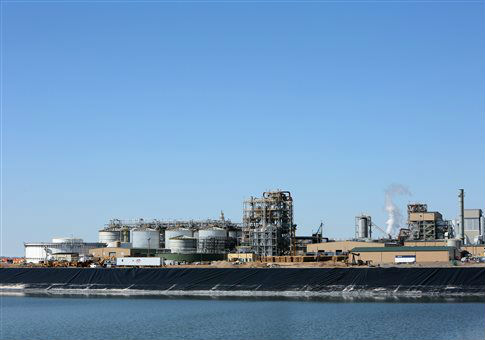
The bulk of those grants supported a bioenergy facility in Kansas, where the Energy Ernest Moniz, the secretary of energy, and Gov. Sam Brownback (R.) attended a ribbon-cutting ceremony in 2014. While they hailed the new biofuel plant, two federal agencies were reportedly investigating the company.
Both the Department of Labor and U.S. Immigration and Customs Service have been tight lipped about the investigations, but Alhalabi and other former Abengoa employees have alleged extensive violations of U.S. labor and immigration laws and the terms of their stimulus loan guarantees that required them to give priority to American job applicants.
According to Lydia Evanson, formerly the human resources director at another Abengoa subsidiary, the company routinely hired Spanish nationals to fill even menial jobs at its stimulus-funded projects.
At first she thought that the company’s executives simply did not understand the terms of its agreements with DOE or applicable laws, she told the Free Beacon last year.
“What I came to realize, and it took me a while because I didn’t want to realize it, is that they understood. They knew the law. They didn’t care,” Evanson said. “I really came to believe that they’re so politically connected that it’s just hubris and arrogance.”
Another former Abengoa employee echoed many of Evanson’s and Alhalabi’s allegations in an interview on Tuesday.
“All the office workers are from Spain, which in this environment is a lot of staff. You’re talking about hundreds and hundreds of workers,” said Moe Karrit, a former lead electric design engineer at Abener. “They hate Americans. They make fun of Americans,” he said.
He also predicted that the company would hit dire financial straits, but not before extracting as much taxpayer money as possible.
“They’re trying everything to prolong [bankruptcy] as much as they can before declaring, ‘goodbye, you pay the bill,’” Karrit said. “Nobody’s catching them right now, but it’s starting to be obvious.”
More than 20 of Abengoa’s contractors have filed complaints alleging that the company failed to pay them more than $40 million in fees, the Arizona Republic reported last year. Karrit says delaying or refusing payments to contractors is de facto company policy.
“I’ve seen contractors not getting paid for six months,” he said.
In a Wednesday email, Alhalabi backed up those allegations. “Not only it is their normal practice not to pay the invoices, but also to drag their feet hoping to settle for a fraction on the dollar,” he wrote.
Abengoa did settle in 2013 after one contractor filed a lawsuit in federal court seeking more than $317,000 that it said was never paid.
The company did not respond to a request for comment on this story.