Showing posts with label Transnationalism. Show all posts

Friday, November 15, 2019

Flight from London to Sydney breaks 2 world records

2:04 a.m.
It was a milestone decades in the making.
On Friday, a Qantas airplane loaded with 100 metric tons of jet fuel flew 11,060 miles from London to Sydney, nonstop. The journey lasted 19 hours and 19 minutes, and shattered two records, becoming the longest commercial airline passenger flight for both distance and duration, CNN reports.
The new Boeing 787-9 Dreamliner departed from Heathrow Airport at 6 a.m. Thursday morning, and flew over Germany, Russia, Poland, Belarus, Kazakhstan, China, the Philippines, and Indonesia. This was a test flight, and while the plane can hold up to 256 people, there were just 50 on board. All passengers were outfitted with monitors, and researchers from Australia's Charles Perkins Centre will study how sleep patterns, movement, and food consumption on an extremely long flight affect a person's health.
The last time Qantas attempted to fly this route without stopping, it was 1989. The airline used a Boeing 747, ripping out most of the seats and loading the plane with as much fuel as possible, even towing it to the runway in order to conserve gas, CNN reports. "Flying nonstop from the east coast of Australia to London and New York is truly the final frontier in aviation, so we're determined to do all the groundwork to get this right," Qantas CEO Alan Joyce said. Qantas is hopeful it can start offering nonstop flights from London to Sydney and vice versa in 2022. Catherine Garcia

Thursday, August 29, 2019

Sub-Saharan Africa not the made up stuff the media peddle here

Letter from Africa: Nigerian anger over South African xenophobia

  • 29 August 2019
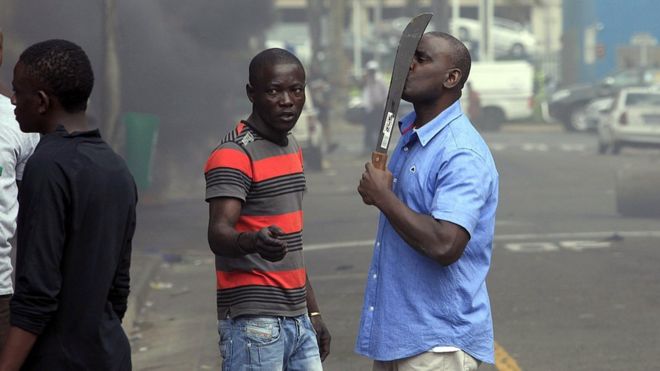
An armed man in South Africa during anti-foreigner violenceImage copyrightGETTY IMAGES
Image captionSouth Africa has been gripped by anti-foreigner violence
In our series of letters from African writers, Nigerian novelist Adaobi Tricia Nwaubani reflects on her country's souring relations with South Africa because of xenophobic attacks.
Animosity between Africa's two superpowers - Nigeria and South Africa - has heightened in recent weeks, with an influential Nigerian student body demanding that all South African-owned businesses leave the West African state. 
The National Association of Nigerian Students (Nans) - which represents university students at campuses across the country - has picketed branches of South African telecoms giant MTN, and those of supermarket chain Shoprite, turning away staff and customers. 
Those protests were sparked by the death of a Nigerian woman who was reportedly strangled in her hotel room during a visit to the South African city of Johannesburg.
Elizabeth Ndubuisi-Chukwu is just the latest Nigerian to die in South Africa in apparently violent circumstances. 

'Killings must stop'

An autopsy revealed she had died of "unnatural causes consistent with strangulation" but officials say CCTV footage showed that nobody entered her room. Police are still investigating.
The Nigerian media seem to report at least one such incident every month, with numerous news outlets using the same telling headline: "Another Nigerian killed in South Africa."

Threats, attacks and killings against foreigners in South Africa

Source: Xenowatch, African Centre for Migration & Society
While local media reports suggest that 800,000 Nigerians live in South Africa, official South African records say the number is about 30,000. It is not clear if the official data includes undocumented migrants. 
"We have faced enough... These killings must stop," said Ahmed Lawan, the head of Nigeria's legislature.
"The South African government must as a matter of urgency do whatever it takes to protect the lives and property of Nigerians living there." 
But it is unclear whether the South African government is committed to protecting Nigerians or other migrants. 
Police arrested more than 650 foreign nationals - including traders who had their goods seized - in Johannesburg earlier this month. A court ordered that 489 of them be deported within 30 days, because they were not legally in South Africa. 
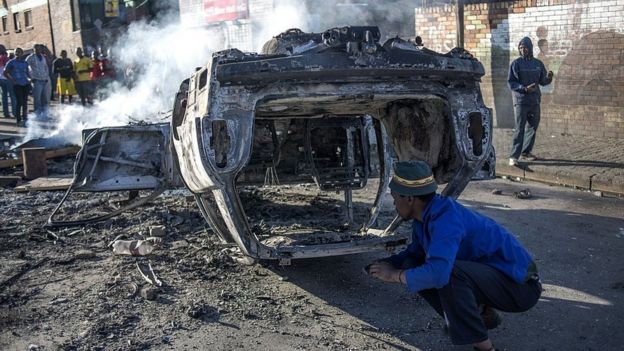
People look at a burnt-out car torched in the early hours outside the Jeppies Hostles, in the Jeppestown area of Johannesburg, on 17 April 2015Image copyrightGETTY IMAGES
Image captionSouth African officials often blame criminality, rather than xenophobia, for the violence
During a parliamentary debate, Nigerian legislators suggested that the foreign ministry should from now on issue travel alerts to Nigerians planning to visit South Africa. 
A presidential aide, Abike Dabiri-Erewa, met South Africa's Deputy High Commissioner to Nigeria, Bobby Moroe, and demanded an investigation into Mrs Ndubuisi-Chukwu's death. 
Mr Moroe was also invited to meet Mr Lawan, and he expressed the South African government's concern about the situation. 
"On behalf of the government of South Africa, we express our sincere condolences," Mr Moroe said.
BBC

Presentational white space
South Africa has a history of xenophobic attacks by black people who accuse citizens of other African countries, as well as Asian countries, of coming to steal their jobs. 
The wave of xenophobic attacks that swept South Africa in 2008 claimed at least 62 lives. Subsequent incidents, particularly in 2015, have displaced thousands of African migrants and led to the large-scale looting of their shops and other businesses. 
We hear that South Africans detest Nigerians because they believe we are criminals, are too loud, and our men steal their women. 
"They are arrogant and they don't know how to talk to people, especially Nigerians," South African protesters wrote in a petition to their ministry of home affairs during an anti-immigration march in the capital, Pretoria, in 2017. 
Nigerians, on the other hand, believe that South Africans are simply jealous of us. Of our self confidence, and our ability to thrive and outshine.
Presentational grey line
The tension between the two nations brings to mind a proverb in the Igbo language about a man who lays his pile of clothing by the riverbank while skinny dipping: A naked madman comes along, grabs the clothes and dashes away. Desperate to retrieve his clothes, the other man jumps out of the river in the nude and chases after the madman. Two naked men running through the streets - who, then, is the madman? 

Presidents to discuss crisis

Nigerians have nothing to gain by being lured into the xenophobia. While the student group's intentions may be noble, it probably has not considered the thousands of Nigerians employed by MTN, Shoprite, MultiChoice, and the many other South African companies that are household names in Nigeria. 
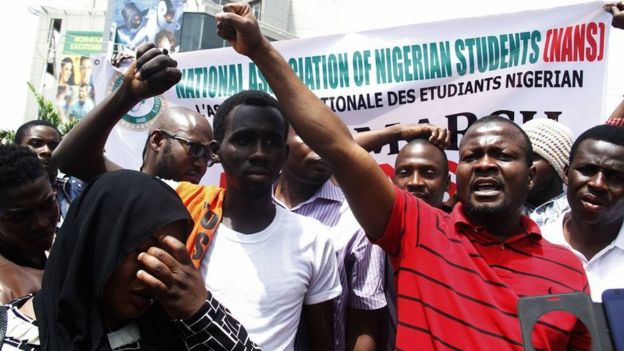
Nigerian students shout slogans against South Africa as they protest outside the South African Digital Satellite TV's (DSTV) Nigerian headquarters in Abuja against the recent spike in attacks targeting foreign nationals in South Africa on February 23, 2017Image copyrightGETTY IMAGES
Image captionNigerian students have targeted South African firms
Forcing these businesses to leave, or crippling their operations, would only worsen Nigeria's already grim unemployment statistics and the loss of the valuable services they provide would leave a vacuum.
"Please, be patient," Mrs Dabiri-Erewa told students wanting to drive out South African firms, encouraging them instead to exercise restraint while awaiting the outcome of diplomatic intervention. 
According to Nigeria's government, the leaders of the two countries are scheduled to meet in October in South Africa. 
Nigeria's President Muhammadu Buhari and his South African counterpart Cyril Ramaphosa will discuss, among others, "issues relating to the wellbeing of citizens", the government says. 
Nigerians have responded to the news with great hope - that President Buhari will use the opportunity to demand tangible measures from South Africa to deter its citizens from attacking Nigerians at will. 

Sunday, March 3, 2019

Canadian Economy Halts – GDP Growth Drops to 0.1 Percent, and No-One Is Talking About Why…

Canadian Economy Halts – GDP Growth Drops to 0.1 Percent, and No-One Is Talking About Why…

The Canadian government shocked the professional financial and economic media with their latest fourth quarter GDP release showing the economy has essentially come to a grinding halt at 0.1% growth.  [Compare to U.S. GDP growth of 3%]
The Canadian Q4 GDP growth isn’t one percent, it’s one-tenth of one percent: 0.1%, essentially halted; but everyone discussing this is missing something very important.
First, The Financial Post headline:
[FP] Canada’s economy practically came to a halt in the final three months of 2018, in a much deeper-than-expected slowdown that brings the underlying strength of the expansion into doubt.
The country’s economy grew by just 0.1 per cent in the fourth quarter, for an annualized pace of 0.4 per cent, Statistics Canada said Friday from Ottawa. That’s the worst quarterly performance in two and a half years, down from annualized 2 per cent in the third quarter and well below economist expectations for a 1 per cent annualized increase.
While a slowdown was widely expected in the final months of the year due to falling oil prices, it’s a much bleaker picture than anyone anticipated with weakness extending well beyond the energy sector. Consumption spending grew at the slowest pace in almost four years, housing fell by the most in a decade, business investment dropped sharply for a second straight quarter, and domestic demand posted its largest decline since 2015.  (read more)
The financial punditry go on to give multiple reasons for the drop and all of them are factually accurate.  However, there’s a key aspect that I cannot find discussed in any analysis of the data.
A very specific key aspect.
First, let me say CTH does not want to see the Canadian economy falter; not even a little bit.  By disposition CTH wants to see economic abundance for everyone, especially our close friends and allies.  But stand back, look at the bigger, BIG, picture, the media always avoid discussing…. you’ve got to ask yourself how can Canada be slowing down at the exact same time the USA economy is skyrocketing?…. There’s a connection.
Again, all of the currently expressed financial reasons for the slowdown are accurate; I am not disputing them. However, it’s what they are not discussing that really matters.
In the third paragraph of the FP article I highlighted a partial sentence: “business investment dropped sharply for a second straight quarter.”  That means sharp drops in business investment for Canada in the time-frame  July 2018 through December 2018.
REPORT THIS AD

Now pause, and reference the U.S. fourth quarter: “Consumer spending continued to grow solidly and, most encouragingly, business investment growth recovered sharply after a dip in the third quarter. Despite big external headwinds and financial market volatility in the fourth quarter, U.S. firms are not retrenching sharply on capex.”
Astute economic followers will note what the background is.
♦In July, August, September (Q3) of 2018 the new NAFTA negotiation was in the final stages. The U.S. and Mexico had already come to the terms; Canada was the outlier having to re-join an agreement in September where they previously abandoned negotiations.
♦On October 1st, 2018, the first day of Q4, the USMCA was unveiled. Now the U.S., Mexico and Canada were all committed.  Throughout the fourth quarter, all business interests had an opportunity to review the much anticipated USMCA outcome and details.
Multinational corporations, domestic corporations, U.S. and Canadian businesses were all looking for the same very specific detail:  What happened with the NAFTA loophole?
REPORT THIS AD

Within the new USMCA the critically important NAFTA loophole was closed.
Over the past three decades both Canada and Mexico structured key parts of their independent trade agreements to take advantage of their unique access to the U.S. market.  Under the existing NAFTA, Mexico and Canada generate billions in economic activity through exploiting the NAFTA loophole.
China, Asia (writ large), and the EU enter into trade agreements with Mexico and Canada as back-doors into the U.S. market.  So long as corporations can avoid U.S. tariffs (and rules of origin that pertain to those tariffs), by going through Canada and Mexico they would continue to exploit this approach.
By shipping parts to Mexico and/or Canada; and by deploying satellite assembly facilities in Canada and/or Mexico; China, Asia and to a lesser extent EU corporations exploited a NAFTA loophole for rules of origin on finished goods.
REPORT THIS AD

Through a process of building, assembling or partially manufacturing their products in Mexico/Canada those foreign corporations could skirt U.S. trade tariffs and direct U.S. trade agreements.  The finished foreign products entered the U.S. under NAFTA rules.
Why deal with the U.S. when you can just deal with Mexico, and use NAFTA rules to ship your product directly into the U.S. market?
This exploitative approach, a backdoor to the U.S. market, was the primary reason for massive foreign investment in Canada and Mexico; it was also the primary reason why candidate Donald Trump, now President Donald Trump, wanted to shut down that loophole and renegotiate NAFTA.
At the conclusion of Round #6, just before giving up on Chrystia Freeland for good, this was the direct issue at the heart of a very frustrated U.S.T.R. Lighthizer’s strongly worded response to Canada:
[…]  In another proposal, Canada reserved the right to treat the United States and Mexico even worse than other countries if they enter into future agreements. Those other countries may, in fact, even include China, if there is an agreement between China and [Canada]. This proposal, I think if the United States had made it, would be dubbed a “poison pill.” We did not make it, though. Obviously, this is unacceptable to us, and my guess is it is to the Mexican side also. (read full remarks)
This loophole was the primary reason U.S. manufacturers relocated operations to Mexico.  Corporations within the U.S. Auto-Sector could enhance profits by building in Mexico or Canada using cheap parts imported from Asia/China.  The labor factor was not as big a part of the overall cost consideration as cheaper machined parts and imported raw materials.
If the U.S. applied the same tariffs to Canada and Mexico we apply to all trade nations, then the benefit of using Canada and Mexico -by those trade nations- is lost.
Corporations will no longer have any advantage, and many are likely to just deal directly with the U.S. This was the reason Trump, Lighthizer and Ross to retained Steel and Aluminum tariffs on Canada and Mexico until they agreed to the new USMCA rules.
REPORT THIS AD

When Trump took away the flawed NAFTA market access; and when Trump removed the ability of Mexico and Canada to broker themselves for economic benefit; there was no longer a financial benefit behind corporations investing in Canada.  Under a binding trade pact between the USMCA partners, the NAFTA flaw is closed.
As a direct outcome billions of investment dollars are now being removed from any future consideration into Canada.
That’s the overarching reason for the Canadian GDP to halt.
Here’s the proverbial $64,000 question:  Can Canada re-engineer their economy and actually begin to “make” products again, not just simply “assemble” foreign products from other nations?
  • Can Canada reverse three-decades of specifically structured economic policy decisions that were centered around this “assembly” (brokered) economy?
  • Can the environmentalists be put back into a box while heavy manufacturing and raw material development are reconstituted?
  • Can the environmentalists allow natural resource development?  Oil development, mining operations, lowered overall energy costs, etc?
  • Can Canada somehow lower national energy costs so that Heavy manufacturing might consider restarting? (NOTE: heavy manufacturing requires massive energy use.)
  • Can Canada find any industrial development investors who would be willing to take a chance on all the above?
See the problem?
The Canadian economy is not likely going to get better without a radical shift in Canadian political perspectives and outlook(s).
Then again, perhaps that’s really why Justin and Chrystia were so damned set on protecting their “cultural industries” (ie. media) from competition.
Think about it.

Sunday, May 13, 2018

Clarice The 'Election Collusion' Was between Our Intelligence Community and Britain

The 'Election Collusion' Was between Our Intelligence Community and Britain


As I will explain, the widespread notion that Russia and Trump colluded to beat Hillary has long been demonstrable bunk. What seems more clear each day is that there was collusion between certain members of the U.S. and British intelligence communities to spy on the Trump campaign. This may explain, in large part, the reluctance of the Department of Justice to reveal what it knows publicly. After all -- with rare exceptions -- the two countries’ intelligence services have long had important information gathering and sharing agreements, and exposure of this may harm the traditional reciprocal relationship. 
Whether the British counterparts were hoodwinked into playing this role is still unclear. Maybe they were. On the other hand, with most of what they know about the U.S. electorate doubtless coming from the NYT and even more left-wing British media, they may well have done this willingly, believing the globalist Hillary had a sure shot at the presidency and this was a means of cementing a relationship with her.

Key Developments This Week
Congressman Devin Nunes, chairman of the House Intelligence Committee, has been stonewalled by the Department of Justice respecting the details of the originating Electronic Communication (EC) on July 31, 2016, which formed the basis of the commencement of the FBI counterintelligence investigation into the Trump campaign. In particular, he wanted to know the identity of the person whose name had been redacted on what has been described as an FBI/DOJ source “a U.S. Citizen who has provided intelligence to the CIA and FBI”. The DOJ replied that revealing the source “might damage international relationships.” Failing to get a response, Nunes threatened to hold the attorney general in contempt of Congress and the DoJ offered a private meeting. At this meeting they were denied an opportunity to view the relevant documents, but Greg Jarrett reports they will get to see them next week:
Jarrett: Our top story, the corrupt DOJ Leaderships is still stonewalling Congress about a potential Bombshell revelation -- the identity of an FBI Mole within the Trump Campaign. House Intelligence Committee members Devin Nunes and Trey Gowdy will have to wait until next week to get a direct look at the very documents related to the Russia Probe.
At about the time the meeting took place, Kimberley Strassel of the Wall Street Journal dropped a bombshell, making public what we long suspected.
The bureau already has some explaining to do. Thanks to the Washington Post’s unnamed law-enforcement leakers, we know Mr. Nunes’s request deals with a “top secret intelligence source” of the FBI and CIA, who is a U.S. citizen and who was involved in the Russia collusion probe. When government agencies refer to sources, they mean people who appear to be average citizens but use their profession or contacts to spy for the agency. Ergo, we might take this to mean that the FBI secretly had a person on the payroll who used his or her non-FBI credentials to interact in some capacity with the Trump campaign.
This would amount to spying, and it is hugely disconcerting. It would also be a major escalation from the electronic surveillance we already knew about, which was bad enough. (snip)
And to the point, when precisely was this human source operating? Because if it was prior to that infamous Papadopoulos tip, then the FBI isn’t being straight. It would mean the bureau was spying on the Trump campaign prior to that moment. And that in turn would mean that the FBI had been spurred to act on the basis of something other than a junior campaign aide’s loose lips.
We also know that among the Justice Department’s stated reasons for not complying with the Nunes subpoena was its worry that to do so might damage international relationships. This suggests the “source” may be overseas, have ties to foreign intelligence, or both. That’s notable, given the highly suspicious role foreigners have played in this escapade. It was an Australian diplomat who reported the Papadopoulos conversation. Dossier author Christopher Steele is British, used to work for MI6, and retains ties to that spy agency as well as to a network of former spooks. It was a former British diplomat who tipped off Sen. John McCain to the dossier. How this “top secret” source fits into this puzzle could matter deeply.
But what is clear is that we’ve barely scratched the surface of the FBI’s 2016 behavior, and the country will never get the straight story until President Trump moves to declassify everything possible. It’s time to rip off the band-aid.
British Involvement in Electronic Spying on the Trump Campaign
The fingerprints are already clear on this, In January 2017 the NYT reported that Trump associates’ communications had been intercepted abroad and passed on to its U.S. counterparts. Shortly afterward, Robert Hannigan, director of Britain’s GCHQ (its national security center) abruptly resigned after serving in that position for just three years. CGHQ intercepts communications at the request of the CIA and sends it the CIA as if this were their own undertaking.


British Involvement in Human Intelligence Gathering on the Trump Campaign
In January, Glenn Simpson, head of GPS Fusion, Hillary’s spy operation on Trump, told investigators that in September 2016, Christopher Steele, author of the discredited dossier, had  been informed by the FBI that it had “a human source inside the Trump organization." 
On the assumption that this is true, the Internet has been examining who it might be.
Carter Page came to many minds, but it’s hard to see how revealing his identity would “damage international relationships.” Moreover, the FISA warrant on him seems to have violated internal regulations and the FISA itself.
He has long been known to have been an FBI informant, and may as well have informed for the CIA. Mark Wauck, a former FBI agent with experience in such matters, writes me:
If Carter Page is the informant whose info helps Rosenstein justify the [Special Counsel], then at one and probably more than one point the FBI was misrepresenting Page to the FISC and was putting untruths in its own files about Page and was providing untruths in Page's name to DoJ to justify the SC.
It's like keeping a double set of books.
In one set of files, classified as 65 (espionage) the FBI says Carter Page is a Russian spy and they go to the FISC and ask for a FISA on that basis. The EC that opens the investigation spells it out: he's a Russian guy and we can't trust him.
In a second set of files classified as 134 (CI asset) the FBI says Carter Page is a good guy who's working for us and he's giving us super valuable and reliable info re the Russians subverting our election and maybe that Trump is Putin's guy. So in this set of files Page isn't a spy at all, we've done the background and we trust him and his info. Which must mean that the 65 files are a pack of lies.
So if Carter Page is the guy that must mean that the FBI was cooking the books. This is only possible if a bunch of people near the top are in on the deception, but the admin people lower down don't know -- which is how the FBI file system works. The admin people handling 134s won't see the 65 files, and vice versa. And what we may find is that the 134 files were filled with creative writing.
I know this sounds complicated, but trust me on this -- if Carter Page is the guy the FBI/DoJ is trying to hide from Nunes, then the FBI was keeping a double set of books, and probably totally cooking the books. And that means there could only one reason for that: to get Trump. If this is what was going on, people should be going to jail.
The most likely prospect was not in the Trump campaign itself, but someone who worked with U.S. and apparently British intelligence, with a record of trying to spy on lowly campaign workers and even trick them into compromising actions, a U.S. citizen with strong ties to British intelligence who lived in the U.K.: Stefan Halper, a former advisor to three Republican presidents (and therefore, had perfect cover), a Cambridge Fellow, who, as we detail, interacted with various Trump campaign workers ostensibly to assist them. On November 3, 2016, he publicly stated that Hillary would be the best option for U.S.-U.K. relations. It’s reasonable to assume, therefore, that the “help” was not for the Trump campaign, but for Hillary
"I believe [Hillary] Clinton would be best for US-UK relations and for relations with the European Union. Clinton is well-known, deeply experienced and predictable. US-UK relations will remain steady regardless of the winner although Clinton will be less disruptive over time," Halper, who served as deputy assistant secretary of state for political-military affairs and senior adviser to the Department of Defense and the Department of Justice, said.
Here’s how Halper “helped” the Trump campaign from publicly available information:
  • On July 16, 2016 he invited Carter Page to a Cambridge symposium 
  • On September 11, 2016 he met with a senior Trump official 
  • On September 13-16 he met with Papadopoulos.
Halper is a close associate of former MI6 head Richard Dearlove, who in a recent video interview, cagily refused to acknowledge the veracity of the Steele dossier.
It was previously reported that Halper had conducted a data-gathering operation to collect inside information on Jimmy Carter’s foreign policy during the 1980 campaign, a charge he strongly denied. But if that charge were true, he certainly had experience in such things.
If Halper was not a person we’d consider a mole in the campaign, as he never was actually part of the campaign team -- just someone trying to fish for dirt (or lure people like Page and Papadopoulos into some compromising acts) -- why the weasel description in the report Nunes is examining?
Mark Wauck agrees with my take:  "The advantage for the FBI would be that they could represent that they had a human source (Halper) with a decades-long track record of supposed reliability who could confirm the dossier because he was in personal contact with Page (Papadopoulos wasn't part of the dossier, as I recall). At the same time their internal files would be 'administratively pure.' That 'confirmation' from Halper could be used by the FBI to support the dossier and 1) get a Full CI investigation on Page and 2) then get the FISA for that Full CI investigation (Halper could claim knowledge of clandestine contacts, etc.). It's pretty obvious why the FBI/DoJ would not want these details coming out, because they would not want Halper being required to testify to Congress or to the IG, etc.”
In the same sense, the Clinton-supporting IC officials likely used whatever British intelligence services they could to disguise what was really CIA spying on Trump. It also seems obvious that this coordination was not spontaneous, but was well-planned beforehand.
Australia’s officials seem to have gotten into the game though in a more peripheral way through Australia’s High Commissioner to Britain, Alexander Downer, with long-standing ties to Hillary Clinton. At least one other peripheral character, Josef Mifsud, a Maltese-based professor living in London who interacted with Papadopoulos in March of 2016, seems to have been involved. 
But the key figure seems to be Halper and the reasons why he is so artfully described in the redacted EC seem beyond doubt.
We’re still waiting for the long-delayed OIG report to land, but in the meantime, in closed session on May 16, the Senate Intelligence Committee will question the authors of the January 2017 intelligence report, which claimed that Russia acted to help Trump. In the witness chairs: former Director of National Intelligence James Clapper, former CIA Director John Brennan, former National Administration director Admiral Mike Rogers. Also invited -- James Comey, former head of the FBI. Not on the list is Halper, but as a U.S. citizen, he ought to be subject to Congressional interrogation.
Things seem to be coming to a head. In the meantime, another pratfall for the Mueller $10-million-dollar team: They indicted a Russian company that wasn’t in existence at the time of the alleged criminal activity. AsScott Johnson of Powerline, quipped, "Mueller indicts a ham sandwich."