Sunday, December 8, 2024

iThe despicable Fans Willis

Judicial Watch: Court Finds Fani Willis in Default in Open Records Lawsuit, Orders Her to Produce Records in Five Business Days

https://www.judicialwatch.org/fani-willis-in-default/?utm_source=deployer&utm_medium=email&utm_content=&utm_campaign=weekend+playback&utm_term=members
(Washington, DC) – Judicial Watch announced today that the Superior Court in Fulton County entered an order granting a motion for default judgment against District Attorney Fani Willis in Judicial Watch’s lawsuit for communications Willis had with Special Counsel Jack Smith and the House January 6 Committee. In doing so, the court grants Judicial Watch’s request for attorneys’ fees and orders Willis to search for and provide releasable records to Judicial Watch within five business days. 

The March 2024 lawsuit was filed in the Superior Court of Fulton County, GA, after Willis and the county denied having any records responsive to an August 2023 Georgia Open Records Act (ORA) request for communications with the Special Counsel’s office and/or the January 6 Committee (Judicial Watch Inc. v. Fani Willis et al. (No. 24-CV-002805)).

In its lawsuit Judicial Watch stated that Willis’ “representation about not having records responsive to the request is likely false.” Judicial Watch referred to a December 5, 2023, letter from House Judiciary Committee Chairman Jim Jordan to Willis that cites a December 2021 letter from Willis to then-House January 6 Committee Chairman Bennie Thompson (D-MS). In that letter Willis requested assistance from the committee and offered to travel to DC. 

In May 2024, Judicial Watch asked the court to declare a default judgment, noting that Willis was served with the lawsuit in March 2024 and had “not filed an answer,” which “was due 30 days after service.”

The recently issued default judgment states: “The Court finds Defendant [Willis, in her official capacity] is in default and has been since 11 April 2024.” Further, Willis “never moved to open default on any basis (not even during the period when she could have opened default as a matter of right), she never paid costs, and she never offered up a meritorious defense.”

Plaintiff is thus entitled to judgment by default as if every item and paragraph of the complaint were supported by proper and sufficient evidence. O.C.G.A. § 9-11-55(a). Here, this means Plaintiff has established that Defendant violated the ORA by failing to either turn over responsive records or else notify Plaintiff of her decision to withhold some or all such records.

In its complaint, Plaintiff sought the following relief:

 1) a declaration that Defendant has violated the ORA;

2) an order for Defendant to search for all records responsive to Plaintiff’s request without further delay;

3) an injunction ordering Defendant to cease withholding non-exempt public records responsive to the request;

4) an award of attorney’s fees and costs pursuant to O.C.G.A. § 50-18-73(b);

5) a writ of mandamus, ordering Defendant to provide the requested records; and

6) any other relief the Court deems proper. 

By finding Defendant in default, the Court has in effect declared that she has violated the ORA. The Court also hereby ORDERS Defendant to conduct a diligent search of her records for responsive materials within five business days of the entry of this Order. Within that same five day period, Defendant is ORDERED to provide Plaintiff with copies of all responsive records that are not legally exempted or excepted from disclosure. If Defendant is required or decides to withhold all or part of a requested record, she should follow the procedures set forth in the ORA (see O.C.G.A. § 50-18-71(d)). If the records are stored electronically, they may be produced electronically in a commonly used format such as PDF. The Court expects that such production will include the correspondence identified by Plaintiff in its complaint. If it does not, Defendant is further ORDERED to provide an explanation why such correspondence does not exist in Defendant’s records (or why it is being withheld). Beyond that, no other relief, injunctive or otherwise, is necessary at this time (to include striking Defendant’s answer, which is of no effect based on the Court’s finding of default). 

The court set a hearing on the Judicial Watch’s attorneys fees award for December 20.

“Fani Willis is something else. We’ve been doing this work for 30 years, and this is the first time in our experience a government official has been found in default for not showing up in court to answer an open records lawsuit.,” Judicial Watch President Tom Fitton said. “Judicial Watch looks forward to getting any documents from the Fani Willis operation about collusion with the Biden administration and Nancy Pelosi’s Congress on her unprecedented and compromised ‘get-Trump’ prosecution.”

Judicial Watch is assisted in the case by John Monroe of John Monroe Law in Georgia.

Judicial Watch has several Freedom of Information Act (FOIA) lawsuits related to the prosecutorial abuse targeting Trump:

 In February 2024, the U.S. Department of Justice asked a federal court to allow the agency to keep secret the names of top staffers working in Special Counsel Jack Smith’s office that is targeting former President Donald Trump and other Americans.

(Before his appointment to investigate and prosecute Trump, Specia Counsel Jack Smith previously was at the center of several controversial issues, the IRS scandal among them. In 2014, a Judicial Watch investigation revealed that top IRS officials had been in communication with Jack Smith’s then-Public Integrity Section about a plan to launch criminal investigations into conservative tax-exempt groups. Read more here.)

In January 2024, Judicial Watch filed lawsuit against Fulton County, Georgia, for records regarding the hiring of Nathan Wade as a special prosecutor by District Attorney Fani Willis. Wade was hired to pursue unprecedented criminal investigations and prosecutions against former President Trump and others over the 2020 election disputes.

In October 2023, Judicial Watch sued the DOJ for records and communications between the Office of U.S. Special Counsel Jack Smith and the Fulton County, Georgia, District Attorney’s office regarding requests/receipt of federal funding/assistance in the investigation of former President Trump and his 18 codefendants in the Fulton County indictment of August 14, 2023. To date, the DOJ is refusing to confirm or deny the existence of records, claiming that to do so would interfere with enforcement proceedings. Judicial Watch’s litigation challenging this is continuing.

Through the New York Freedom of Information Law, in July 2023, Judicial Watch received the engagement letter showing New York County District Attorney Alvin L. Bragg paid $900 per hour for partners and $500 per hour for associates to the Gibson, Dunn & Crutcher law firm for the purpose of suing Rep. Jim Jordan (R-OH) in an effort to shut down the House Judiciary Committee’s oversight investigation into Bragg’s unprecedented indictment of former President Donald Trump.

In his new book Rights and Freedoms in Peril Judicial Watch President Tom Fitton details a long chain of abuses officials and politicians have made against the American people and calls readers to battle for “the soul and survival of America.”


When the military gets political

Judicial Watch Sues Justice Dept. for Details of Meeting Between Milley and Garland about President Trump

(Washington, DC) – Judicial Watch announced today that it filed a Freedom of Information Act (FOIA) lawsuit against the U.S. Department of Justice for details of a reported meeting between Attorney General Merrick Garland and Joint Chiefs of Staff Chairman General Mark A. Milley in which they discussed President Trump and during which General Milley pressured Garland to target American “far right” militia movements (Judicial Watch Inc. v. U.S. Department of Justice (No. 1:24-cv-03380)).

Judicial Watch sued after the Justice Department failed to respond to an October 15, 2024, FOIA request for:

Records and communications including emails, email chains, email attachments, text message meeting minutes, outlook calendars, voice recordings, video recordings, correspondence, statements, letters, memoranda, letters, reports, briefings, cables, presentations, notes, or other form of record, regarding a meeting between Merrick Garland, Attorney General, DOJ, and General Mark Alexander Milley, former, Chairman of the Joint Chiefs of Staff, concerning:

(1) President or former President Donald J. Trump

(2) Domestic Violent Extremism

(3) Far-right Militia Movements. 

The request asked that records be provided for the period “from January 7, 2021, to present.”

In his recent book, journalist Bob Woodward wrote that in early 2021 Garland and Milley met for lunch at the Department of Justice. They discussed then-former President Donald J. Trump, and Chairman Milley pressed the attorney general to investigate domestic threats and “far-right militia groups.” Woodward described the meeting as “highly unusual, if not unprecedented.” 

“General Milley and Garland’s reported meeting about targeting President Trump and other American citizens further demonstrates the Biden administration was and is at odds with the foundational principles of our constitutional republic,” Judicial Watch President Tom Fitton said. “And that the Justice Department would flout FOIA law to hide the details of this conspiracy meeting speaks volumes about its contempt for the rule of law.”   


https://www.judicialwatch.org/meeting-milley-and-garland/?utm_source=deployer&utm_medium=email&utm_content=&utm_campaign=weekend+playback&utm_term=members

Paul Krugman Rides Into The Sunset...with a legacy of being wrong on so much

Paul Krugman Rides Into The Sunset

Tyler Durden's Photo
BY TYLER DURDEN
SATURDAY, DEC 07, 2024 - 03:40 PM

Authored by William Andersen via The Mises Institute,

After spending 25 years as a columnist for the New York Times, Paul Krugman is finally retiring from that position - 25 years too late, if one wishes to be honest. It is hard to measure the influence he had from that perch, but his columns surely were the deciding factor in his winning the Nobel in economics in 2008 after eight years of lambasting the George W. Bush administration.

[ZH: Yes, we know that isn't a picture of Krugman, but it always makes us laugh...]

(His Nobel Prize was given, ostensibly, for “his work in economic geography and in identifying international trade patterns,” but one should have no doubt that, without having the power and influence of the New York Times behind him, it is doubtful that the Nobel Committee would even have known of his existence. I weighed in on the Nobel selection in a column in Forbes, hastily-written during a short break between classes I was teaching at Frostburg State University.)

Not surprisingly, the response from his peers is hagiographic. Kathleen Kingsbury, quoting from Krugman’s first column, declares:

That lede and the column were signature Krugman: The authoritative voice. The lively writing. The direct style. The clear hand guiding readers through a thicket of policy, data and trade-offs. The big ideas — in that column, they were about the First Global Economy and the Second Global Economy and how the interplay of political and economic questions would shape life worldwide in the 21st century. In little time, Paul became an essential read in Opinion, helping countless readers become more fluent in and mindful of how trade, taxes, technology, the markets, labor and capital intersected with political leadership, ideology and partisanship to shape the lives of people across America and the world.

Indeed, Krugman has been influential, but his influence hasn’t been a good thing. He is a disciple of John Maynard Keynes and has played an important role in legitimizing the application of Keynesian schemes by governments to “stimulate” their economies. Those governments were unsuccessful, Krugman claimed, because they had failed to inflate their economies enough to break out of the Keynesian “liquidity trap,” an imaginary state of affairs that Murray N. Rothbard fully debunked.

Krugman even resorted to fantasy in his quest to fight the mighty “liquidity trap,” claiming that if the US were to prepare for a never-to-come alien invasion, the burst of government spending would revitalize the economy. That nonsense alone should have discredited him as a serious economist, but instead cemented his status as the great advocate for the Keynesian trope that government spending is the key to economic prosperity.

To his credit, Krugman did condemn the tariffs proposed by President-elect Donald Trump, but the truth is that he never has truly understood economics from the praxeological vantage point, nor has he ever been interested in seeing economics in that way. An economy, to Krugman, is a series of aggregates—consisting of homogeneous labor, natural resources, and capital—all to be manipulated by government agencies and central banks. The idea that demand springs from what we produce in a market economy was anathema to Krugman, who hated that economic doctrine so much that he referred to Jean-Baptiste Say as a “cockroach.”

Given Krugman’s inability to understand the basics of economic logic, perhaps it isn’t surprising that he made the wild prediction: “By 2005 or so, it will become clear that the Internet’s impact on the economy has been no greater than the fax machine’s.” Someone who cannot understand how production of goods drives demand for other goods most likely isn’t going to comprehend how improving pathways for information will also improve commerce.

Krugman was just as uncharitable to the Austrians as he was toward Say—although he never really understood Austrian economics and, to be honest, was happy to remain in blissful ignorance. He referred to the Austrian Business Cycle Theory wrongly as “The Hangover Theory,” turning a well-developed theory that meticulously explains the processes of booms and busts and reducing it to a morality play. He wrote:

A few weeks ago, a journalist devoted a substantial part of a profile of yours truly to my failure to pay due attention to the “Austrian theory” of the business cycle—a theory that I regard as being about as worthy of serious study as the phlogiston theory of fire. Oh well. But the incident set me thinking—not so much about that particular theory as about the general worldview behind it. Call it the overinvestment theory of recessions, or “liquidationism,” or just call it the “hangover theory.” It is the idea that slumps are the price we pay for booms, that the suffering the economy experiences during a recession is a necessary punishment for the excesses of the previous expansion.

The hangover theory is perversely seductive—not because it offers an easy way out, but because it doesn’t. It turns the wiggles on our charts into a morality play, a tale of hubris and downfall. And it offers adherents the special pleasure of dispensing painful advice with a clear conscience, secure in the belief that they are not heartless but merely practicing tough love. Powerful as these seductions may be, they must be resisted—for the hangover theory is disastrously wrongheaded. Recessions are not necessary consequences of booms. They can and should be fought, not with austerity but with liberality—with policies that encourage people to spend more, not less.

In other words, government spending on wars was just as economically useful as spending money on new capital and research that increases crop yields because, after all, someone is spending money. To Krugman, an economy is a purely circular thing in which we produce something to put on the shelves and spending is the process by which we remove the goods from the shelves so we can produce something else to put on the shelves—and so on.

It is not surprising that regime-minded elites worshiped his every declaration. Governments were not spending too much money; they were spending too little! Those who print money hand-over-fist, who intervene in the markets to direct resources to politically-favored winners are the real public benefactors. Those who question the wisdom of untrammeled government spending are the true enemies of the people.

At a Southern Economic Association meeting in 2004, I asked Krugman if he was endorsing the 70 percent tax rates that existed before 1981. “No,” he replied emphatically, “Those rates were insane!” When Rep. Alexandria Ocasio-Cortez called for the return of 70 percent marginal rates in 2019, Krugman said he believed those rates were “reasonable.” No doubt, he would attribute that change of heart to personal “growth” or just an evolutionary change in his thinking.

In truth, believing in an all-powerful state that can, in Keynes’ own words, turn “stones into bread” through the magic of spending and creation of new credit does not require personal growth or maturity. Instead, it reflects a mind that prefers fantasy over reality, lies over truth. Paul Krugman can retire peacefully, knowing that he has sanitized the use of raw state power in place of mutually-beneficial exchange that characterizes the marketplace.


Who knew?


Guinea Is The Deadliest Place In The World To Drive (Worse Than Libya!)

Tyler Durden's Photo
BY TYLER DURDEN
SUNDAY, DEC 08, 2024 - 05:45 AM

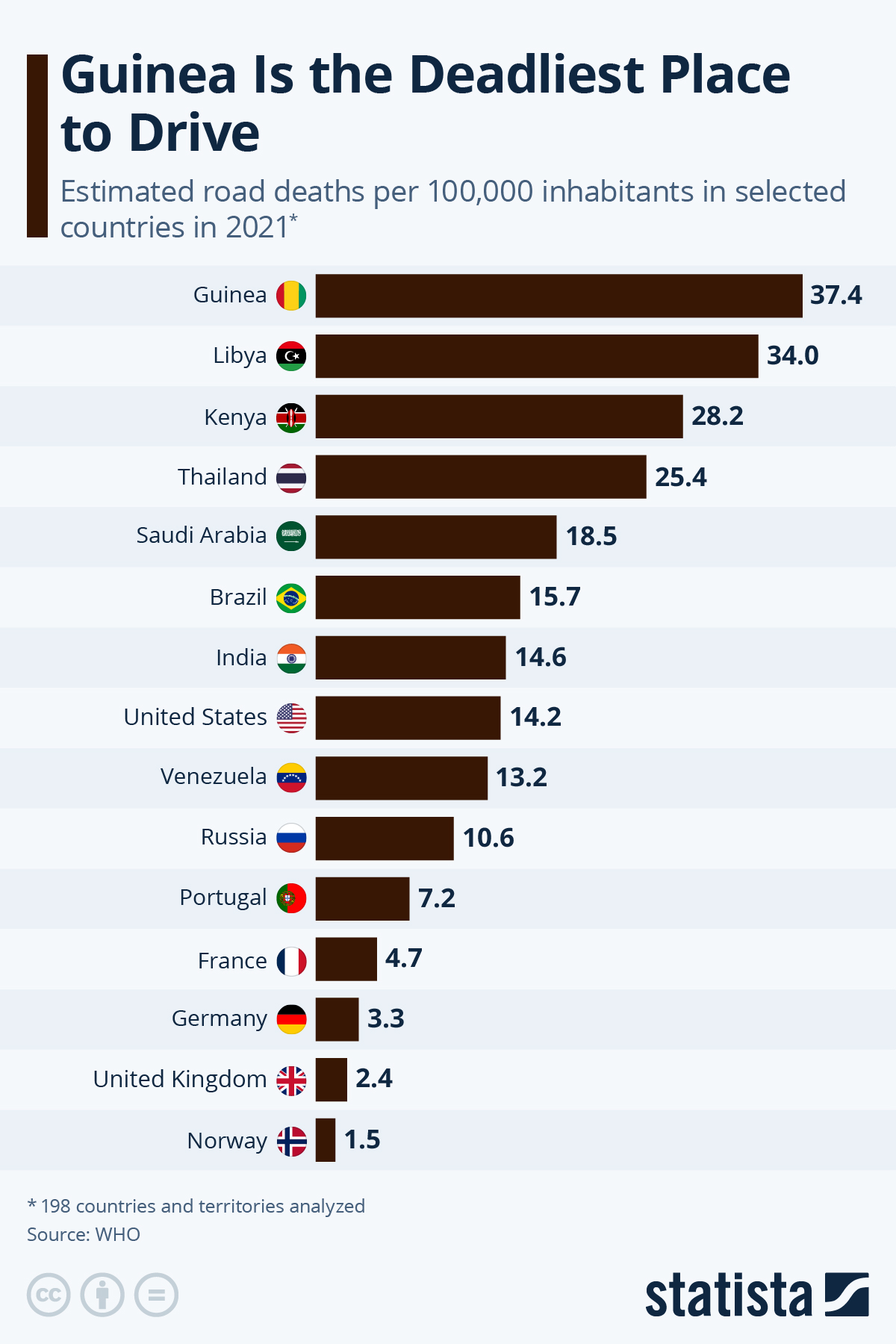
According to the World Health Organisation (WHO), an estimated 1.19 million people die in road accidents around the world each year. The United Nations General Assembly has set the target of halving this number by 2030.

Road traffic injuries have become the leading cause of death for people aged between 5 and 29 years old. According to the WHO, more than half of all road traffic deaths are of pedestrians, cyclists, and motorcyclists.

As Statista's Anna Fleck shows in the chart below, road safety (or lack of) is a global issue. But in some places, road deaths are more likely than others, with as many as nine in ten road traffic deaths occurring in low- and middle-income countries.

Infographic: Guinea is the World's Deadliest Place to Drive | Statista

You will find more infographics at Statista

According to the World Bank this is partly a result of "rising incomes in many developing countries have led to more motor vehicles and greater traffic volumes, but road safety management capacity, road infrastructure and enforcement of traffic safety regulations have not kept pace.”

Of 197 countries and territories analyzed in the WHO database, the West African nation of Guinea had the highest number of deaths per capita in 2021, when the most recent data was analyzed, at 37 per 100,000 inhabitants.

It is followed by Libya (34 deaths per 100,000) and Haiti (31 deaths per 100,000). 

Although not fully illustrated here, Africa is the world region with the highest death rates, with 12 out of the top 20 countries listed as the most fatal countries worldwide for road deaths.

The United States comes in rank 79 with approximately 14 people killed from road accidents per 100,000 population in 2021.


A tragedy in the Netherlands: Drug gangs?

Netherlands: Several killed in explosion in The Hague 

21 hours ago

An apartment complex in The Hague collapsed Saturday after a massive deadly explosion and fire. At least five houses were destroyed. Search and rescue operations are ongoing.

How Alvin Bragg's office encourages anti Semitism

Unhinged man dubbed ‘MackNazi’ terrorizing NYC, ripping down Israeli hostage posters


In November 2023, he shoved Joseph Goodrich, 32, to the ground, punched him and dislocated his shoulder — after Goodrich tried to stop the anti-Israel radical from tearing down hostage posters, according to a criminal complaint and the victim’s lawyer, Peter Gordon.

Watson was charged with assault, but soft-on-crime Manhattan District Attorney Alvin Bragg’s office gave him a slap on the wrist, allowing him in June to plea bargain to a conditional discharge on a lesser charge of second-degree harassment if Watson completed anger management courses and kept out of trouble for a year.