Showing posts with label Foreign Policy. Show all posts

Saturday, August 22, 2020

John Kerry’s just mad that Trump’s foreign policy is working far better than his

John Kerry’s just mad that Trump’s foreign policy is working far better than his


It took approximately 20 seconds for former Secretary of State John Kerry to drop the first flagrant lie in his Democratic National Convention speech, when he claimed that the Obama administration’s so-called Iran deal had “eliminated the threat of an Iran with a nuclear weapon.” It didn’t get any better from there.

Kerry knows well that sunset provisions in the Joint Comprehensive Plan of Action provided Iran’s government with a pathway to building nuclear weapons in a few years. He knows well that Israel uncovered a giant cache of documents with instructions on how to jumpstart a program to build a nuclear arsenal, which undermined both the spirit and the rationale of the nonproliferation agreement Iran signed. He knows that Iran was developing ballistic-missile programs.

Kerry’s big accomplishment was to destroy a sanctions program that was working, thereby saving the Islamic Republic from economic ruin. This allowed the Islamist government to strengthen its proxies in Syria, Lebanon, the Palestinian territories, Yemen and Iraq.

Now Kerry says Trump “doesn’t know how to defend the troops”? Well, I’m not sure that the man who oversaw the billions in direct cash payments to a government that had a hand in murdering and maiming hundreds of American troops has the moral authority to level that criticism.

Kerry himself acknowledged that sanctions relief would likely end up in the coffers of Iran’s Revolutionary Guard — now a designated terror group.

Surely, then, he knew that the pallets of euros and Swiss francs he was shipping to Tehran in an unmarked cargo plane would also find their way to the groups triggering conflicts across the Middle East — not to mention subjugating people at home.

While many argued for a maximum-pressure campaign against the Islamic Republic, Kerry preferred the no-pressure route. The Iran deal, in fact, often seemed to be the Obama administration’s top obsession. Nothing would stand in the way. And while the media echo chamber was misleading the public at home, Kerry was placating Russia and allowing a humanitarian disaster to unfold in Syria in an effort to save the deal.

Around the time the Obama administration was chasing an Iran deal, the Syrian government, backed by the Islamic Republic, was crossing the president’s “red line” and gassing civilians. Even when the United States began funding rebel forces in Syria, the administration reportedly wouldn’t allow Iran’s ally to be touched.

When pressed on the matter by some Syrian civil-society workers in London, then-Secretary Kerry snapped, “What do you want me to do, go to war with Russia?” Obama officials — led by Kerry — long peddled this false choice: the Iran deal or war. Well, we are no longer a party to the Iran deal, and there is no war.

–– ADVERTISEMENT ––

Kerry would continue to entertain Iranian officials even after he was out of government. When Trump ordered a drone strike on terrorist Qassem Soleimani, a man who masterminded the killing of American soldiers and thousands of Iraqi civilians, Kerry said the world was in “no way at all” safer and claimed that Trump was risking an “outright war.”

Kerry was wrong about Iran. Kerry was also wrong about Israel. When the US embassy was about to be moved to Jerusalem, Kerry warned it would lead to “an explosion” in the Middle East — more specifically, “an absolute explosion in the region, not just in the West Bank and perhaps even in Israel itself, but throughout the region.”

Moreover, Kerry declared, it would have serious and negative repercussions on relations between Israel and the Arab world, making peace far less likely.

Of course, outside of some typical Palestinian noise, the opposite has happened. Only recently, Israel and the United Arab Emirates agreed to a historic deal that normalized relationsbetween them. Other Arab Gulf states are expected to join the UAE, though it is well-known that many of them already have clandestine working relationships with Israel.

This week, Sudan, the third-largest Arab nation, announced it was close to reaching its own peace deal with the Jewish state.

All of this seems pretty significant. It would surely have been massive news if the Obama administration had helped forge the pacts. Right now, though, Obama has one more Nobel Prize than he does a peace agreement.

And time keeps proving John Kerry wrong.

Sunday, August 11, 2019

The legacy of Hillary and Obama's Libya policy...."we came, we saw, he died"


The expanding chaos of the renewed war in Libya, increasingly a 'failed state' if there ever was a prime example of one, now approaching a decade on from its so-called "liberation" in 2011 by US-NATO forces, keeps providing daily and weekly reminders of the Obama-Hillary Clinton legacy of 'humanitarian intervention'. 
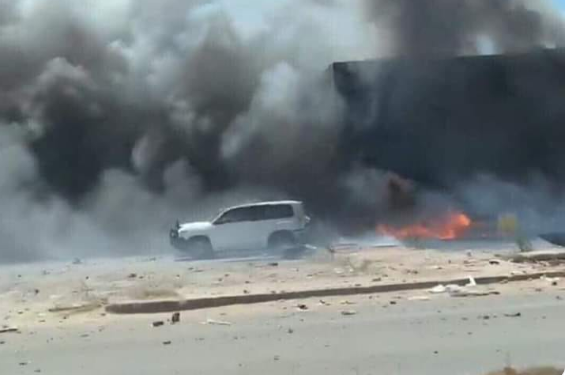
On Saturday what is being reported as either a car bomb or possibly a roadside bomb ripped through a neighborhood in the eastern Libyan city of Benghazi near United Nations offices.
The blast killed two UN staff, identified as United Nations Libya mission (UNSMIL) guards, with an additional ten people wounded, some among them children, according to Reuters.
The vehicle was detonated outside a busy shopping mall at a peak time of traffic, given locals are preparing to celebrate the Muslim holiday of Eid al-Adha.
The Associated Press reported the following details:
The place is close to the offices of the U.N. Support Mission in Libya. Footage circulated online shows what appear to be burnt U.N.-owned vehicles, while thick smoke rising in the sky.

Thursday, June 7, 2018

Lebanon armed forces gets mIlitary aid from the US...another classic deep state blunder


Congress Forces Pentagon to Come Clean on Aid to Lebanon

What is the U.S. getting in exchange? Apparently not a safeguard against Hezbollah.
12
The relationship between Hezbollah and Lebanon’s military remains murky. Source: AFP, via Getty Images
Last month, following the first Lebanese elections since 2009, Israel's defense minister made a grave observation. Speaking at an annual conference in Herzliya, Avigdor Lieberman said that Hezbollah – the Iran-backed militia, political party and terror group – had effectively taken control of the state.
To emphasize the point, Lieberman added that Hezbollah was now "in complete control not just of the Lebanese [government], but also its army." 
Hezbollah's influence in Lebanon is nothing new. It has steadily enhanced its position and legitimacy inside Beirut over the last decade. The May 9 elections though consolidated its power because the main bloc that opposed Iranian and Syrian influence underperformed. 
All of this poses a peculiar challenge for America. Since 2007, the U.S. has provided $1.7 billion worth of aid and equipment to the Lebanese Armed Forces, or LAF. 
Usually American military aid is a win-win. The recipient nation receives training, weapons and material, and the U.S. gets leverage and visibility into a foreign military. This is why the annual U.S. military subsidy to Egypt created as a byproduct of Egypt's 1978 peace treaty with Israel was such a strategic coup for America; it meant the U.S. replaced the Soviet Union as the patron of Egypt's powerful army.  
In the case of Lebanon, the record of military assistance is mixed at best. U.S. military leaders have praised the relationship in recent years, assuring Congress for example that U.S. equipment has not ended up in the hands of Hezbollah. In February, the head of U.S. Central Command, General Joseph Votel, publicly acknowledged for the first time that American special operations forces work alongside the LAF. The LAF has fought valiantly against Sunni jihadis like the Islamic State. 
Many in Congress however take the view of Lieberman, and are ready to write off the U.S. relationship with the LAF, particularly because Hezbollah's arsenal in southern Lebanon has grown while the U.S. has supported the LAF over three administrations. 
The original goal of America's aid to Lebanon's military, during the George W. Bush administration, was to help the LAF implement U.N. Security Council Resolution 1701, which requires the military to disarm Lebanon's militias. In the last 11 years, the LAF has made zero progress in disarming the most important of those militias, Hezbollah. 
One lawmaker demanding accountability is Republican Senator Ted Cruz. Last month he attached an amendment to the Senate defense authorization bill requiring the Pentagon and the State Department to assess how well the LAF is meeting the terms of that resolution. It was a compromise for Cruz, who initially wanted to end the U.S. funding altogether, according to Senate and Pentagon officials. It is nonetheless significant. 
Tony Badran, a research fellow at the Foundation for Defense of Democracies, told me this week that the Cruz amendment was important because "incredibly, up to this point it was free money with no accountability."
"Now, as is normally the case," he said, "the U.S. is asking what is being done with this money to address the U.S. interest in Lebanon."
Badran said that the confusion on the aims of U.S. support for the LAF is primarily the fault of the Obama administration. When the George W. Bush administration authorized the first significant military aid to the LAF – after the 2005 revolution that kicked the Syrian army out of Lebanon – the goal was to create an institution more powerful than the ethnic militias that fought the country's civil war between 1975 and 1990. Particularly after Israel's war with Lebanon in 2006, the aim of U.S. assistance to the LAF was to tame Hezbollah.
Over time though the focus of U.S. policy shifted. In the Obama years, the rise of the Islamic State tore Syria and Iraq apart. The LAF found itself on the same side as Hezbollah against Sunni jihadis. Both forces fought together last summer against Islamic State fighters on the Lebanese-Syrian border.
With the Cruz report coming, it's likely that Congress will have fodder in 2019 to cut off U.S. military aid to the LAF. But some critics of U.S. assistance say this would be a mistake, at first. Hanin Ghaddar, a former editor of Lebanon's NOW news site, told me the U.S. now has an opportunity to use the leverage of its military aid to protect the LAF from Hezbollah and other political interference. "We need to try conditioning the aid, maybe decrease it," she said. "Cutting the aid completely is not constructive. This throws them into Russia's and Iran's arms." 
Ghaddar knows from personal experience how powerful U.S. influence can be. In January 2017 a Lebanese military tribunal sentenced her for criticizing the LAF's double standard on Hezbollah at a 2014 forum at the Washington Institute for Near East Policy, where she is currently a scholar. By April, the verdict was withdrawn and the case was dropped after a number of current and former U.S. officials appealed on her behalf.

The question now will be whether this kind of pressure will work to at least keep the LAF independent in southern Lebanon from Hezbollah. "The problem for us is we treat them like they're doing us a favor," said Danielle Pletka, the vice president for foreign and defense policy studies at the American Enterprise Institute. "But we need to tell them if the U.S. can't certify you are not cooperating in any way with a State Department-designated foreign terrorist organization that is responsible for the death of Americans, then we are cutting you off."
For nearly a decade the U.S. military and the LAF have avoided that conversation. Thanks to Senator Cruz, they will now have to have it.
This column does not necessarily reflect the opinion of the editorial board or Bloomberg LP and its owners.