MEXICO CITY, June 26 (Reuters) - Fourteen people were found dead in the Mexican state of Zacatecas on Friday, the state government said, as violence in the country continues to worsen.
State officials said in a statement that they were investigating to determine the cause of death. The corpses were found in Fresnillo, one of the largest cities in the central mining state.
The bodies were wrapped in blankets on the side of the road, according to local media.
Although the number of crimes in Mexico has fallen as much of the country stays home to contain the coronavirus, the number of murders has risen to record levels.
Also on Friday, Mexico City's chief of police was shot and wounded in a dramatic assassination attempt that he blamed on the Jalisco New Generation Cartel. Two of his bodyguards were killed in the attack. (Reporting by Julia Love; Editing by Sandra Maler
MEXICO CITY, June 26 (Reuters) - Mexico City's chief of police was shot and injured and two of his bodyguards killed in a dramatic assassination attempt early on Friday that he quickly blamed on one of Mexico's most powerful drug gangs, the Jalisco New Generation Cartel (CJNG).
The city's public security chief Omar Garcia Harfuch suffered three bullet wounds as he and bodyguards came under heavy fire around dawn in an upscale Mexico City neighborhood, where the attack was captured on security cameras.
Some three hours later, apparently from his hospital bed, Garcia sent out a message on Twitter blaming his injuries and the death of two bodyguards on a "cowardly attack" by the CJNG, a gang notorious as one of the most violent in Mexico.
A 26-year-old woman traveling in a car with relatives to sell street food nearby was killed in the gunfire that ripped through the Lomas de Chapultepec neighborhood. The area is home to many wealthy people and has ambassadorial residences.
President Andres Manuel Lopez Obrador and Mexico City Mayor Claudia Sheinbaum said the attack showed that authorities were putting pressure on criminal gangs in the capital, which has rarely witnessed such brazen outbreaks of violence.
"There will be no turning back," Sheinbaum told a news conference.
Still, the early morning mayhem was the latest in a series of public security lapses that have raised tough questions about the president's ability to control gang violence.
Grainy security camera footage broadcast on Mexican television showed a group of heavily armed men in an open-backed truck disguised as a work vehicle, and an SUV blocking off a road to open fire on Garcia's automobile.
Separately, fast-arriving police could be seen shouting and moving towards the high caliber gunfire that rang out for several minutes just after 6.30 a.m. local time (1130 GMT).
Television footage of Garcia's armored SUV showed a vehicle riddled with bullets cordoned off by police.
Garcia was wounded in the shoulder, collarbone and the knee, Security Minister Alfonso Durazo told a news conference.
Late on Friday evening, Garcia wrote on Twitter that he had come out of surgery and was well.
NOBODY OFF LIMITS
The assassination attempt served as a warning that "nobody is off limits" and was reminiscent of previous attacks on officials during Mexico's drug war, said Gladys McCormick, a security analyst at Syracuse University in New York.
It fit the CJNG's modus operandi "to a T" and had the hallmark of the cartel staking out its turf, she said.
Led by a former police officer and based in the western state of Jalisco, the CJNG has been blamed for fueling record levels of violence in Mexico during its battles to eliminate rivals for control of drug trafficking and crime rackets.
Lopez Obrador took office 19 months ago vowing to pacify the country, but homicides hit a new high last year and are on track be higher still in 2020.
The shooters fled. Mexican authorities said 12 suspects were quickly rounded up and that two others were later caught in the State of Mexico, a region bordering the capital.
Late on Friday, the Mexico City attorney general's office said three more suspects, including the alleged mastermind of the attack, were detained in the capital's Tlahuac borough.
Police recovered military-grade long guns including a Barrett rifle from the crime scene.
Videos posted on the internet by the CJNG have featured gunmen brandishing high-performance weapons used by the gang in its bloody feuds with other outfits, notably the Sinaloa Cartel of captured kingpin Joaquin "El Chapo" Guzman.
(Reporting by Paulo Prada Additional reporting by Raul Cortes, Dave Graham, Tomas Bravo, Lizbeth Diaz, Anthony Esposito, Daina Beth Solomon, Julia Love and Noe Torres; editing by Steve Orlofsky, Diane Craft, Grant McCool and Himani Sarkar)
Mexico's president asked the United States for answers and an apology for the Obama-era gun-running operation known as "Fast and Furious." On Friday, Mexican President Andres Manuel Lopez Obrador called for an investigation into Operation Fast and Furious to prevent it from happening again.
"What seems serious to me is that a violation of our sovereignty was carried out, a secret operation, and that Mexicans were killed with these weapons," Lopez Obrador said during a press conference in Mexico City on Friday.
"How could this be? A government that invades in this way, that flagrantly violates sovereignty, international laws," Lopez Obrador continued. "We have to shine light on this so that an action of this type will never be carried out again."
"There is still time for the U.S. to apologize," the Mexican president stated.
He also said that his government would send a diplomatic note to Washington asking for information on the gun-running scheme. Mexico Foreign Affairs Minister Marcelo Ebrard confirmed the communication, and said he was sending a letter to the U.S. regarding Operation Fast and Furious.
Operation Fast and Furious was a strategy created to assist the Bureau of Alcohol, Tobacco, Firearms, and Explosives to combat Mexican drug cartels. Between 2009 and 2011, the Phoenix Field Division of the ATF would allow and track the illegal sale of approximately 2,000 firearms worth roughly $1.5 million. The weapons from Operation Fast and Furious would end up being used to kill hundreds of Mexicans and at least one American, U.S. Border Patrol agent Brian Terry in 2010.
Lopez Obrador first brought up the decade-old incident last Monday when talking about Genaro Garcia Luna, who was Mexico's security minister between 2006 and 2012. Garcia Luna was arrested in Texas by U.S. federal agents last December on drug trafficking and bribery charges.
Roberta Jacobson, a former American ambassador to Mexico appointed under U.S. President Barack Obama, suggested that both governments were aware of potential corruption tied to Garcia Luna. The report was published in Mexican magazine Proceso last weekend.
Lopez Obrador said the "cover-ups" were not the work of just "one government."
Last Monday, Lopez Obrador said U.S. officials with the Central Intelligence Agency, the Federal Bureau of Investigation, and the Drug Enforcement Agency should be investigated for potential cooperation with Garcia Luna. The DEA and the CIA declined to comment. The FBI did not immediately respond to a request for comment, according to Reuters.
MEXICO CITY, April 3 (Reuters) - Mexico registered more murders in March than in any other of President Andres Manuel Lopez Obrador's months in office, preliminary figures show, suggesting that coronavirus-related social distancing measures were not enough to curb raging violence.
The country saw 2,585 murders in March, an average of around 83 per day, according to data on victims reported by state prosecutors and the federal government. That was the highest monthly number since June 2019.
Lopez Obrador, who took office in December 2018, acknowledged on Friday that violence driven by organized crime had persisted in March, despite the government's introduction of measures to contain the spread of the coronavirus, such as suspending classes and urging residents of the capital to stay home.
"It seemed in late March, when the coronavirus had become more widespread, that we would have a considerable reduction (in violence)," he said during his regular morning news conference.
"Unfortunately, it didn't turn out that way."
The president said that crime rates fell overall in the first quarter of the year, but that they did not decline as much as he would have liked. Final figures show murders dipped in January and February.
Lopez Obrador has adopted a security strategy that emphasizes attacking the root causes of crime, such as poverty. The approach has been criticized by some as Mexico continues to be rocked by outbursts of staggering violence. (Reporting by Raul Cortes; writing by Julia Love; Editing by Rosalba O'Brien)
MEXICO CITY, March 31 (Reuters) - As the outlook for Mexico's economy gets gloomier during the coronavirus crisis, President Andres Manuel Lopez Obrador has driven home the message that his government is ready to help the poor to weather the storm - but that the rich can forget it.
Private sector economists believe the economy will contract by up to 7% this year and business lobbies have urged the leftist leader to pledge more money to protect jobs and cushion the impact of the slump.
Lopez Obrador says the government will make additional savings where necessary, but insists that no money will be cut from the welfare programs he has put at the heart of his agenda since taking office in December 2018.
Speaking at his regular morning news conference, he said in previous crises "those on top were protected", and attacked bailouts orchestrated by Mexico in its 1994-95 economic crash and by then-U.S. President Barack Obama following the 2008 financial crisis.
"We're going to save the people," Lopez Obrador said on Tuesday. "Because there are some who may be thinking we're going to save those on top, with this idea, this sophistry, that if those on top are doing well, those at the bottom will do well."
"No, that doesn't apply any more, wealth isn't contagious, it's not permeable, we need to ensure there's better distribution of income," he said.
Twice defeated in bids for the presidency before his resounding 2018 triumph, Lopez Obrador has publicly admitted to polarizing Mexico from his news conferences, which he has used to pillory critics and extol the virtues of his base.
He has kept his base fired up with rhetoric that Mexico's social malaises and chronic inequality are the result of years of domination by corrupt political and business elites who are now desperately trying to thwart his presidency.
Last week, Lopez Obrador said there will be no "neo-liberal" tax breaks for banks and big business to soften the economic blow, using a term he applies to capture all that was wrong with Mexican governments before his election.
Instead, he has promised help for the lower end of the economic spectrum, including one million small business loans worth about $1.1 billion and advance payment of pensions to some eight million senior citizens worth some $1.8 billion.
Lopez Obrador's flouting of government recommendations to avoid physical contact to contain coronavirus has alarmed even some supporters and his once sky-high approval rating slipped below 50% for the first time in an opinion poll last week.
On Sunday he caused more outrage by greeting the mother of incarcerated drug lord, Joaquin "El Chapo" Guzman, a rags-to-riches figure who, like the president, holds strong anti-establishment appeal among supporters.
Political analysts say the president's rhetoric suggests he is already looking to the 2021 mid-term legislative elections.
"The idea is obviously to maintain the electoral base," said Federico Berrueto, director general of polling firm Gabinete de Comunicacion Estrategica. "But if there are serious problems due to the pandemic, that base could be undermined." (Reporting by Ana Isabel Martinez Editing by Dave Graham and Grant McCool)
MEXICO CITY, March 13 (Reuters) - Mexico could consider measures at its northern border to slow coronavirus' spread into its relatively unaffected territory, health officials said on Friday, with an eye to containing a U.S. outbreak that has infected more than 1,800 people.
Mexico has so far confirmed 16 cases of coronavirus with no deaths, a fraction of more than 1,800 cases in the United States, where 41 people have died.
Mexico's deputy health minister Hugo Lopez-Gatell said contagion from the United States was a threat.
"Mexico wouldn't bring the virus to the United States, rather the United States would bring it here," he said at a news conference "The possible flow of coronavirus would come from the north to the south."
"If it were technically necessary, we would consider mechanisms of restriction or stronger surveillance," he said.
U.S. President Donald Trump, meanwhile, says coronavirus bolsters his argument for blocking northbound border crossings with a U.S.-Mexico wall.
Trump has long called for a wall on the Mexican border as a way to block migrants from entering the United States, and wrote on Twitter that the barrier is now needed "more than ever" as coronavirus spreads.
"To this point, and because we have had a very strong border policy, we have had 40 deaths related to CoronaVirus. If we had weak or open borders, that number would be many times higher!" Trump tweeted on Friday.
Unlike several other Latin American countries, Mexico has yet to take measures such as closing schools or banning entry to people coming from places with high numbers of coronavirus cases.
However, the private Tecnologico de Monterrey university said on Thursday it would suspend academic and classes from next week until further notice, while Mexico's National Autonomous University (UNAM) said it would tighten preventative measures to prevent the spread of the virus.
(Reporting by Lizbeth Diaz and Daina Beth Solomon; Additional reporting by Stefanie Eschenbacher; Editing by Frank Jack Daniel)
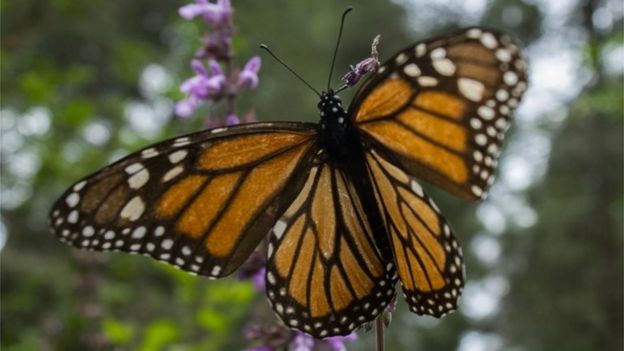
Image copyrightAFPImage captionTwo activists campaigning for the conservation of the monarch butterfly were found dead within days
Homero Gómez was one of best-known guardians of the monarch butterfly in Mexico. His body was found in a well last month. Three days later, another guide at a monarch butterfly reserve was also found dead.
Mr Gómez's colleagues and family, who believe he was murdered for his work protecting the threatened species from illegal loggers, are living in fear. They spoke to the BBC's Will Grant in Michoacán.
"Hello friends, it's a lovely warm day here at El Rosario butterfly sanctuary after a recent cold snap," said Homero Gómez on one of his regular Twitter videos.
A burly, good-natured man with a thick moustache, he would appear in a haze of thousands of tiny orange monarch butterflies - the insects settling on his white shirt - to encourage the public to visit the reserve and witness the spectacular annual migration for themselves.
He was right, it is a breathtakingly beautiful sight.
As you climb through the forest in Michoacán, clouds of butterflies flutter overhead at the end of their 4,500km journey from Canada. You reach a point where they entirely coat the oyamel firs - the natural habitat for their winter in Mexico - the green branches obscured by the vibrant orange of their wings.
'Not scared of anyone'
Homero Gómez dedicated his life to protecting the monarch from the twin threats of climate change and deforestation. His friends and family fear it may have cost him his life.
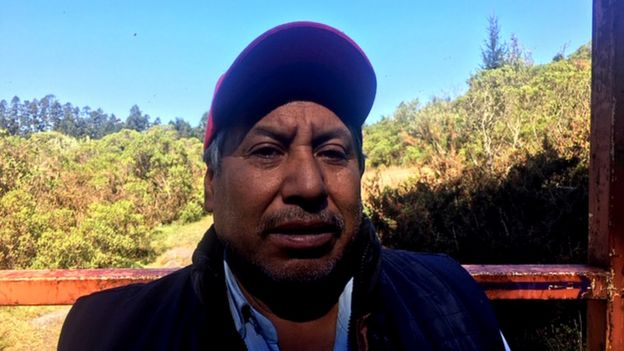
"He was very cheerful, strong, active and jovial," recalls Javier Miranda, one of the guides at the reserve, as we trek into the sanctuary.
Image captionJavier Miranda worked with Homero Gómez at the butterfly sanctuary
"And he wasn't scared of anyone. He was always working to benefit the ejido [a Mexican cooperative system of community and shared ownership] and would cajole the government by saying 'help us with this, support us with that'."
Since Homero Gómez's body was found down a well, the atmosphere among the guides at El Rosario is one of grief and fear.
"We had many years of working together," said Mr Miranda as he wept at the side of the trail, tourists passing by oblivious to his tears. "We can't let what Homero taught us collapse. We have to keep the sanctuary going without him."
The drug cartels that rule Michoacán are involved in a range of different criminal enterprises, including illegal logging of protected tropical hardwoods, firs and pines.
One theory in the community is that Homero Gómez was murdered for hindering the cartels' activities. He organised a large-scale reforestation programme and set up teams of guides to patrol the reserve day and night.
Pushed on whether he thought his friend's activism had got him killed, Mr Miranda did not want to say, partly out of fear of reprisals against others at the sanctuary.
Worried and frightened
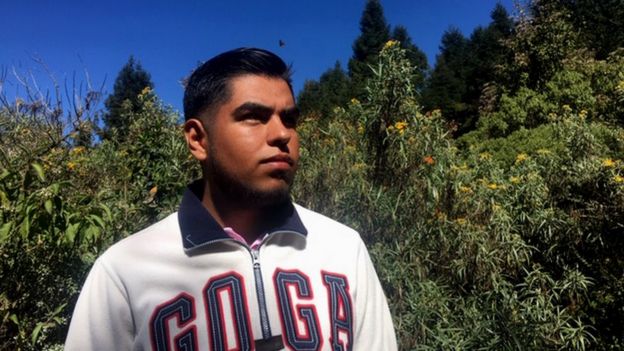
But the Gómez family have few no qualms about speaking out. "The whole family believes it was murder," explains his 19-year-old son, also called Homero, whom I met inside the reserve.
Image captionHomero Gómez's son thinks the activist was murdered
"The state attorney gave a news conference in which he said that my father's death was an accident, that he drowned. But the autopsy showed the body had received a blow to the head."
The family say they have been given no viable explanation for the head trauma. Furthermore, they say, Homero Gómez knew the area intimately and would not have fallen down a well, which was not even on his normal route home.
"The family is worried and frightened," says the young man, still numb with grief.
"My father was a fundamental piece of the ejido. He was an obstacle to anyone who wanted to mess with this community because he was always active in protecting the forest and his people." He adds that the family have not ruled out that he was killed by illegal loggers for "impeding" their business.
Yet the state attorney general's office has already indicated they believe Homero Gómez's death was an accident. They turned down repeated requests for an interview.
Juan Plancarte Esquivel of the state Human Rights Commission admits that the official reaction in the case has been inadequate.
The authorities "need to raise their level" he says, "to give trustworthy answers which can satisfy the calls being made for investigations - calls which in this state are louder and more frequent every day".
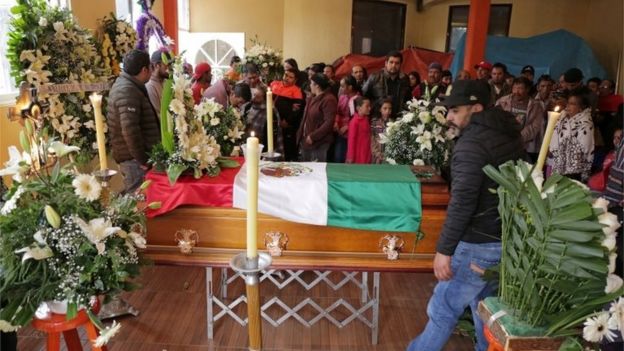
At Homero Gómez's funeral, a handful of monarch butterflies flew into the church in Ocampo and fluttered above the congregation. In Mexican culture, the monarch is considered the soul of the recently departed as its annual return to Mexico coincides with Day of the Dead on 2 November.
Image copyrightREUTERSImage captionHomero Gómez's body was found two weeks after he had disappeared
His son says that Homero Gómez firmly held that belief too: "We know he will return in the form of millions of butterflies in November."
Keep these in mind as you contemplate the direction of the American government over the past 50 years and especially since the Obama election.
The Goals of Communism
(as read into the congressional record January 10, 1963, from "The Naked Communist" by Cleon Skousen)
1. U.S. acceptance of coexistence as the only alternative to atomic war.
2. U.S. willingness to capitulate in preference to engaging in atomic war.
3. Develop the illusion that total disarmament of the United States would be a demonstration of moral strength.
4. Permit free trade between all nations regardless of Communist affiliation and regardless of whether or not items could be used for war.
5. Extension of long-term loans to Russia and Soviet satellites.
6. Provide American aid to all nations regardless of Communist domination.
7. Grant recognition of Red China. Admission of Red China to the U.N.
8. Set up East and West Germany as separate states in spite of Khrushchev's promise in 1955 to settle the German question by free elections under supervision of the U.N.
9. Prolong the conferences to ban atomic tests because the United States has agreed to suspend tests as long as negotiations are in progress.
10. Allow all Soviet satellites individual representation in the U.N.
11. Promote the U.N. as the only hope for mankind. If its charter is rewritten, demand that it be set up as a one-world government with its own independent armed forces. (Some Communist leaders believe the world can be taken over as easily by the U.N. as by Moscow. Sometimes these two centers compete with each other as they are now doing in the Congo.)
12. Resist any attempt to outlaw the Communist Party.
13. Do away with all loyalty oaths.
14. Continue giving Russia access to the U.S. Patent Office.
15. Capture one or both of the political parties in the United States.
16. Use technical decisions of the courts to weaken basic American institutions by claiming their activities violate civil rights.
17. Get control of the schools. Use them as transmission belts for socialism and current Communist propaganda. Soften the curriculum. Get control of teachers' associations. Put the party line in textbooks.
18. Gain control of all student newspapers.
19. Use student riots to foment public protests against programs or organizations which are under Communist attack.
20. Infiltrate the press. Get control of book-review assignments, editorial writing, policymaking positions.
21. Gain control of key positions in radio, TV, and motion pictures.
22. Continue discrediting American culture by degrading all forms of artistic expression. An American Communist cell was told to "eliminate all good sculpture from parks and buildings, substitute shapeless, awkward and meaningless forms."
23. Control art critics and directors of art museums. "Our plan is to promote ugliness, repulsive, meaningless art."
24. Eliminate all laws governing obscenity by calling them "censorship" and a violation of free speech and free press.
25. Break down cultural standards of morality by promoting pornography and obscenity in books, magazines, motion pictures, radio, and TV.
26. Present homosexuality, degeneracy and promiscuity as "normal, natural, healthy."
27. Infiltrate the churches and replace revealed religion with "social" religion. Discredit the Bible and emphasize the need for intellectual maturity which does not need a "religious crutch."
28. Eliminate prayer or any phase of religious expression in the schools on the ground that it violates the principle of "separation of church and state."
29. Discredit the American Constitution by calling it inadequate, old-fashioned, out of step with modern needs, a hindrance to cooperation between nations on a worldwide basis.
30. Discredit the American Founding Fathers. Present them as selfish aristocrats who had no concern for the "common man."
31. Belittle all forms of American culture and discourage the teaching of American history on the ground that it was only a minor part of the "big picture." Give more emphasis to Russian history since the Communists took over.
32. Support any socialist movement to give centralized control over any part of the culture--education, social agencies, welfare programs, mental health clinics, etc.
33. Eliminate all laws or procedures which interfere with the operation of the Communist apparatus.
34. Eliminate the House Committee on Un-American Activities.
35. Discredit and eventually dismantle the FBI.
36. Infiltrate and gain control of more unions.
37. Infiltrate and gain control of big business.
38. Transfer some of the powers of arrest from the police to social agencies. Treat all behavioral problems as psychiatric disorders which no one but psychiatrists can understand.
39. Dominate the psychiatric profession and use mental health laws as a means of gaining coercive control over those who oppose Communist goals.
40. Discredit the family as an institution. Encourage promiscuity and easy divorce.
41. Emphasize the need to raise children away from the negative influence of parents. Attribute prejudices, mental blocks and retarding of children to suppressive influence of parents.
42. Create the impression that violence and insurrection are legitimate aspects of the American tradition; that students and special-interest groups should rise up and use united force to solve economic, political or social problems.
43. Overthrow all colonial governments before native populations are ready for self-government.
44. Internationalize the Panama Canal.
45. Repeal the Connally reservation so the United States cannot prevent the World Court from seizing jurisdiction over nations and individuals alike.


 AFP
AFP
 REUTERS
 Posts
Posts

