Showing posts with label government statistics. Show all posts

Saturday, July 18, 2020

Why you cannot trust the Wuhan virus statistics

'But you can actually argue that it could have been the COVID-19 that caused him to crash'


While Florida listed a man in his 20s as among the state's COVID-19 fatalities, a county health officer told WOFL-TV that the man died in a motorcycle crash.


What are the details?

The station was looking into records that showed two individuals in their 20s as coronavirus fatalities and asked Orange County Health Officer Dr. Raul Pino if either person had any underlying conditions.
Pino's on-camera reply to WOFL?
"The first one didn't have any. He died in a motorcycle accident," he said.
The station then asked Pino if the man's data was removed.
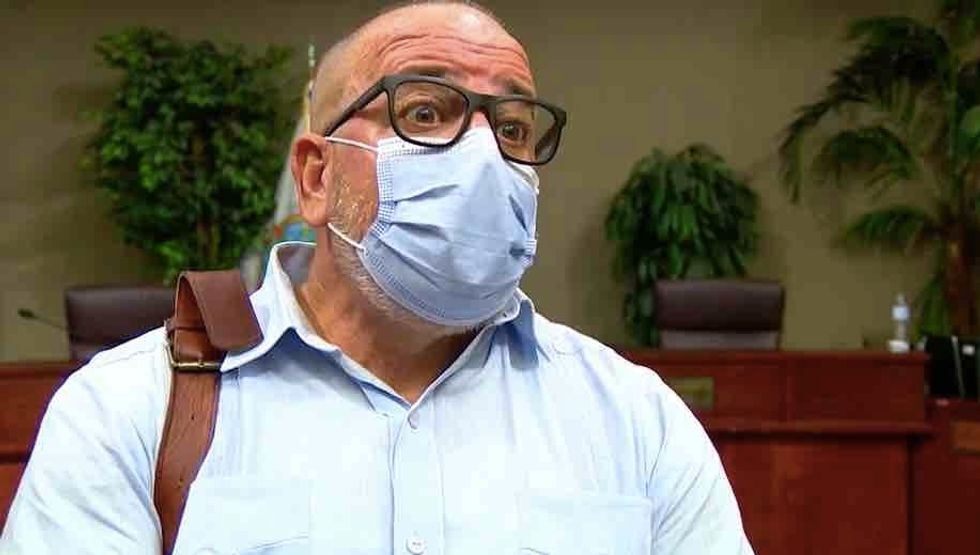
"I don't think so. I have to double-check," Pino replied to WOFL. "We were arguing, we were discussing, and trying to argue with the state. Not because of the numbers — I mean, it's a hundred; it [doesn't] make any difference if it's 99. But ... the fact that the individual ... didn't die from COVID-19, died in [the] crash. But you can actually argue that it could have been the COVID-19 that caused him to crash. So I don't know the conclusion of that one."


Orange County Health Officer Dr. Raul PinoImage source: WOFL-TV video screenshot
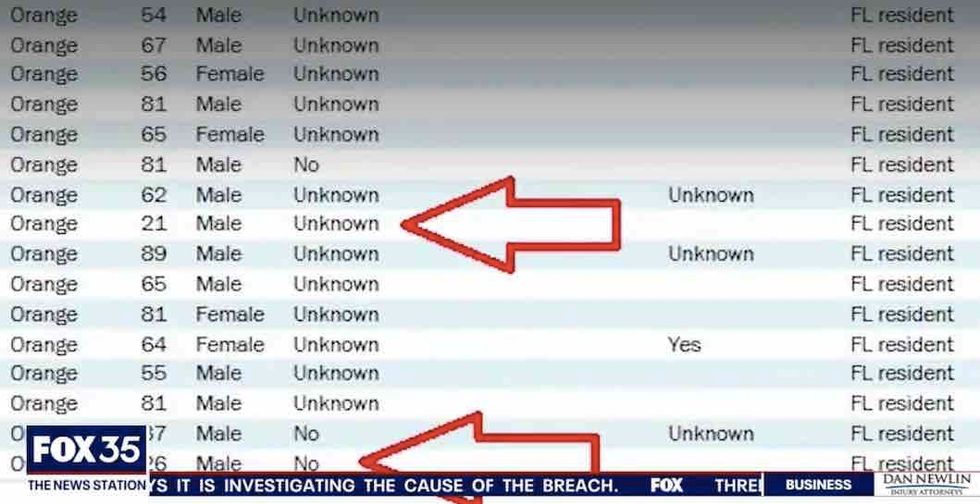
The station said in its report that there were still two people in their 20s on Orange County's list of coronavirus deaths.
Image source: WOFL-TV video screenshot

Is there a contradiction afoot?

WOFL said the Florida Department of Health sent it a statement to clarify that a "COVID death" is determined if "COVID-19 is listed as the immediate or underlying cause of death, or listed as one of the significant conditions contributing to death. Or, if there is a confirmed COVID-19 infection from a lab test — and the cause of death doesn't meet exclusion criteria — like trauma, suicide, homicide, overdose, motor-vehicle accident, etc."
Pino added to the station that "the only thing that I could say to people is the data I provide you with is the data we consume from the state, and we offer you ... the best data that we have."
In addition, Pino told WOFL that the medical examiner has to certify all COVID-19 deaths. The station said it reached out to that office and had not heard back.

Anything else?

WOFL in a separate report earlier this week noted that while the Florida Department of Health has said "countless" coronavirus testing sites across the state have reported a near 100% positivity rate for COVID-19, the reality was far different in some cases.
For example, state data showed that Orlando Health, a local hospital, had a 98% COVID-19 positivity rate — but when the station reached out to the hospital, officials said their positivity rate was only 9.4%.
State reports also claimed Orlando VA Medical Center had a positivity rate of 76% — but the hospital told WOFL its positivity rate was only 6%.

Saturday, July 11, 2020

Data suggest Florida's record-breaking coronavirus days may have been inflated by as much as 30%


The state appears to be posting backlogged cases as if they occurred on the days in question.
Image
Miami restaurant owners protest the city's order closing dining rooms, 7/10
(Joe Raedle/Getty)
Last Updated:
July 10, 2020 - 11:02pm
Florida health officials appear to have inflated recent record coronavirus case numbers there by as much as 30%, according to an analysis of data released by the state's Department of Health. 
U.S. health officials have been warning for several weeks that COVID-19 case trends in Florida are pointing to a possible looming catastrophe as the state records ever-increasing numbers of the disease. After several months of flat infection rates, positive case results in Florida began rising slowly in mid-June before beginning a steep climb near the end of the month. 
Deaths in the state have remained largely flat over that time period, leaving experts struggling to explain why surging case rates have not resulted in an uptick in mortality. One possibility, according to data provided by the state itself, is that the new case numbers regularly posted by Florida health officials have been significantly inflated in recent weeks. 

'Chart date' vs 'event date'
At issue is how Florida quantifies its COVID-19 data. The state's dashboard presents new cases in a relatively straightforward manner, presenting a bar chart that displays "new cases of residents by day." 
Yet the state's wealth of coronavirus data is significantly more multifaceted than that. An ArcGIS data manager allows users to access detailed, cross-referential data readouts for all of the state's confirmed coronavirus cases, including the sex, age group, region and "origin" of each case, among numerous other metrics. 
Two of those data options are "case date" and "event date." The state in a Department of Health document defines the case date as the "date used to create bar chart in the Dashboard," while the "event date" is defined as the "date symptoms started, or if that date is unknown, date lab results were reported to the DOH."
That subtle distinction means that many cases posted to the dashboard may not meaningfully align with the date on which they were posted. Users may thus be misled into believing that case dates on the chart represent timely data, recent cases from which current trends may be reliably derived. However, charted case dates may in fact represent "events" — positive tests or illness-onset dates — that came weeks or even months before. 
A charted display of both of those metrics indicates as much. Data show that the state was apparently undercounting thousands of cases between early and mid-June, after which through the end of June and into early July it began posting what were presumably the backlogged cases it had missed in the prior weeks. 
After June 20, the state had several skyrocketing case days approaching 10,000 "new" cases; the number of event-date cases on those days was lower sometimes by 25%. On the state's highest-charting day so far, July 4, officials posted around 11,400 cases; the "event date" metric indicates a little over 8,000 cases on that day, about 30% less than the figure posted on the dashboard and cited in nationwide media outlets. 

State officials give conflicting responses
Though the Department of Health clearly ties "event dates" to the onset of symptoms in many cases, state health department representatives gave a series of conflicting responses when questioned about the matter. 
Asked about the difference between chart dates and event dates, a department official said in an email to Just the News: "Event date will be updated as more information is gathered about the case. For instance, we would not know the person’s onset date when we received the lab result." 
"The county interviews the individual and determines their onset date," the official added, "so the 'event date' would change."
Further queries seeking clarification on the state's data-gathering practices were eventually met with a reply from Alberto Moscoso, the director of the health department's Office of Communications.
"Epidemiologists collect information that informs the Department of Health of an individual’s symptoms, contacts and location of where they may have acquired COVID-19," he told Just the News.
"The first date of entry in answer to any question, COVID-related or not, is designated the event date," he continued. "The average period of incubation for COVID-19 is about 5 days, with the longest period of incubation being 14 days. It is important to keep this in mind as many event dates are listed months before the onset of the illness."
"Thus, the event date should be viewed as the first date noted as part of an epidemiological investigation, and not be interpreted as the onset date for COVID-19," he added. "In some situations, the event date may represent the onset of COVID-19 symptoms or when the individual tested positive."
Moscoso's claim that the event date should "not be interpreted as the onset date for COVID-19" appears to conflict at least partially with both the state's posted definition of the term as well as the earlier email from the health department suggesting that the onset of illness is tied directly to the "event date."

Just the News requested further clarification on these discrepancies; eventually the health department simply copied and pasted Mosoco's earlier reply and re-sent it. 
Determining the onset date of symptoms is critical for public health officials in determining the current course of the pandemic, as unclear or misplaced data can scramble key epidemiological indicators used to determine a disease's path in a given community. 
Data problems have cropped up in numerous other localities as well. The Texas health department, for instance, this week revealed that it lacks illness-onset data for nine out of every ten coronavirus infections reported in the state.
Los Angeles County, meanwhile, posted a record number of coronavirus cases on Tuesday of this week, but the state admitted that the huge increase came "in part" as a result of a few thousand backlogged cases. 

Sunday, May 17, 2020

Requests for N.J. public records rejected during coronavirus crisis as Murphy administration uses little-known law

Governor Murphy press briefing 2020-05-12
Gov. Phil Murphy speaks at a press briefing in Trenton earlier this month.Michael Mancuso | NJ Advance Media for NJ.com
By 
In 2005, New Jersey enacted a sweeping law called the Emergency Health Powers Act, giving the governor greater authority to take actions to protect Garden State residents during a health crisis.
Gov. Phil Murphy has cited the statute frequently the last two months as he’s issued a series of orders to place the state in near-lockdown to fight the coronavirus pandemic.
But in an unexpected development, some government agencies in Murphy’s administration have also cited the law to reject requests from media outlets seeking public records related to how the state has responded to an outbreak that has killed more than 10,000 residents and caused widespread unemployment.
The ability to obtain records is one of the key tools journalists, advocates, and everyday citizens wield to examine the inner workings of government and discover how your taxpayer dollars are being spent (or misspent).
And the use of the 2005 law to deny documents has drawn criticism from open-government advocates and led two of the law’s sponsors to say the statute might need alterations.
State Senate Majority Leader Loretta Weinberg, one of the sponsors, said it’s “troubling” those records were rejected and insisted the law was “never designed to make government secret.”
“That was not my intention,” Weinberg, D-Bergen, said. “If the wording was inappropriate, we should be changing it. People in our government should be more anxious to share information than keep it.”
The issue underscores how difficult it has sometimes been to secure documents using the state’s Open Public Records Act — also known as OPRA — during the pandemic.
As COVID-19 spread rapidly through the state, Murphy also signed a new law in March that relaxes the requirement that state and local government agencies must respond to a records request within seven days. The law says they now have to make a “reasonable effort” to meet that deadline or “as soon as possible thereafter” if there’s a state of emergency. 
In an unusual step, NJ Advance Media, the USA Today Network, and the Associated Press shared information about the records they have recently sought, to show the frequency and impact of the state’s refusal to provide documents amid an unprecedented public emergency.
  • NJ Advance Media — which provides content to NJ.com, The Star-Ledger and other affiliated newspapers — has not received responses from the state Department of Health and State Police to requests for information about contracts the state made with laboratories and consultants related to the virus, among other records. The health department has asked for delays twice for inspection reports and other information on nursing homes. The department has, however, delivered documents related to a longterm care facility in Andover that has faced controversy.
  • The USA Today Network — which publishes The Record, the Asbury Park Press, and other New Jersey newspapers — sought records that show how the state worked with U.S. Centers for Disease Control and Prevention officials in the months before and as the virus hit the state and how it managed the protective gear that keeps healthcare workers safe. They were denied based on the 2005 health powers law. The Network objected to the denials, saying that law does not permit the state to keep all records hidden simply because they relate in some way to COVID-19.
  • The Associated Press sought information about hospital capacity and supplies at nursing homes but were also denied based on the 2005 law.
Record keepers have asked for more time to respond to other record requests from the news organizations that would show how much the state is spending to respond to the crisis.
Murphy, a Democrat and avowed progressive, has often said his administration strives for transparency. Throughout the COVID-19 pandemic, he has held daily briefings relaying information and statistics about the spread of the virus in New Jersey, the American state with the second-most cases and deaths.
Murphy’s administration did not respond to requests for comment for this story. But the governor’s office referred to comments Murphy made in March in which he defended relaxing public-records laws, arguing that drastic steps are needed because the state is “at war” with the virus.
“It’s nothing against the journalists (or) the media community,” Murphy said. “Trust me, that’s not the point. In fact, I’m going out of my way to praise media as an essential service because I mean it. ... We just have to deal with the reality of manpower, the ability to turn things around. ... There’s no thematic association with that other than we’re at war with a virus.”
CJ Griffin, an attorney who runs a public-records blog in New Jersey, argued that transparency is even more essential “during a war and during a public health crisis" because misconduct is more likely in those times.
“And the public is starving for information now," Griffin added. “They want to have confidence in government."
“I think there’s this general sense of secrecy that tends to happen whenever an emergency pops up," she said.
The issue with the 2005 Emergency Health Powers Act stems from a one-sentence provision about documents buried deep in the law.
Sponsors say the law was enacted after Hurricane Katrina to make sure governors could take broad action to protect New Jersey’s health during states of emergency. This is the first time a governor has used it, Murphy’s office said.
“The only reason it’s coming up now is because we’ve haven’t had a public health emergency,” said Walter Leurs, a lawyer specializing in transparency issues.
That may be why there weren’t questions over the provision that says “any correspondence, records, reports and medical information made, maintained, received or filed pursuant to this act shall not be considered a public or government record.”
Leurs, who is also president of the New Jersey Foundation for Open Government, said that means “any record that relates to the public health emergency that was sent or received that was kept on file is not a public record.”
“Which is everything,” he said. “The way that law was written, its intent was very, very broad. What happens is: The government gives us the information they want to give us."
State Sen. Joseph Vitale, who helped write the law, said he understands the dilemma the Murphy administration is facing during the pandemic.
“They’re going 100 miles an hour 24/7," Vitale, D-Middlesex, said.
But the legislator insisted he “didn’t contemplate" the law would be used to deny pubic records.
“That’s information that is helpful," Vitale said. “It would hold hospitals accountable. The more information, the better. I’ll take another look at that.”
Then there’s the new law relaxing OPRA response times during a crisis. The bipartisan measure (A3849) was part of a package of bills the Democratic-controlled state Legislature quickly approved in the early days of the outbreak to help the state manage the emergency. It passed both houses without a single no vote before Murphy signed it.
Weinberg, who also sponsored this law, said the goal is to give clerks “a little extra time“ to gather records during states of emergency.
Sponsors say this provides leeway in case state or local workers need deadline extensions because they’re stuck at home and can’t immediately drum up records that are physically in an office. They also say it takes into account that many government agencies have been busy reacting to the virus and may not be able to quickly gather records.
Lori Buckelew, a senior legislative analyst with the state League of Municipalities, said the new law was needed because of the lessons local governments learned from Hurricane Sandy in 2012.
“During Sandy, you had municipalities, especially Shore communities, dealing with a natural disaster but still had to handle OPRA requests within seven days,” Buckelew said.
Even with loosened deadlines, she said, “what we’re hearing anecdotally is most towns are responding to requests."
Leurs said there’s “really no reason for municipalities to need more time” because most documents are now electronic.
Griffin said agencies that were already good about providing records are “still really good" in the wake of the law — but ones that weren’t good are “to the point of almost ignoring OPRA altogether.”
State Sen. Declan O’Scanlon, another sponsor, said relaxing those rules was necessary and not punitive.
“We were not trying to screw the press here," O’Scanlon, R-Monmouth, said. "This is just trying to understand and accept human beings’ ability to handle this stuff.”
NJ Advance Media staff writers Payton GuionKelly HeyboerSusan K. Livio, and Ted Sherman contributed to this report.
Our journalism needs your support. Please subscribe today to NJ.com.

Brent Johnson may be reached at bjohnson@njadvancemedia.com.