Showing posts with label income redistribution. Show all posts

Friday, March 6, 2020

MSNBC no wonder they can't do economic theory


During a segment on "The 11th Hour," MSNBC host Brian Williams and New York Times editorial board member Mara Gay made a bit of a math oversight when discussing the impact of former New York City Mayor Mike Bloomberg's money in the Democratic presidential primary.

Bloomberg has dropped out of the race, endorsed Joe Biden, and is starting an organization to support whoever the Democratic nominee is against President Donald Trump. To drive home just how much money Bloomberg has already poured into the primary for himself, Gay and Williams referenced a tweet.
"Bloomberg spent $500 million on ads," the tweet from Mekita Rivas reads. "The U.S. population is 327 million. He could have given each American $1 million and still have money left over. I feel like a $1 million check would be life-changing for most people. Yet he wasted it all on ads and STILL LOST."
There is some truth in that tweet. The U.S. population is around 327 million. For most Americans, a $1 million check would be life-changing. And Bloomberg did waste hundreds of millions of dollars on ads for a failure of a campaign.

The math is just a little bit off, however. Bloomberg is super rich, but his outrageous ad spending could only have given each American about $1.53. Not exactly life changing, for most.
But not only did the tweet's author not catch the math error, neither did Williams, Gay, or any number of producers or network staffers who saw the tweet and made the graphic before putting it on air. Both Williams and Gay marveled at the inaccurate illustration of Bloomberg's spending.
"It's an incredible way of putting it," Williams said.
"It's an incredible way of putting it," Gay agreed. "It's true. It's disturbing."
Gay later acknowledged the mistake on Twitter.
"Buying a calculator, brb," she wrote.
MSNBC issued a correction later in the show and removed it from later editions of the program.

Tuesday, November 12, 2019

Today government redistributes sufficient resources to elevate the average household in the bottom quintile to a net income, after transfers and taxes, of $50,901—

The Truth About Income Inequality

The census fails to account for taxes and most welfare payments, painting a distorted picture.

Never in American history has the debate over income inequality so dominated the public square, with Democratic presidential candidates and congressional leaders calling for massive tax increases and federal expenditures to redistribute the nation’s income. Unfortunately, official measures of income inequality, the numbers being debated, are profoundly distorted by what the Census Bureau chooses to count as household income. 
The published census data for 2017 portray the top quintile of households as having almost 17 times as much income as the bottom quintile. But this picture is false. The measure fails to account for the one-third of all household income paid in federal, state and local taxes. Since households in the top income quintile pay almost two-thirds of all taxes, ignoring the earned income lost to taxes substantially overstates inequality. 
$300,000
Earned income
250,000
200,000
Net transfers
Net taxes
150,000
100,000
Net income
Net income
50,000
Earned income
0
1
2
3
4
5
The Census Bureau also fails to count $1.9 trillion in annual public transfer payments to American households. The bureau ignores transfer payments from some 95 federal programs such as Medicare, Medicaid and food stamps, which make up more than 40% of federal spending, along with dozens of state and local programs. Government transfers provide 89% of all resources available to the bottom income quintile of households and more than half of the total resources available to the second quintile. 
In all, leaving out taxes and most transfers overstates inequality by more than 300%, as measured by the ratio of the top quintile’s income to the bottom quintile’s. More than 80% of all taxes are paid by the top two quintiles, and more than 70% of all government transfer payments go to the bottom two quintiles.
America’s system of data collection is among the most sophisticated in the world, but the Census Bureau’s decision not to count taxes as lost income and transfers as gained income grossly distorts its measure of the income distribution. As a result, the raging national debate over income inequality, the outcome of which could alter the foundations of our economic and political system, is based on faulty information.
The average bottom-quintile household earns only $4,908, while the average top-quintile one earns $295,904, or 60 times as much. But using official government data sources on taxes and all transfer payments to compute net income produces the more complete comparison displayed in the nearby chart. 
PHOTO: GETTY IMAGES/ISTOCKPHOTO
The average bottom-quintile household receives $45,389 in government transfers. Private transfers from charitable and family sources provide another $3,313. The average household in the bottom quintile pays $2,709 in taxes, mostly sales, property and excise taxes. The net result is that the average household in the bottom quintile has $50,901 of available resources. 
Government transfers go mostly to low-income households. The average bottom-quintile household and the average second-quintile household receive government transfers of some $17 and $4 respectively for every dollar of taxes they pay. The average middle-income household receives $17,850 in government transfers and pays an almost identical $17,737 in taxes, while the fourth and top quintiles of households receive government transfers of only 29 cents and 6 cents respectively for every dollar paid in taxes. (In the chart, transfers received minus taxes paid are shown as net government transfers for low-income households and net taxes for high income households.) 
The average top-quintile household pays on average $109,125 in taxes and is left, after taxes and transfer payments, with only 3.8 times as much as the bottom quintile: $194,906 compared with $50,901. No matter how much income you think government in a free society should redistribute, it is much harder to argue that the bottom quintile is getting too little or the top quintile is getting too much when the ratio of net resources available to them is 3.8 to 1 rather than 60 to 1 (the ratio of what they earn) or the Census number of 17 to 1 (which excludes taxes and most transfers).
Today government redistributes sufficient resources to elevate the average household in the bottom quintile to a net income, after transfers and taxes, of $50,901—well within the range of American middle-class earnings. The average household in the second quintile is only slightly better off than the average bottom-quintile household. The average second-quintile household receives only 9.4% more, even though it earns more than six times as much income, it has more than twice the proportion of its prime working-age individuals employed, and they work twice as many hours a week on average. The average middle-income household is only 32% better off than the average bottom-quintile households despite earning more than 13 times as much, having 2.5 times as many of prime working-age individuals employed and working more than twice as many hours a week. 
Antipoverty spending in the past 50 years has not only raised most of the households in the bottom quintile of earners into the middle class, but has also induced many low-income earners to stop working. In 1967, when funding for the War on Poverty started to flow, almost 70% of prime working-age adults in bottom-quintile households were employed. Over the next 50 years, that share fell to 36%. The second quintile, which historically had the highest labor-force participation rate among prime work-age adults, saw its labor-force participation rate fall from 90% to 85%, while the top three income quintiles all increased their work effort.
Any debate about further redistribution of income needs to be tethered to these facts. America already redistributes enough income to compress the income difference between the top and bottom quintiles from 60 to 1 in earned income down to 3.8 to 1 in income received. If 3.8 to 1 is too large an income differential, those who favor more redistribution need to explain to the bottom 60% of income-earning households why they should keep working when they could get almost as much from riding in the wagon as they get now from pulling it. 
Mr. Gramm is a former chairman of the Senate Banking Committee. Mr. Early served twice as assistant commissioner at the Bureau of Labor Statistics.

Wednesday, October 23, 2019

Federal largesse

$3.22 Trillion: Federal Programs That 'Transfer Income' Projected to Hit Record in FY20

Listen to the Article!
 
Terence P. Jeffrey
By Terence P. Jeffrey | October 23, 2019 | 7:56 AM EDT 

(Getty Images/Mark Wilson)
Federal spending programs that are "designed to transfer income ... to individuals or families" are set to hit a record $3,223,943,000,000 in fiscal 2020, according to projections published by the Office of Management and Budget.
These so-called "payments for individuals" (as the OMB calls them) are projected to account for 67.9% of all federal spending this fiscal year and consume 14.4% of the nation's gross domestic product.
In its Historical Table 6.1, Composition of Outlays, the OMB reports the annual amounts spent on "payments for individuals" going back to fiscal 1940 in both current year and constant fiscal 2012 dollars. In the same table, it published its estimated totals for fiscal 2019 through fiscal 2024.
In 1940, the federal government spent only 2.1% of GDP on "payments for individuals." As a percentage of GDP, these payments peaked in fiscal 2010 at 15.5%.
But in inflation-adjusted dollars, the total amount the federal government spends on these payments has increased since then.
In fiscal 2010, federal "payments for individuals" totaled $2,406,300,000,000 in constant 2012 dollars. But by fiscal 2019, according to the OMB estimate, they had increased to $2,835,300,000,000 in constant fiscal 2012 dollars, and in fiscal 2020, they are projected to hit a record $2,837,500,000,000 in constant 2012 dollars (or $3,223,943,000,000 in current year dollars).
What exactly are these "payments to individuals" that will consume 67.9% of all federal spending this year?
"These are federal government spending programs designed to transfer income (in cash or in kind) to individuals or families," the OMB says in the introduction to its historical spending tables.
"To the extent feasible," says the OMB, "this category does not include reimbursements for current services rendered to the Government (e.g., salaries and interest)."
"The payments may be in the form of cash paid directly to individuals or they may take the form of the provision of services or the payment of bills for activities generally financed from personal income," the OMB says.
"They include outlays for the provision of medical care (in veterans' hospitals, for example) and for the payment of medical bills (e.g., Medicare)," says the OMB.
"They also include subsidies to reduce the cost of housing below market rates and food and nutrition assistance (such as SNAP — formerly food stamps)," the OMB says.
In Table 11.3, Outlays for Payments for Individuals by Category and Major Program, the OMB breaks down the total outlays for "spending programs designed to transfer income" by the programs through which the income is transferred.
The most expensive set of these programs deals with medical care.
In fiscal 2020, the OMB estimates, federal medical care programs will spend a total of $1,434,169,000,000. Within this category, Medicare will spend $808,340,000,000, and Medicaid will spend $418,151,000,000.
Social Security and the railroad retirement program will spend another $1,110,989,000,000.
The civil service retirement program will spend $89,524,000,000. The earned income tax credit will spend $62,551,000,000. The Supplemental Security Income program will spend $53,440,000,000. Housing assistance programs will spend $48,928,000,000. The Supplemental Nutrition Assistance Program (food stamps) will spend $48,603,000,000. Non-veteran student assistance will spend $44,654,000,000.
When a family's child tax credits exceed their tax liability, payments will cost $35,595,000,000.
And child nutrition and special milk programs will cost $24,862,000,000.
All of this spending will be conducted by a government that is going bankrupt.
At the same time the federal government will be spending a record amount on "programs designed to transfer income," according to the OMB's estimates, it will also be setting a record in overall spending while running up a record debt — despite bringing in record tax revenues.
This fiscal year, according to the OMB's Table 1.1, the federal government will haul in $3,644,772,000,000 in total tax revenue, push out $4,745,573,000,000 in total spending and run a deficit of $1,100,801,000,000.
At the end of the fiscal year, the OMB predicts in its Table 7.1, federal debt will reach $24,057,463,000,000.
In the OMB's Table 1.3, which puts the numbers in constant fiscal 2012 dollars, this year's projected total tax revenues ($3,209,300,000,000) and total spending ($4,178,500,000,000) are both records.
When the projected debt total for the end of this fiscal year ($24,057,463,000,000) is compared to the debt at the close of previous fiscal years (after they have been adjusted into constant September 2019 dollars using the Bureau of Labor Statistics inflation calculator), it, too, is a record.
The people who run our government are truly record setters — when it comes to taking money from one group and giving it to another.
That includes taking money from future generations and spending it on their own.


CNSNews Reader,
The liberal media are terrified of the truth, especially when it leads to uncomfortable questions about their own leftist worldview.
CNSNews covers the stories that the liberal media are afraid to touch. It drives the national debate through real, honest journalism — not by misrepresenting or ignoring the facts.
CNSNews relies on the support of our loyal readers to keep providing the news and commentary that matter to the American people, not just stories that prop up the liberal agenda.
Make a donation today. Just $15 a month would make a tremendous impact and enable us to keeping shining the light where the liberal media are afraid to tread.
— The CNSNews Team

Tuesday, August 20, 2019

Is this their backdoor way of acknowledging a good job market?

Even the SF Bay ferries are crowded these days

It is one of those deals with the devil that make modern life so complex: You take a good-paying job in the city while opting for a good life in the country or the suburbs.
The suburbs are more affordable, the schools are better, and the grass is greener. But the devil demands his price: The dreaded morning and evening commutes.
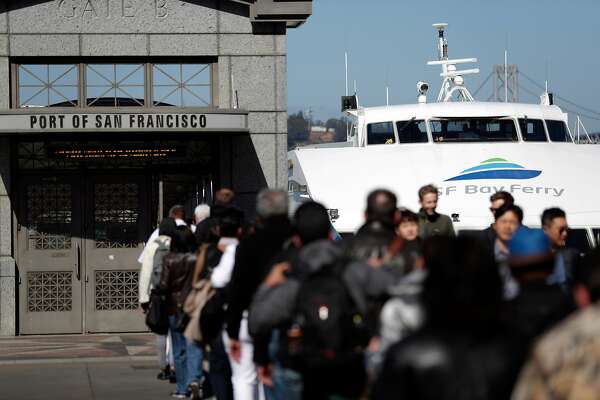
Everyone knows traffic is impossible and BART is jammed. That’s one reason for a boom in commuting by ferry. Ridership on the San Francisco-Alameda-Oakland run is up 115 percent over what it was five years ago, and the San Francisco-Vallejo ferries are carrying 66 percent more passengers than they were back then.
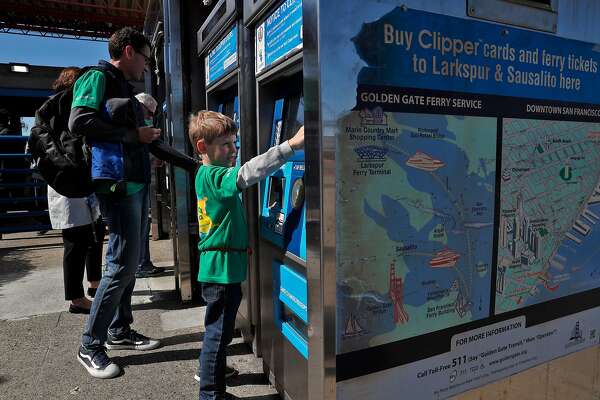
On most weekday afternoons, the lines for the Vallejo and Oakland ferries snake back from the docks to the front of the San Francisco Ferry Building, and sometimes passengers have to be left behind. And at the Larkspur terminal of the Golden Gate ferries, a 2,000-car parking lot is now simply not big enough.