Showing posts with label mideast. Show all posts

Sunday, August 16, 2020

UAE, Israel firms sign deal after establishing ties

UAE, Israel firms sign deal after establishing ties

The agreement is being touted as the first such deal since Israel and the United Arab Emirates moved to establish full diplomatic relations this week. The new partnership aims to focus on COVID-19 research and testing.

    
A handout image provided by the United Arab Emirates News Agency (WAM) on August 16, 2020, shows representatives from the Emirati company APEX National Investment (R) and the Israeli TeraGroup, signing an agreement to develop research on the novel coronavirus, in the Emirati capital Abu Dhabi

The UAE Apex National Investment company has signed a "strategic commercial agreement" with Israel's TeraGroup to conduct research into COVID-19 and develop a virus testing device, UAE's state news agency WAM reported.

The deal "is considered the first business to inaugurate trade, economy and effective partnerships between the Emirati and Israeli business sectors," WAM quoted APEX's chairman Khalifa Yousef Khoury as saying.

He added that it was "for the benefit of serving humanity by strengthening research and studies on the novel coronavirus."

Read more: Mixed reaction to historic agreement between Israel and UAE

The agreement was signed at a press conference in the Emirati capital, Abu Dhabi. It comes after Israel and the UAE on Thursday announced a US-brokered deal to normalize diplomatic ties between the two states.

The historic accord requires Israel to halt its controversial plans to annex part of the occupied West Bank.

As part of that rapprochement, the two countries' foreign ministers held their first publicly acknowledged call on Sunday after the UAE opened its telephone lines to Israel. 

Israel's Gabi Ashkenazi and his UAE counterpart, Sheikh Abdullah bin Zayed "exchanged greetings following the historic Peace Accord signed by the two countries," Hend al-Otaiba of the UAE's Foreign Ministry tweeted.

Ashkenazi said they had agreed during the call to "meet soon."

Following Thursday's breakthrough, the countries said in a joint statement: "The United Arab Emirates and Israel will immediately expand and accelerate cooperation regarding the treatment of and development of a vaccine for the coronavirus." 

The statement added that delegations from the two states would meet in the coming weeks to sign agreements related to investment, tourism, direct flights, security, telecommunications and other issues. 

The UAE is now the third country, after Egypt and Jordan, to have diplomatic relations with Israel.

 
Watch video02:05

Israel, UAE reach historic peace deal

nm/aw (Reuters, dpa)


Monday, July 27, 2020

Can Lebanon be saved from clutches of Iran?

Hezbollah’s historical repression of Lebanese neutrality may be coming to an end

The patriarch of Lebanon’s Maronite Church Beshara Al-Rai joined a growing roster of Lebanese leaders who think that the main culprit behind the country’s free-falling economy is Hezbollah and its endless wars.
In a visit to President Michel Aoun, Al-Rai called for restoring regional neutrality, a policy the country used in the past, during which Lebanon saw its “golden years” between 1949 and 1969. Al-Rai also said that national defense should be the job of the Lebanese Army alone.
In a follow-up statement, Al-Rai said that Lebanon used to be “the hospital of the Arabs, the hotel of the Arabs, the tourism of the Arabs,” and that it was Lebanon’s neutrality that allowed it to play such roles.
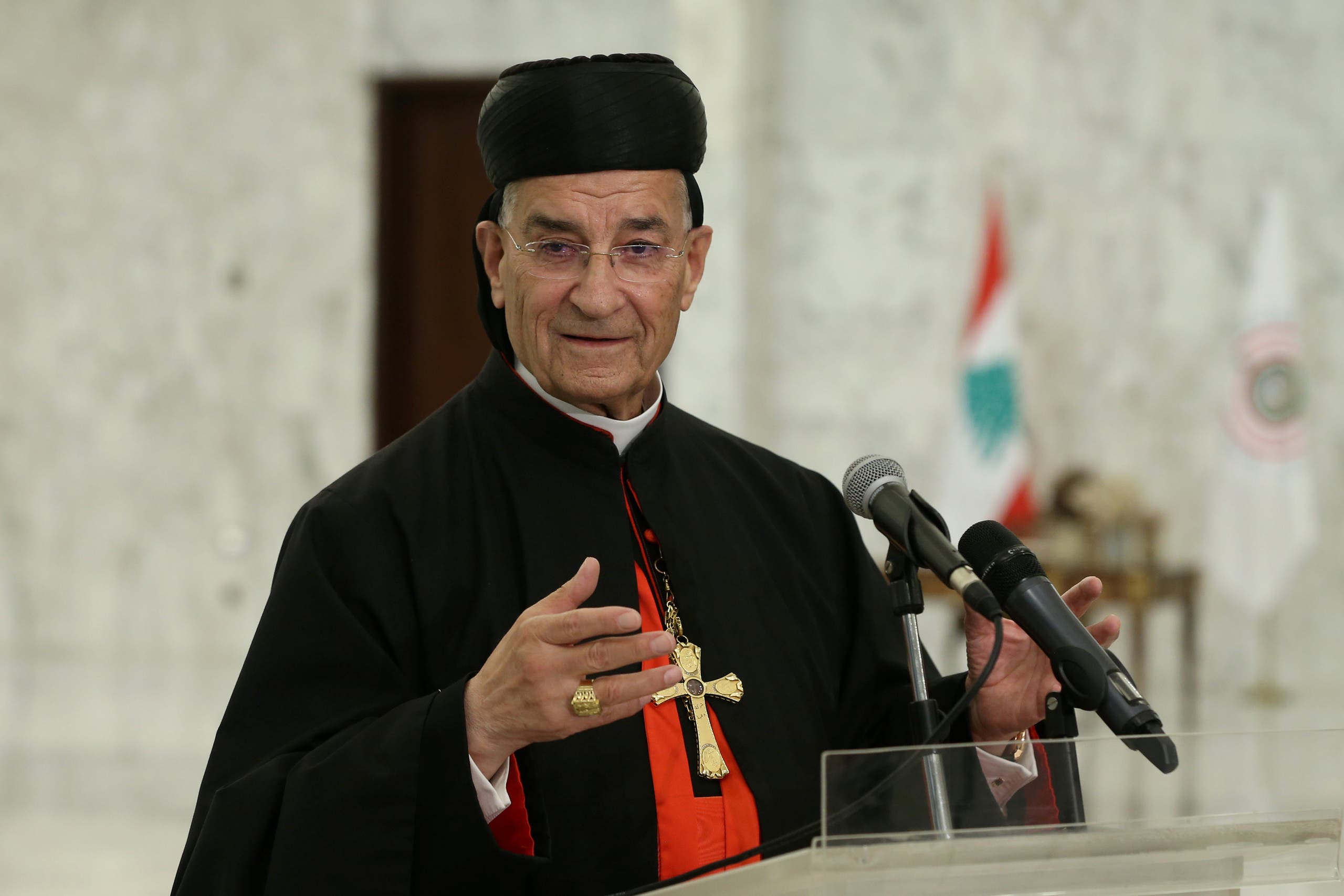
Lebanese Maronite Patriarch Bechara Boutros Al-Rai speaks after meeting with Lebanon's President Michel Aoun at the presidential palace in Baabda, Lebanon July 15, 2020. (Reuters)
“But when we joined alliances and [militias] and military engagements, we became completely isolated from the Arabs and the West, and we became alone, like a ship in a stormy sea.” The patriarch concluded that “neutrality is the source of national unity and stability, which leads to [economic] growth and prosperity.”
Hezbollah has repressed the debate over its arms and Lebanese neutrality ever since it lost its raison d’ĂȘtre when Israel withdrew from southern Lebanon in 2000. At first, the pro-Iranian militia tried to continue warring with Israel over a tiny strip of land known as Shebaa Farms whose ownership is claimed by Syria. But the narrative of “liberating the Shebaa Farms” never gained traction.
Realizing that Hezbollah had become an obstacle to economic growth, late Lebanese Prime Minister Rafic al-Hariri held rounds of talks with its chief Hassan Nasrallah. Al-Hariri offered Hezbollah a face-saving exit strategy that would have seen the militia transformed into a political group.
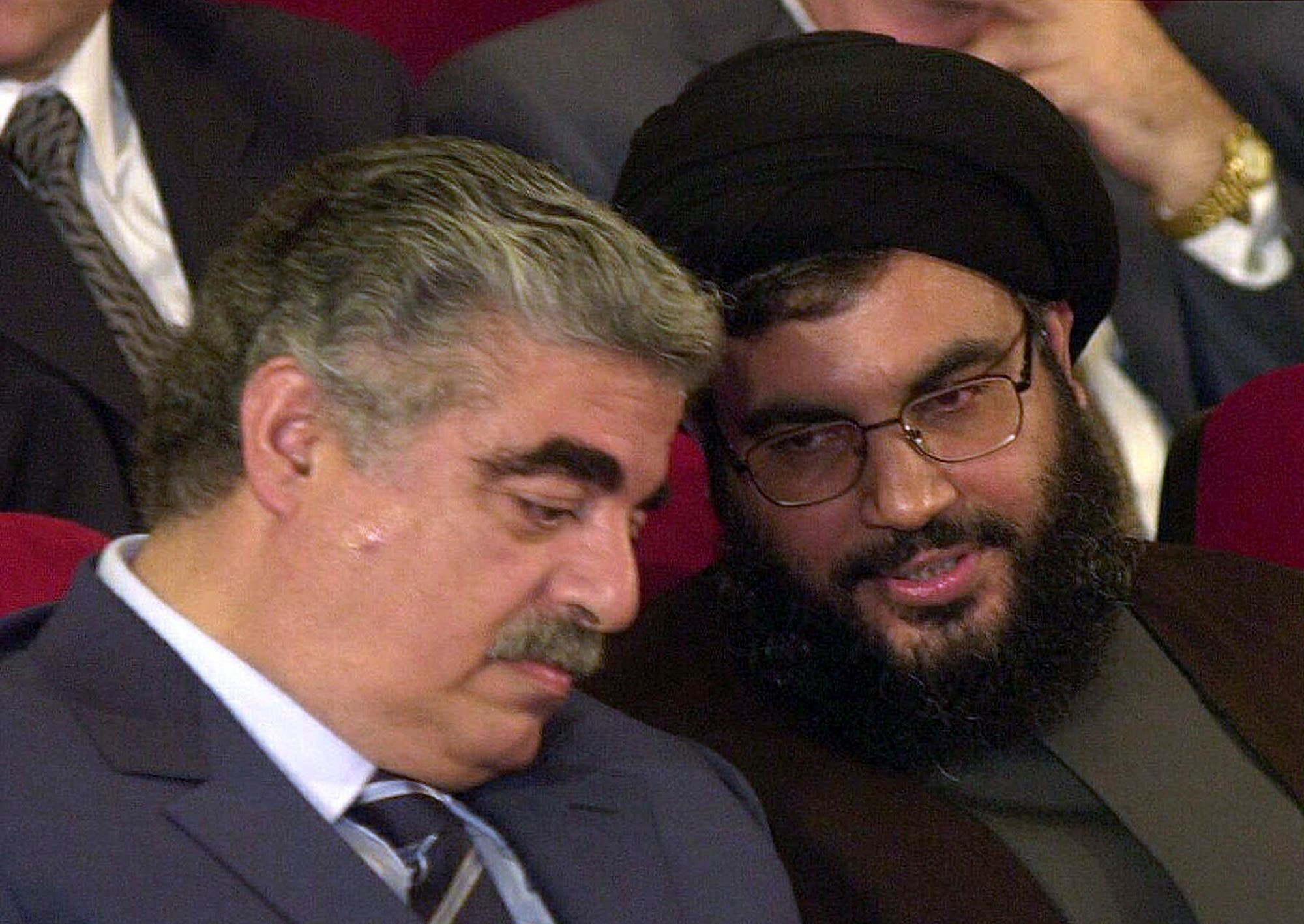
The late Lebanese Prime Minister Rafik Hariri, left, talks with Hezbollah leader Hassan Nasrallah, right, during an official ceremony on May 25, 2001 in Beirut. (File photo: AP)
When Hezbollah refused, Al-Hariri lobbied Arab and world capitals. The UN passed Security Council resolution 1559, which called for Hezbollah’s disarmament. Months later, Hariri was assassinated, and a UN special tribunal indicted Hezbollah operatives for the killing.
Al-Hariri’s death, however, did not end calls for Hezbollah’s disarmament, but only intensified them. A coalition of pro-Hariri Sunnis, Maronite Christians under Aoun and his rival Samir Geagea, and Druze under Walid Jumblatt, coalesced around Resolution1559, forcing Syrian President Bashar al-Assad to withdraw his forces from Lebanon, 29 years after having entered it.
Hezbollah, for its part, laid low, and pretended to join in the national unity. In reality, the militia lurked around waiting to break its opponent coalition.
Applying carrots and sticks, Hezbollah lured Aoun away and later helped make him president, while assassinations continued to take down national anti-Hezbollah figures. The party tried to renew its war credentials by starting what it called a defensively preemptive war with Israel in 2006, which resulted in so much destruction that, instead of winning regional and national support, Hezbollah almost lost its Shia base.
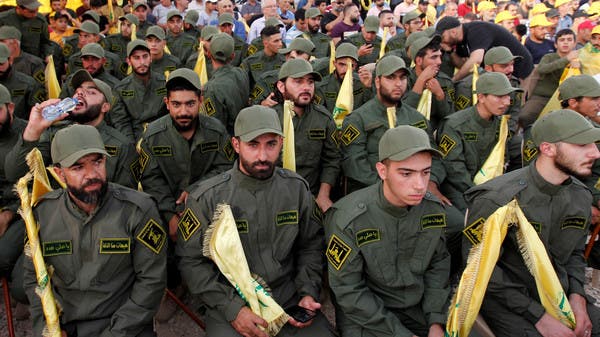
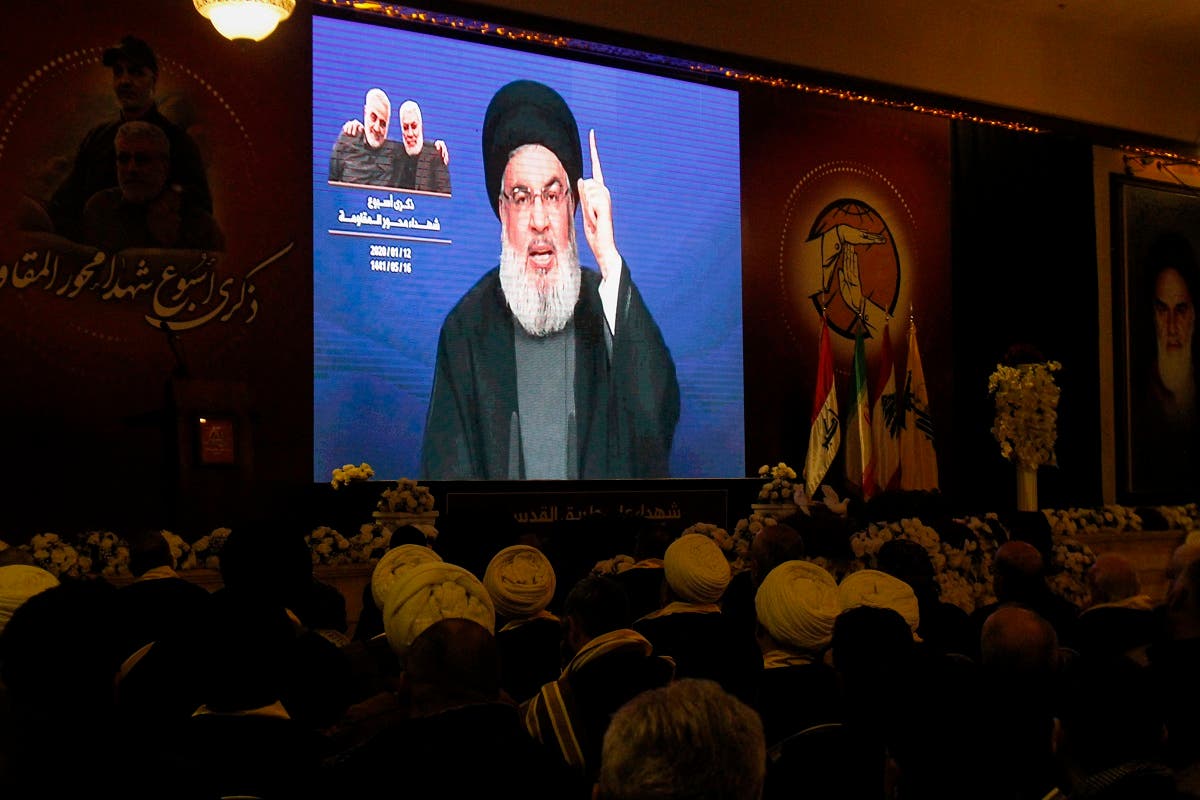
Hezbollah supporters watch as the group's leader Hasan Nasrallah delivers a speech on a screen in the southern Lebanese city of Nabatieh on January 12, 2020. (AFP)
Again, the coalition for disarming Hezbollah came to the rescue, holding indirect negotiations with Israel through the UN to end the war, and soliciting reconstruction money from friends of Lebanon. Gulf capitals proved especially generous in preventing a Lebanese economic collapse. Lebanon was set to implement Security Council resolution 1701, which Hezbollah had agreed to, a resolution that reaffirmed 1559 and called for UN-mediated talks with Israel and Syria to end border disputes and demarcate the borders.
But like always, Hezbollah reneged on what it had agreed to. Hence, with its majority, the coalition to disarm Hezbollah went for one last gasp: It ordered the army to dismantle the militia’s telecom network, perhaps as a prelude to disbanding the militia.
Hezbollah responded with brute force, sending its fighters to invade neighborhoods and villages, and killing many.
The terms to end Hezbollah’s mini civil war in 2008 stipulated, yet again, neutrality. Michel Suleiman, who was elected president by consensus, summoned the oligarchs and Hezbollah to agree on neutrality, and encoded the agreement in the Declaration of Baabda 2012. Next, Hezbollah went after Suleiman, slandering him until his term ended.
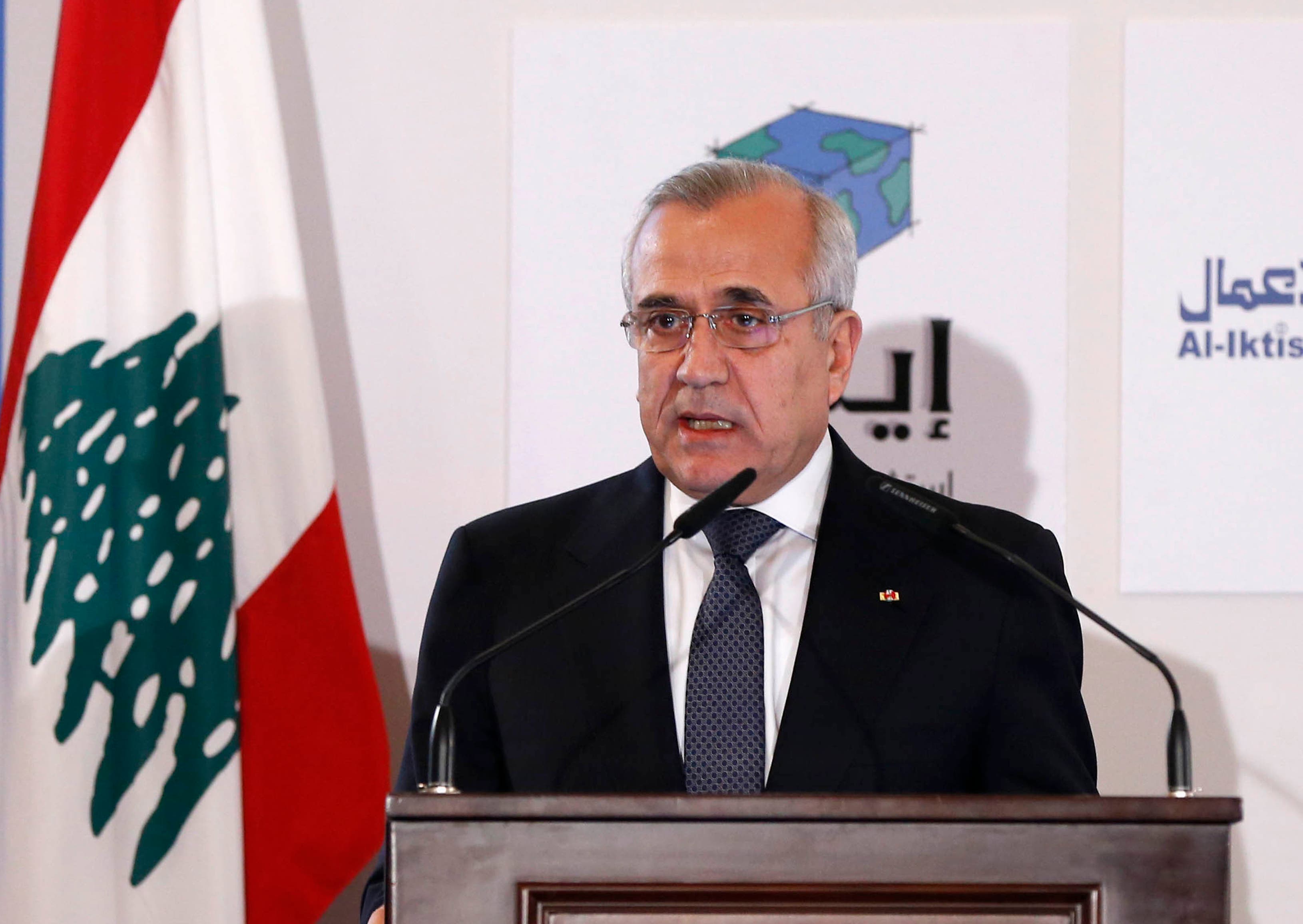
Lebanon's President Michel Suleiman speaks during the third Lebanon Economic Forum in Beirut March 8, 2014. (File photo: Reuters)
After Suleiman, Hezbollah was determined to install a loyalist president who would never call for disarmament or neutrality. Aoun obliged. But by controlling all levers of power, the world realized that Lebanon was now in Hezbollah’s pocket. The country thus lost its international friends. It’s economy started its decline.
A free-falling economy convinced Al-Rai, who had been on the fence, to join the chorus calling for Hezbollah’s disarmament and Lebanese neutrality. Al-Rai’s position surprised the pro-Iranian militia, whose early reaction included defaming the patriarch.
But the head of the Maronite Church is a heavyweight in Lebanese politics, and his call for neutrality started snowballing.
Hezbollah is on the back foot again, and will probably revert to its usual playbook: Try to divide and conquer its opponents with violence and promises of senior state jobs. Whether the party succeeds in repressing calls for its disarmament, like it did in the past, is anybody’s guess.
The only difference today is that the party will have to play its game unlike anytime before: Against the background of an unfolding Lebanese famine.
________________
Hussain Abdul-Hussain is an Iraqi-Lebanese columnist and writer. He is the Washington bureau chief of Kuwaiti daily al-Rai and a former visiting fellow at Chatham House in London. He tweets @hahussain.
Last Update: Wednesday, 22 July 2020 KSA 21:57 - GMT 18:57
Disclaimer: Views expressed by writers in this section are their own and do not reflect Al Arabiya English's point-of-view.

Saturday, September 14, 2019

Iran spurs war in the middle east..

Saudi Arabia oil facilities ablaze after drone strikes


Drone attacks have set alight two major oil facilities run by the state-owned company Aramco in Saudi Arabia, state media say.
Footage showed a huge blaze at Abqaiq, site of Aramco's largest oil processing plant, while a second drone attack started fires in the Khurais oilfield.
The fires are now under control at both facilities, state media said.
A spokesman for the Iran-aligned Houthi group in Yemen said it had deployed 10 drones in the attacks.
The military spokesman, Yahya Sarea, told al-Masirah TV, which is owned by the Houthi movement and is based in Beirut, that further attacks could be expected in the future.
He said Saturday's attack was one of the biggest operations the Houthi forces had undertaken inside Saudi Arabia and was carried out in "co-operation with the honourable people inside the kingdom".
Saudi Arabia is said to be shutting down around half of its oil output, the Wall Street Journal reports. 
Officials have not yet commented on who they think is behind the attacks. 
"At 04:00 (01:00 GMT), the industrial security teams of Aramco started dealing with fires at two of its facilities in Abqaiq and Khurais as a result of... drones," the official Saudi Press Agency reported.
"The two fires have been controlled."
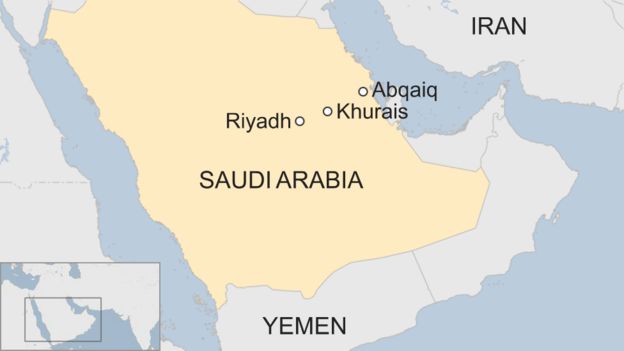
Map
There have been no details on the damage but Agence France-Presse quoted interior ministry spokesman Mansour al-Turki as saying there were no casualties.
Abqaiq is about 60km (37 miles) south-west of Dhahran in Saudi Arabia's Eastern Province, while Khurais, some 200km further south-west, has the country's second largest oilfield.
Saudi security forces foiled an attempt by al-Qaeda to attack the Abqaiq facility with suicide bombers in 2006.

An attack method open to all

Jonathan Marcus, BBC defence and diplomatic correspondent
This latest attack underlines the strategic threat posed by the Houthis to Saudi Arabia's oil installations.
The growing sophistication of the Houthis' drone operations is bound to renew the debate as to where this capability comes from. Have the Houthis simply weaponised commercial civilian drones or have they had significant assistance from Iran?
The Trump administration is likely to point the finger squarely at Tehran, but experts vary in the extent to which they think Iran is facilitating the drone campaign.
The Saudi Air Force has been pummelling targets in Yemen for years. Now the Houthis have a capable, if much more limited, ability to strike back. It shows that the era of armed drone operations being restricted to a handful of major nations is now over.
Drone technology - albeit of varying degrees of sophistication - is available to all; from the US to China, Israel and Iran... and from the Houthis to Hezbolllah.

Markets await news from key facilities

Analysis by BBC business correspondent Katie Prescott
Aramco ranks as the world's largest oil business and these facilities are significant. 
The Khurais oilfield produces about 1% of the world's oil and Abqaiq is the company's largest facility - with the capacity to process 7% of the global supply. Even a brief or partial disruption could affect the company, and the oil supply, given their size.
But whether this will have an impact on the oil price come Monday will depend on just how extensive the damage is. Markets now have the weekend to digest information from Aramco and assess the long-term impact.
According to Richard Mallinson, geopolitical analyst at Energy Aspects, any reaction on Monday morning is likely to be muted, as markets are less worried about supply than demand at the moment, due to slower global economic growth and the ongoing trade war between the US and China.
However, there are concerns that escalating tensions in the region could pose a broader risk, potentially threatening the fifth of the world's oil supply that goes through the critical Strait of Hormuz.

Who are the Houthis?

The Iran-aligned Houthi rebel movement has been fighting the Yemeni government and a Saudi-led coalition.
Yemen has been at war since 2015, when President Abdrabbuh Mansour Hadi was forced to flee the capital Sanaa by the Houthis. Saudi Arabia backs President Hadi, and has led a coalition of regional countries against the rebels.
The coalition launches air strikes almost every day, while the Houthis often fire missiles into Saudi Arabia.
Mr Sarea, the Houthi group's military spokesman, told al-Masirah that operations against Saudi targets would "only grow wider and will be more painful than before, so long as their aggression and blockade continues".
Saudi-led coalition air strike on Dhamar in Yemen, 1 SeptImage copyrightEPA
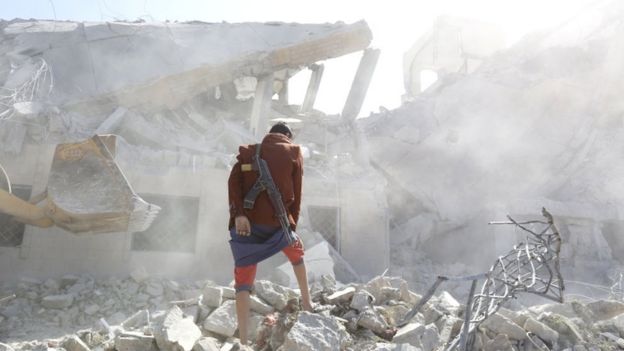
Image captionSaudi-led coalition air strikes regularly target Houthis in Yemen
Houthi fighters were blamed for drone attacks on the Shaybah natural gas liquefaction facility last month and on other oil facilities in May.
There have been other sources of tension in the region, often stemming from the rivalry between Saudi Arabia and Iran.
Saudi Arabia and the US both blamed Iran for attacks in the Gulf on two oil tankers in June and July, allegations Tehran denied.
In May, four tankers, two of them Saudi-flagged, were damaged by explosions within the UAE's territorial waters in the Gulf of Oman.
Saudi Arabia and then US National Security Adviser John Bolton blamed Iran. Tehran said the accusations were "ridiculous".
Tension in the vital shipping lanes worsened when Iran shot down a US surveillance drone over the Strait of Hormuz in June, leading a month later to the Pentagon announcing

Thursday, August 1, 2019

Saudi women can now travel without male guardian's approval – report


Okaz newspaper reports key step in dismantling strict controls over nation’s women
Saudi woman at the wheel of a car
 A Saudi Information Ministry image, from 2018, before the kingdom lifted its ban on women driving. Photograph: AP
Women in Saudi Arabia will no longer need the permission of a male guardian to travel, according to local news reports. The policy, if confirmed, would mark a key step in dismantling controls that have made women second-class citizens in their own country.
Saudi women over the age of 21 will be able to apply for a passport and travel outside the country, without approval, Okaz newspaper reported on Thursday. The change would put them on an equal footing with men. They would also reportedly be able to register births and deaths, a right previously restricted to men.
The paper did not say where it got the information, but the country’s official gazette tweeted that amendments to travel rules, labour law and civil status law would be included in its next edition, Bloomberg reported.
The reported move comes at a time of increased international scrutiny of women’s status in Saudi Arabia. In recent months several young women have fled the country and made public pleas for help in seeking asylum from their family and the government.
Last year authorities arrested many of the country’s most prominent female campaigners in a sweeping crackdown on activists.
The country’s crown prince and de facto ruler, Mohammed bin Salman, has sought to present himself as a modernist reformer since being appointed heir to the throne in 2017. Critics say the jailing of female activists under his watch and the treatment of dissidents, including Jamal Khashoggi, the journalist who was murdered at the Saudi consulate in Istanbul, suggests the regime only wants change on its terms.
Prince Mohammed has brought in sweeping social and economic changes, aimed partly at weaning the country off its dependence on oil revenue. He has also dismantled some of the strictest controls over women. Last year a driving ban was lifted, and rules were altered freeing women from needing permission from a male guardian to study at university, undergo surgery or get a job.
The crown prince has also curbed the powers of the religious police, who once pursued women they considered immodestly dressed to check they had a guardian’s permission for their activities. They also broke up mixed-sex gatherings.
The changes were welcomed by activists who say Saudi Arabia’s guardianship system has kept its women in a legal limbo as “perpetual minors” and should be dismantled entirely.
Prince Mohammed has also been criticised for Saudi Arabia’s role in Yemen’s brutal civil war, and his relentless pursuit of opponents at home and abroad, most prominently of Khashoggi. A forensic and damning UN report said that the crown prince should be investigated over the murder because there was “credible evidence” that he and other senior officials were liable for the killing. He has denied any involvement.