
Showing posts with label Cuba. Show all posts

Tuesday, June 30, 2020

Cuba: 80 years on and the Cubans are still short on food...communism and poverty go hand and hand

HAVANA (Reuters) - In the courtyard of a temple belonging to the Abakua Afro-Cuban religious brotherhood in Havana, Nelson Piloto is pulling up the lawn to plant bell peppers and cassava in the face of Cuba’s looming food crisis. 

Nelson Piloto waters his garden in the courtyard of a temple belonging to the Afro Cuban Abakua brotherhood amid the spread of the coronavirus disease (COVID-19) in Havana, Cuba, June 26, 2020. REUTERS/Alexandre Meneghini
Piloto, 40, says he is responding to the Communist government’s call for citizens to produce more of their own food, including in big cities, in whatever spaces they can find, from backyards to balconies. 
Standing across from two giant ceiba trees that are considered sacred by many in Cuba, the temple usually resounds with ceremonies involving drumming, animal sacrifices and dance. But it sits empty now due to coronavirus lockdown restrictions on gatherings. 
“I’m making the most of the earth,” said Piloto, leaning on his hoe. 
Food security has lately risen to the top of the national agenda in Cuba, with countless news headlines and televised roundtable discussions dedicated to the topic. 
“Cuba can and must develop its program of municipal self-sustainability definitively and with urgency, in the face of the obsessive and tightened U.S. blockade and the food crisis COVID-19 will leave,” José Ramón Machado Ventura, 89, deputy leader of the Cuban Communist Party, was quoted as saying by state-run media on Monday.
The Caribbean island imports roughly two-thirds of the food it consumes at a cost of around $2 billion annually, in addition to key farming supplies like fertilizer, machinery and animal feed. 
But imports have nosedived in recent years as aid from ally Venezuela shrank following its economic implosion and U.S. President Donald Trump tightened the half century-old U.S. trade embargo. 
That led first to shortages of imported food and then to drops in national agricultural production. Output of Cuban staples like rice, tomatoes and pork fell 18%, 13% and 8% respectively last year, according to data released this month. 
The coronavirus pandemic, which has paralyzed the key tourism sector, has only exacerbated the situation. 
“Today we Cubans have two big worries: COVID-19 and food. Both kill. We are flooded with scarcity,” said Yanet Montes, 51, leaving a popular Havana agricultural market with just a few mangoes. 
She and others said the availability of produce at such markets was dwindling, with long lines for the most sought-after items like tarot root sometimes starting at dawn. 
1990s SURVIVAL LESSONS 
Leaders have appealed to Cubans to redeploy lessons learned during the so-called “Special Period,” the deep economic depression Cuba fell into after the 1991 collapse of former benefactor the Soviet Union. 
Last year, they urged farmers to use oxen instead of tractors due to fuel scarcity. 
The premium placed on fuel savings is one reason planning departments are now looking to expand organic farming in urban and suburban areas where goods can be sold directly. 
Cuba became something of an organic farming pioneer in the 1990s, developing techniques like worm composting, soil conservation and the use of biopesticides, to replace imported supplies and large scale monoculture. 
Havana now produces 18% of the agricultural produce it consumes, according to state run media. 
Communist Party activists are signing up in some provinces to do voluntary work in the fields while authorities have distributed leaflets to neighborhood leaders in towns and cities on expanding family farming. 

Slideshow (4 Images)
In a residential neighborhood in east Havana, Luis Ledesma asked his wife if he could tear up her flower beds so he could plant pumpkin, sweet potato, cassava, cucumber and chives. 
“One of the things that is difficult to find these days is rice,” said the 61-year-old, who recently acquired five chickens and a cockerel and wants to install rabbit cages next. “But root vegetables can replace rice.” 

REFORM 

Some Cuba observers are cautiously hopeful the crisis will push the government to reform its agricultural model which, like the rest of the economy, remains heavily centralized. 
“Nothing good can come from the combination of monopoly of supplies, monopoly of distribution and distorted prices,” said Cuban economist Pedro Monreal. 
The government has hinted recently at a possible reform of the vast state network responsible for purchasing and distributing most farm output, which has come under fire for wasting crops and disincentiving production. 
Another Cuban economist, Omar Everleny, said the government should free farmers altogether from this monopoly, allowing them to find their own ways to sell produce and import their own equipment. 
“I have the impression in the next few months we will see new reforms,” he said. 
Come what may, some Cubans like sustainable agriculture enthusiast Marnia Briones hope the country won’t lose the habits that have arisen from this and previous crises, which some have termed its “green revolution”. 
“It’s great more people are planting but it cannot just be when there is a crisis,” said the Havana-based artist. “It should be fomented as a healthier lifestyle for the whole of humanity.” 
Reporting by Sarah Marsh in Havana; Additional Reporting by Nelson Acosta; Editing by Daniel Flynn and Tom Brown

Saturday, February 29, 2020

One more thing for Bernie on Cuba's glorious free health care: It killed Hugo Chávez

One more thing for Bernie on Cuba's glorious free health care: It killed Hugo Chávez


Bernie Sanders got himself into hot water with Florida's voters by praising Cuba's "literacy programs," which were ugly coercive propaganda efforts for those who experienced them.

It's far from the only thing he's praised about the Castroite communist hellhole.  According to the New York Times:
MIAMI — In the spring of 1989, as the outgoing mayor of Burlington, Vt., Bernie Sanders and his wife, Jane, traveled to Cuba on an eight-day trip, with the hopes of meeting the Cuban dictator, Fidel Castro.
The 47-year-old Mr. Sanders didn't get time with Mr. Castro, but he toured Havana, met with its mayor and marveled that visitors could take a cab anywhere in the country. "The revolution there is far deeper and more profound than I understood it to be," he said back home, according to The Burlington Free Press, and commended Cuba for providing free health care, free education and free housing.
Free health care?  That one's worth a teaching moment for Bernie, too.
Not only do citizens get experiences like this, but it's worth noting that even Fidel Castro himself knew better than to use it.  Socialist systems may create two-tier health care systems for the ordinary people and the elites, which is bad enough, but in the absence of any innovation and the only incentives to "excellence" being political ones, even the elites' system eventually goes to hell, too, at least on life-or-death matters. 
Castro knew this, which is why he decided to import his doctor from Spain to treat his malignant diverticulitis.
His little pawn, Hugo Chávez of Venezuela, wasn't quite as savvy.  He actually believed the lies about Cuba's free health care system — and with some sort of internal cancer, paid for his faith in Castrocare with his life.
Shortly before Chávez's 2013 death in a Cuban hospital, the truth came out about the disastrous state of Cuban health care — even for the elites — back when I was writing editorials at Investor's Business Daily:
Americas: Venezuela's Hugo Chavez is dying of cancer in Havana, in a live demonstration of Cuba's vaunted socialized medical care. He went there instead of Brazil because he wanted to make a political statement. What irony.
...and...
Most galling for him: It didn't have to happen this way.
His expected demise will be entirely due to his gullibility to leftist propaganda and bad choices that came of it.
"In July 2011, during (a)... summit in Caracas, Brazil's President, Dilma Rousseff, told a few of her colleagues — in private — that Chavez was likely to die as a result of 'his excessive paranoia rather than as a consequence of his serious — yet treatable — cancer,'" wrote Venezuelan consultant Pedro Burelli in a newsletter.
"What she meant to say," Burelli added, "was that by choosing secrecy in Cuba over medical competence at the Sirio-Libanese Hospital in Sao Paulo (where she had been treated successfully for lymphatic cancer) Chavez had condemned himself to a shorter life."
Burelli noted that it corresponded to his own sources, who told him that Chavez's chosen successor, Foreign Minister Nicolas Maduro, flew to Brasilia to meet with Rousseff and her oncologist.
He presented the diagnoses from Caracas and Havana and the Brazilian specialist "considered it treatable under world-class protocols available in his center."
Maduro signaled interest. But the Chavista regime then demanded to pretty much take over the 400-bed hospital, which the Brazilians rejected. "From that moment on the patient was doomed," Burelli wrote.
The Cubans, it turned out, gave Chávez the wrong cancer treatment — probably radiation or chemotherapy, which has limits on uses — and, as a result, were unable to correct it after they discovered the error.  That doomed Chávez, a victim of the very Castrocare he touted, as Bernie Sanders does now, as the solution to all of Venezuela's ills.  Venezuela's hospitals now look like Cuba's or, given the lack of water, electricity, and money, probably worse.  But it was Castrocare itself, the elites-tier version, that did Chávez in.
Would Bernie Sanders consent to Cuban-style health care for his own heart condition?  Not if he wanted to live.  The examples of Castro, treated with Western medicine, and Chávez, going down with a treatable illness made untreatable by Castrocare, tell the whole story about the worth of such a system. 
Someone should ask him.


Wednesday, February 26, 2020

Bernie's wet dream: "Before his death in November 2016, Fidel Castro’s net worth was estimated at $900 million."

It’s idiotic to believe Castro was good for the Cuban people or that socialism would be good for the U.S

We’re supposed to believe that it is a wonderful thing in Communist countries where the leaders care so much for their people. They teach them to read. They have free education and health care. Cubans have very strict gun control. Abortion is available on demand in Cuba, and in 2019 they raised the mandatory minimum wage. All things the Democrats running for President support. It looks like an ideal Democrat platform
After 60 years of Castro Brothers control, they have raised the minimum wage to $16 (per month, not per hour). The average wage will shoot up from $24 to $42 per month. Thank goodness Cuba doesn't have the problem with wealth and income inequality that the United States does because that would cause division and strife.
Higher education professors will now receive $56 to $68 per month, very similar to the fake Indian running for President, who wants to move towards socialism, who is worth millions and got paid $400,000 for the tough task of teaching one course. I wonder why the cost of education is so high in the U.S and why student debt is so high when Warren only got $400,000 plus benefits for such a tough schedule.
The Cuban journalists pushing government propaganda will go from an average salary of $15.50 per month to $50 per month, which is very competitive with the millions that our talking heads receive as they push the Democrat talking points. Actually, I am having trouble justifying $50 per month for Maddow, Joe & Mika, Acosta and Tapper. A copier and leaflets would be a much cheaper way to push the Democrat talking points.
We clearly need a millionaire with three houses who has fed off the public trough to lead our country in order to get rid of wealth and income inequality. We have to get to a place where all the wealthy people around DC get more of the money from the greedy people throughout the rest of the country. We need to pay their fair share.

We need leaders like Castro, who cared so much about the common folk. He was very smart and obviously a good investor and saver. Like the common man in Cuba, he only earned an estimated $150 million per year and was worth in excess of $900 million when he died. Thank goodness he cared so much, just like the Clintons, Obama, Pelosi, and others who have lined their pockets very successfully as they claimed they cared about the poor and middle class. There never will be enough for greedy politicians. There are no moderate Democrats running. They all want more power and money. It is they who strive for a much more powerful, dictatorial government.
There is only one reasonable choice for president, and it is the person who is trying to give the power and purse back to the people as fast as possible while most journalists, bureaucrats and other Democrats seek to destroy him and anyone surrounding him or supporting him.
There’s a widely used saying in Cuba that state workers pretend to work, and the government pretends to pay them.  Few people believe the announcement of minor wage increases on Friday will alter that relationship.
Under the plan announced by President Miguel Diaz Canel, the government will step up controls to keep consumer prices from rising both for products and services in the state and private sectors, noted the Communist Party’s Cubadebate website.
The new minimum monthly wage was set at 400 pesos (US $16.00), said the president.  He further noted that an average salary would go up from $24 a month to $42 a month.  Pensions below $20 will also get an undisclosed boost, he said.
The president noted that a top-level University Professor would now receive 1,700 pesos (US $68 a month and the lowest level university educator would receive the equivalent of $56 dollars a month.
He added that government journalists, whose basic salary was only $15.50 a month, will now receive in the neighborhood of $50 a month.
Throughout 2019, Cuba has been suffering growing shortages for many basic products due to slumping national production and a lack of money in the government coffers for imports. Diaz Canel and the Council of Ministers hope the wage hike will stimulate the nation’s economy “at a time of increased hostility from the United States against Cuba.”
One estimate suggests he had an annual income of $150 million, allowing Fidel Castro’s net worth to grow over the course of his adult life. Plus, he likely had a range of other assets, like vehicles, boats, and valuables, which are part of the total.
Before his death in November 2016, Fidel Castro’s net worth was estimated at $900 million. However, as certain information about the infamous Cuban leader is hard to come by, it could have been higher.

Sunday, December 22, 2019

The military regime running Cuba has a new face

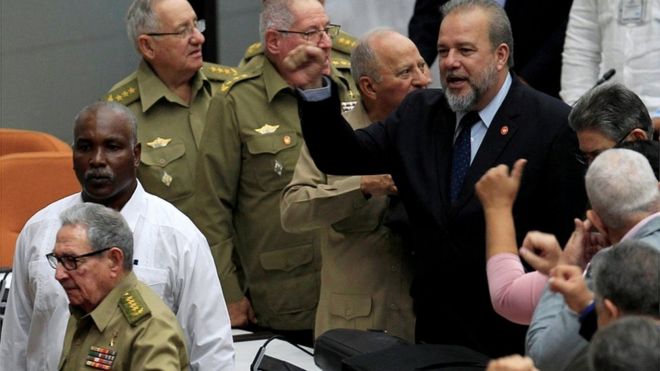
Cuba names Manuel Marrero Cruz as first prime minister since 1976

Newly appointed Cuban prime minister Manuel Marrero Cruz at the National Assembly in Havana, on December 21, 2019Image copyrightREUTERS
Image captionManuel Marrero Cruz, right, was appointed at a National Assembly session also attended by former president Raúl Castro, left

Thursday, December 19, 2019

Cuba gets half it's hard currency from selling the labor of slaves - doctors!

HAVANA (Reuters) - “I’m buying dollars, I’m buying euros,” Roly, 28, whispers furtively to tourists outside a hotel in Havana. 

continue


Saturday, September 21, 2019

Want socialism? Well I've got your socialism right here: Cubans wait hours in gas lines as fuel crisis bites


yesterday
HAVANA (AP) — A fuel shortage blamed on the Trump Administration has turned filling a tank in Cuba into an ordeal even for a country used to waiting in lines.
Around Havana, drivers spend days hunting desperately for gas, calling friends and updating online chat groups with sightings of diesel, regular and higher-octane fuel at gas stations. Lines this week have come to stretch for blocks with waits up to five hours long. Drivers park and shut off their cars to wait in the shade and chat with friends as cars crawl past pumps far in the distance.
Increasingly, gas stations are running out with people still waiting in line. Drivers have started lining up outside empty gas stations in the hope that a truck from the state-run fuel monopoly will come by to fill its pumps.
Cuban officials blame a U.S. policy of sanctioning ships that bring petroleum products from Venezuela, Cuba’s main ally and source of highly subsidized fuel for two decades.
Foreign Minister Bruno Rodríguez said Friday that the Trump administration was waging a worldwide campaign to pressure Cuba’s fuel suppliers and shippers in South America, Europe and North Africa.
“These actions include direct threats, persecution of transport companies, pressure against governments where tankers are flagged or registered and actions against insurance companies, he said. “This is an escalation seeking to dissuade and intimidate, and create additional difficulties for the Cuban people.”
Outside observers say the broader cause is Cuba’s energy overdependence on a single socialist ally whose oil industry has gone into freefall. Cuba relies on Venezuela for about 60 percent of its daily consumption, according to some estimates.
“Once again they committed the great strategic error of putting all their eggs in one basket,” said Jorge Piñon, an expert on Cuban and Venezuelan energy and economics at the University of Texas. “They didn’t learn the lesson of the ’80s when they depended on the Soviet Union without an insurance policy protecting them from political changes.”
Whatever the cause, the result is an energy shortage that’s crippling Cuba’s already slack economy and forcing people to spend much of their week worrying about how to get around.
“If I don’t manage to fill up now all I have is enough to get home and park my car,” said Karel Perez, a 44-year-old restaurant employee.
Interminable gas lines are only the most visible sign of a fuel crisis that’s led to cutbacks in public transport, public services and every sort of state-run business in one of the world’s last centrally planned economies.
Train and bus service has been cut back, state employees are working half days and farmers are being asked to use oxen to pull plows instead driving tractors. Police have been posted to bus stops and gas stations to control the long lines. Public employees with state-owned cars have been told to pick up hitchhikers, a measure enforced by public inspectors last seen during the infamous economic crash known as the special period following the collapse of the Soviet Union. More broadly, the country has been suffering months of intermittent shortages of basic products like soap, detergent and, for a while, chicken, due to a lack of hard currency to buy imported goods.
Problems with public transport became obvious this month, leading to widespread discontent among Cubans. On Sept. 11, President Miguel Díaz-Canel announced that the country had to cut back its use of petroleum products, particularly diesel, due to a shortage of tankers he blamed on U.S. sanctions. Since then, gas lines winding for blocks have become a feature of the landscape in Havana and around the country.
The government says the arrival of tankers in October should relieve the situation somewhat, but many Cubans remain worried.
“Since public transport has gotten bad I try not to go out and I walk to work,” said Jacqueline Pereira, a 35-year-old state employee. “People are tense.”
_______
Andrea Rodríguez on Twitter como: www.twitter.com/ARodriguezAP