Showing posts with label Communism. Show all posts

Sunday, August 9, 2020

China:Hong Kong pro-democracy tycoon Jimmy Lai arrested while the media and Democrats cover for China

Hong Kong pro-democracy tycoon Jimmy Lai arrested
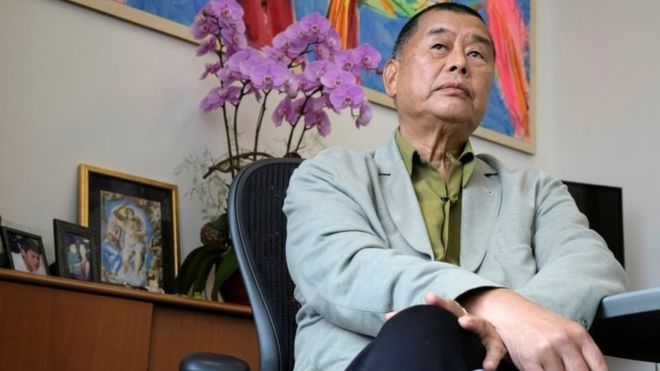
Jimmy Lai. File photoImage copyrightREUTERS
Image captionJimmy Lai has said that "the establishment hates my guts", and that he is prepared to go to prison

Hong Kong business tycoon Jimmy Lai has been arrested for suspected collusion with foreign forces, his aide has said.

Mark Simon said the businessman was held under the controversial national security law imposed by China in June.

Mr Lai has been a prominent supporter of the pro-democracy protests that erupted in Hong Kong last year.

In February, the 71-year-old who also holds UK citizenship was charged with illegal assembly and intimidation. He was later granted police bail.

"Jimmy Lai is being arrested for collusion with foreign powers at this time," said Mr Simon, an executive at Mr Lai's media firm Next Digital.

According to local media, Hong Kong police have also entered the building of his media company, searching the offices. 

Police have confirmed that seven people were arrested on Monday on suspicion of breaking the national security law, but have not yet named Mr Lai. 

The Monday arrests are the third wave of detentions under the new law. Mr Lai's would be the highest profile case so far and the first involving someone who holds foreign citizenship.

Who is Jimmy Lai?

Mr Lai is estimated to be worth more than $1bn (£766m). 

Having made his initial fortune in the clothing industry, he later ventured into media and founded the newspaper Apple Daily, which is frequently critical of Hong Kong and mainland Chinese leadership.

He has also been himself an activist against Beijing's increasingly tight grip on the Hong Kong. In 2019 he supported the reform protests and participated in the demonstrations. 

When earlier this year he was charged for his involvement in those protests, Chinese state media dubbed him a "riot's mastermind" who "has spread waves of hatred and negative information about the Chinese mainland day and night".
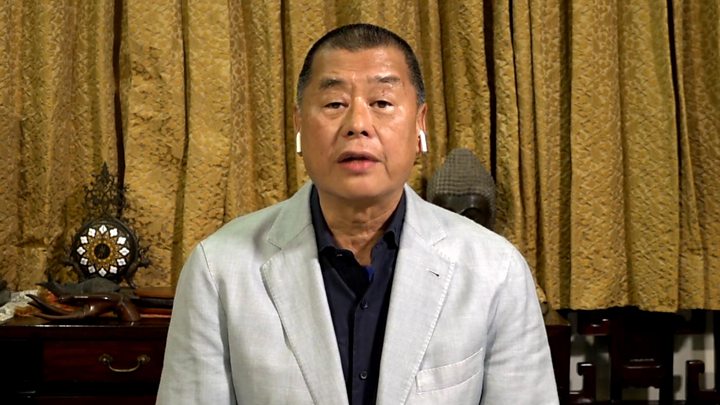
Media captionJimmy Lai: China's security law 'spells the death knell for Hong Kong'

On 30 June, when the security law was passed, Mr Lai told the BBC that this "spells the death knell for Hong Kong". 

He warned that Hong Kong would become as corrupt as mainland China because "without the rule of law, people who do business here will have no protection".

In a separate interview with the AFP news agency, Mr Lai said: "I'm prepared for prison. If it comes, I will have the opportunity to read books I haven't read. The only thing I can do is to be positive."

What is the new security law?

Hong Kong has had a high degree of autonomy since it was returned to Chinese rule in 1997, and its residents have had a far higher level of freedom of speech and media than people on the mainland. 

But the law's key provisions include that crimes of secession, subversion, terrorism and collusion with foreign forces are punishable by a maximum sentence of life in prison.

It makes it easier to punish protesters, and reduces the Hong Kong's autonomy. 

It also gives Beijing powers to shape life in the former British colony in a way it has never had before. 

Critics say it effectively curtails protest and freedom of speech - China has said the new law will return stability to the territory after a year of unrest.

Bernie still trying to bring America to its knees with Cloward-Piven tax policy

Socialist Bernie Sanders Proposes 60 Percent Wealth Tax On Billionaires To Fund Healthcare For One Year

Monday, August 3, 2020

Simple-minded leftist anti white racism. In the radical left the goal is date zero where the world begins anew.

Democratic state Rep. LaShawn K. Ford said history classes in Illinois public schools lead to "white privilege and a racist society" — and he wants them ended until the state can come up with a history curriculum that better represents the contributions of minorities and women, WLS-TV reported.

"I'm calling for the abolishment of history classes in Illinois," Ford said at an Evanston news conference Sunday with other leaders, the station noted. "We're concerned that current school history teachings lead to white privilege and a racist society."

What are the details?

Ford is sponsoring House Bill 49-54 to create new teaching practices in public schools, WLS noted.

"When it comes to teaching history in Illinois, we need to end the miseducation of Illinoisans," Ford added, according to the station. "I'm calling on the Illinois State Board of Education and local school districts to take immediate action by removing current history books and curriculum practices that unfairly communicate our history. Until a suitable alternative is developed, we should instead devote greater attention toward civics and ensuring students understand our democratic processes and how they can be involved."

Ford's bill would require elementary schools to teach students about the civil rights movement, WMAQ-TV reported.

"The miseducation of our children must stop," Meleika Gardner of We Will — Women Empowering Women In Local Legislation — said in a statement, according to WLS. "It is urgent that it comes to an end as we witness our current climate become more hostile. Miseducation has fed and continues to feed systemic racism for generations. If Black History continues to be devalued and taught incorrectly, then it will call for further action."

News conference attendees also want a history curriculum that highlights contributions by members of Jewish, LGBTQ, and other communities — and starting this school year, WMAQ reported.

Anything else?

Ford added that he's "also alarmed that people continue to display symbols of hate, such as the recent display of the Confederate flag in Evanston."

Last week, a woman confronted a group beachgoers for using a Confederate flag towel as they lounged on Lighthouse Beach.

According to the Chicago-Sun Times, the woman — identified as LaShandra Smith-Rayfield — shared video of herself telling the group the Confederate flag "is my swastika" and a "racist symbol of hate."

But as Smith-Rayfield railed against the group, a person she described as a man of color intervened and defended the group's right to use whatever towel they wanted — even if it bore the image of a Confederate flag.

The man said he served in the U.S. military "to defend this flag" and that she was the one who was out of line for harassing the group: "Just leave them alone. People like you haven't done s**t for this country."


Thursday, July 23, 2020

Communist China expands into Bhutan...imperialism?

What’s Behind China’s Expansion of Its Territorial Dispute With Bhutan? 

Beijing may be trying to drive a wedge between India and Bhutan.

Ankit Panda
By Ankit Panda
July 06, 2020
What’s Behind China’s Expansion of Its Territorial Dispute With Bhutan?
Credit: Flickr/ MEAIndia

There’s no shortage of border tension currently in the Himalayas. As many Diplomat readers will be aware, India and China have been locked in their most serious border standoff since 1967 since the start of May, featuring several standoffs along multiple points in the western and Sikkim sectors of their disputed border.

The standoff reached heights unseen in decades after a June 15 melee in which 20 Indian soldiers died along with an unknown number of Chinese casualties. Meanwhile, earlier in the year, a dispute between Nepal and India over the Lipulekh border area boiled over. Now, China is apparently expanding the scope of its border dispute with the small Himalayan kingdom of Bhutan.

The Sino-Bhutanese relationship normally flies under the radar. Bhutan has the distinction of being the only other country apart from India with which China has an unsettled land border. It is also the only state to border China that does not have official diplomatic ties with Beijing. But despite this lack of official relations, the two sides have worked for years to arrive at a resolution to their border disputes, which until now primarily focused on areas in the central and western sectors.

The western sector dispute — over the Doklam plateau — has received the most attention after the 2017 India-China standoff there. The central sector disputes — over areas known as Jakarlung and Pasamlung — have received less attention comparatively. Even without formal diplomatic ties, Bhutan and China have held 24 rounds of border talks between their envoys; talks that have been frozen since their last round in 2016, partly due to the heightened tensions that erupted during the Doklam standoff. A 25th round is yet to take place.

On Saturday, the Chinese Ministry of Foreign Affairs (MFA) issued a statement to two Indian media outlets — the Hindustan Times and The Hindu — highlighting three separate areas of disputed territory with Bhutan. “The boundary between China and Bhutan has never been delimited. There have been disputes over the eastern, central and western sectors for a long time,” the Chinese MFA said, according to The Hindu.

Enjoying this article? Click here to subscribe for full access. Just $5 a month.

The addition of the eastern sector is notable as this hasn’t been part of the agenda across the 24 rounds of China-Bhutan border talks. The MFA statement’s inclusion of the eastern sector came shortly after the government of Bhutan issued a demarche to China after a Chinese delegate at the 58th Global Environment Facility Council, held earlier this summer, referred to the Sakteng Wildlife Sanctuary, an area in eastern Bhutan, as disputed.

The claim itself may have some basis in history, but not one well supported by official Chinese maps. Back in 2017, in the course of studying the Sino-Indian and Sino-Bhutanese disputes over Doklam, I came across at least one older, unofficial Chinese map that portrayed a capacious dispute in the eastern sector. So, if anything, this had been a dormant Chinese claim that was ultimately — for whatever reason — deemed unsuitable for the negotiating agenda with Thimphu across 24 rounds of border talks. Now, that view has changed in Beijing. The political geography of the area in question bears underscoring: Given that India fully administers Arunachal Pradesh, even if Bhutan were to unilaterally cede this area, it would amount to an enclave without any direct border with China’s Tibet Autonomous Region.

The novelty of China’s claim in its dispute with Bhutan has already raised eyebrows, but there are other complicating factors here. First, the purported eastern sector dispute over the Sakteng Wildlife Sanctuary, in geographic terms, would be the single largest tranche of disputed territory across all sectors in the China-Bhutan context, representing about 11 percent of the territory currently administered by the Bhutanese government.

Second, the territory in question abuts the Indian state of Arunachal Pradesh, which is itself claimed in its near entirety as part of Tibet. Not only is this the case, but the Sakteng area specifically borders Arunachal’s western Tawang region, which China has particularly prioritized in negotiations with India; arguably, Tawang is the least negotiable piece of territory for Beijing in the entirety of the eastern sector. Given the ongoing Sino-Indian tensions in the western sector of their border in Ladakh, the timing of the revelation of this “new” dispute with Bhutan will likely be seen as coercive by India.

Third, given that a 25th round of China-Bhutan talks has yet to convene after the 2017 Doklam standoff, the purpose of opening this expansive — and frankly ludicrous — claim to more than 10 percent of sovereign Bhutanese territory may be primarily intended to coerce Thimphu into making concessions in other areas, such as Doklam, on terms favorable to China. Given the special relationship between India and Bhutan, as well, Chinese pressure on Bhutan may be designed to test the relationship between New Delhi and Thimphu.

Friday, July 10, 2020

The totalitarian left will permit no opposition...Marxism by force


Alexandria Ocasio-Cortez seeks to 'cancel' Goya, America's top Latino-owned food company

Here's a man-bites-dog story: 
The president of Goya Foods, America's largest Latino-owned food company with $1.5 billion in sales, did something virtually every other U.S. CEO has been way too chicken to do:
He praised President Trump. And for far-leftists such as Rep. Alexandria Ocasio-Cortez, that was ample reason to put the successful minority-owned company out of business.
Here's what the man said to merit the socialist death sentence.

He praised Trump for all the right reasons, too:
...We're all truly blessed, at the same time, to have a leader like President Trump, who is a builder. And that';s what my grandfather did, he came to this country, to build, to grow, to prosper. And so we have an incredible builder, and we pray, we pray, for our leadership, our president, and we pray for our country, that we will continue to prosper, and to grow. ... 
In an era when corporate America has skidded into a sort of lockstep 'wokeness' with huge amounts of money being thrown around to Black Lives Matter activist groups as a sort of appeasement payoff to keep from becoming a target, here's the CEO from a Spanish immigrant family, stating the obvious about President Trump and doing it while the whole leftwing world was watching was, for us normals at least, an act of unprecedented corporate courage.
After that, he announced that his company would donate a million cans of food to the hungry and homeless in COVID-shutdown relief efforts. They had already donated 200,000 pounds of food earlier.
The huge food donations to the poor are nothing compared to a few nice words for President Trump, so naturally they're trying to cancel the biggest Latino-owned business in America. 
Rep. Alexandria Ocasio-Cortez is leading the charge for a boycott, seeking to throw 4,000 workers out of jobs, since to her, anyone who doesn't hate Trump or embrace socialism must be targeted for elimination. 
She drew a lot of disgust:

She's closely followed by former Rep. Julian Castro, whose lifework seems to be in cancelling and doxxing dissidents. 
Buying a product for generations- and now quitting because the CEO voted the 'wrong' way? Sounds like he's got some Fidel-envy, this is repudiation mob stuff.
The press is playing up the boycott calls as if it were the tolling death bell for the company.
But there's reason to think this won't happen and the CEO knew what he was doing.
The grandson of old Spanish immigrants from the early 20th century, people famous for their industriousness, he seems to come from some pretty tough stock. His family emigrated from Spain to Puerto Rico, created a line of high quality Puerto Rican canned foods, and then expanded to a multi-Hispanic niche throughout the U.S. where the family moved operations, except that at $1.5 billion sales, they're no longer a niche. Goya products can be bought at any WalMart, CostCo, or any big grocery, you don't have to hunt for the black beans, adobo seasoning, canned pulpo, mojo criollo, harina de maiz, or recaito, they're right there.
And it's likely he knows just how serious these lefties with their boycott calls are going to be. He pulled his company out of the Puerto Rican Day Parade in New York in 2017 when the organizers decided to honor an unrepentant Marxist bomber-terrorist, Oscar Lopez Rivera, whose chief accomplishment since then was to get let out of jail by President Obama. They threatened a boycott then, too. And he's still standing.
Which makes sense because a lot of people do depend on Goya. I've bought their products for years and love them. I'll be buying more.
One amusing thing about Ocasio-Cortez's call to boycott Goya: She beclowned herself. Here she is, supposedly America's most important arbiter of all things Latina, Srta. Autentica, and she has to Google to know how to make adobo? It jibes with her ignorance about cauliflower in Caribbean cuisine. She claims all that wokeness about being diverse in her Latinidad and she doesn't know beans about Latino culture.
Because actually, it's unlikely any boycott is going to dent sales of Goya products. Look at all the product endorsements expressed on Twitter by the wokesters vowing to boycott Goya. These clowns aren't serious, they'll be back because they like the products:


And that's just a tiny sample.
Gives us all a good reason to buy more Goya, and if you have not tried the excellent products, to try them now.

Tuesday, June 30, 2020

Cuba: 80 years on and the Cubans are still short on food...communism and poverty go hand and hand

HAVANA (Reuters) - In the courtyard of a temple belonging to the Abakua Afro-Cuban religious brotherhood in Havana, Nelson Piloto is pulling up the lawn to plant bell peppers and cassava in the face of Cuba’s looming food crisis. 

Nelson Piloto waters his garden in the courtyard of a temple belonging to the Afro Cuban Abakua brotherhood amid the spread of the coronavirus disease (COVID-19) in Havana, Cuba, June 26, 2020. REUTERS/Alexandre Meneghini
Piloto, 40, says he is responding to the Communist government’s call for citizens to produce more of their own food, including in big cities, in whatever spaces they can find, from backyards to balconies. 
Standing across from two giant ceiba trees that are considered sacred by many in Cuba, the temple usually resounds with ceremonies involving drumming, animal sacrifices and dance. But it sits empty now due to coronavirus lockdown restrictions on gatherings. 
“I’m making the most of the earth,” said Piloto, leaning on his hoe. 
Food security has lately risen to the top of the national agenda in Cuba, with countless news headlines and televised roundtable discussions dedicated to the topic. 
“Cuba can and must develop its program of municipal self-sustainability definitively and with urgency, in the face of the obsessive and tightened U.S. blockade and the food crisis COVID-19 will leave,” José Ramón Machado Ventura, 89, deputy leader of the Cuban Communist Party, was quoted as saying by state-run media on Monday.
The Caribbean island imports roughly two-thirds of the food it consumes at a cost of around $2 billion annually, in addition to key farming supplies like fertilizer, machinery and animal feed. 
But imports have nosedived in recent years as aid from ally Venezuela shrank following its economic implosion and U.S. President Donald Trump tightened the half century-old U.S. trade embargo. 
That led first to shortages of imported food and then to drops in national agricultural production. Output of Cuban staples like rice, tomatoes and pork fell 18%, 13% and 8% respectively last year, according to data released this month. 
The coronavirus pandemic, which has paralyzed the key tourism sector, has only exacerbated the situation. 
“Today we Cubans have two big worries: COVID-19 and food. Both kill. We are flooded with scarcity,” said Yanet Montes, 51, leaving a popular Havana agricultural market with just a few mangoes. 
She and others said the availability of produce at such markets was dwindling, with long lines for the most sought-after items like tarot root sometimes starting at dawn. 
1990s SURVIVAL LESSONS 
Leaders have appealed to Cubans to redeploy lessons learned during the so-called “Special Period,” the deep economic depression Cuba fell into after the 1991 collapse of former benefactor the Soviet Union. 
Last year, they urged farmers to use oxen instead of tractors due to fuel scarcity. 
The premium placed on fuel savings is one reason planning departments are now looking to expand organic farming in urban and suburban areas where goods can be sold directly. 
Cuba became something of an organic farming pioneer in the 1990s, developing techniques like worm composting, soil conservation and the use of biopesticides, to replace imported supplies and large scale monoculture. 
Havana now produces 18% of the agricultural produce it consumes, according to state run media. 
Communist Party activists are signing up in some provinces to do voluntary work in the fields while authorities have distributed leaflets to neighborhood leaders in towns and cities on expanding family farming. 

Slideshow (4 Images)
In a residential neighborhood in east Havana, Luis Ledesma asked his wife if he could tear up her flower beds so he could plant pumpkin, sweet potato, cassava, cucumber and chives. 
“One of the things that is difficult to find these days is rice,” said the 61-year-old, who recently acquired five chickens and a cockerel and wants to install rabbit cages next. “But root vegetables can replace rice.” 

REFORM 

Some Cuba observers are cautiously hopeful the crisis will push the government to reform its agricultural model which, like the rest of the economy, remains heavily centralized. 
“Nothing good can come from the combination of monopoly of supplies, monopoly of distribution and distorted prices,” said Cuban economist Pedro Monreal. 
The government has hinted recently at a possible reform of the vast state network responsible for purchasing and distributing most farm output, which has come under fire for wasting crops and disincentiving production. 
Another Cuban economist, Omar Everleny, said the government should free farmers altogether from this monopoly, allowing them to find their own ways to sell produce and import their own equipment. 
“I have the impression in the next few months we will see new reforms,” he said. 
Come what may, some Cubans like sustainable agriculture enthusiast Marnia Briones hope the country won’t lose the habits that have arisen from this and previous crises, which some have termed its “green revolution”. 
“It’s great more people are planting but it cannot just be when there is a crisis,” said the Havana-based artist. “It should be fomented as a healthier lifestyle for the whole of humanity.” 
Reporting by Sarah Marsh in Havana; Additional Reporting by Nelson Acosta; Editing by Daniel Flynn and Tom Brown