Showing posts with label anti-Americanism. Show all posts

Wednesday, September 2, 2020

Before Louis Farrakhan there was the anti Semite Black Hitler of Harlem

Sufi Abdul Hamid, the Black Hitler of Harlem


The Black Hitler was a Chicago community organizer who moved to New York. Somewhere along the way he picked up a gold lined cape, a purple turban and a stepladder which he used to give speeches outside of the Jewish stores owned by Harlem’s dwindling Jewish community. 
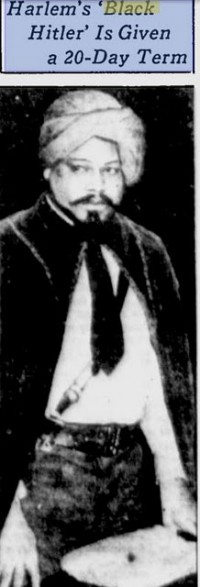

imageThe cape and the turban were sometimes combined with Nazi style military shirt and pants, and jackboots, along with a fez, completing the uniform of a man who is remember today as a pioneering labor leader—but was known back then as the Black Hitler. A dagger thrust through his belt completed the ensemble.

In his stepladder speeches, he declared himself the only man who could stop the Jews, accusing them of spreading filth and disease, and called on his followers to tear out the tongue of any Jew they met. He boasted that he was the “only one fit to carry on the war against the Jews” and vowed an “an open bloody war against the Jews who are much worse than all other whites.” It was speeches like that which earned him the title, ‘Black Hitler’ and intimidated local businesses into hiring workers from his own private labor union. 

The Black Hitler styled himself as Sufi Abdul Hamid, when he opened his mosque, he frontloaded his name all the way up to His Holiness Bishop Amiru Al-Mu-Minin Sufi A. Hamid. His press man claimed that he had been born in Egypt beneath the shadow of a pyramid. The truth is that he was born Eugene Brown in Lowell, Massachusetts and in Chicago had called himself Bishop Conshankin, a Buddhist cleric. Like the Nation of Islam, which was finding its feet at around the same time, his theology was a hodgepodge of traditional Islam and whatever else he picked up along the way.

It is unknown what connection Sufi Abdul Hamid had to the burgeoning Nation of Islam, but in the year before he moved to Harlem— Nation of Islam founder Fard Muhammad disappeared, and his successor Elijah Muhammad moved to Chicago after conflicts with the state government and rival NOI leaders.  Hamid was probably never part of the Nation of Islam, but he had almost certainly seen it in action, and his New York operation was guided by similar methods.

The year was 1932. In Germany, the actual Hitler was running for president. In New York City, Mayor Jimmy Walker was still reigning as the corrupt but entertaining figurehead of the Tammany Hall Democratic party apparatus, but not for long. In a few months the Seabury Commission’s investigation into the city’s horrifyingly corrupt justice system would send the Tin Pan Alley singing mayor fleeing off to Europe along with his showgirl wife.  

The Great Depression had hit New York: The time was ripe for a messiah or a violent explosion. And Sufi Abdul Hamid offered them both

The Great Depression had hit New York’s prosperous commercial and industrial sector like a sledgehammer. The city that never slept had not gone quiet, but it had slowed down. New York’s black population had exploded in its boom days drawn by the lure of jobs, but now that the bust had come the streets of Harlem were full of unemployed men. The time was ripe for a messiah or a violent explosion. And Sufi Abdul Hamid offered them both.

Hamid was not the only one working the streets of Harlem. The Communists in the form of the Young Communist League and the Young Liberators had been there first looking for cannon fodder for the revolution. The Japanese were dreaming of a black army that would serve as their fifth column in the conquest of the United States. Both were to be disappointed. The Black Communist, once commonplace among Harlem intellectuals, would become an endangered species beginning with the Hitler-Stalin pact and ending with the liberal takeover of civil rights. But for now some of those same intellectuals would visit Japan and even endorse its brutal invasion of China.

Marcus Garvey’s UNIA also took Japan’s side. And Imperial Japan’s simultaneous cultivation of Muslims in order to subvert the British Empire, also lead to ties in the US between Japanese officials and the Nation of Islam’s Elijah Muhammad. The Moorish Science Temple, a more explicit fusion of Islam, Asiatic exoticism and Black Nationalism, would eventually be investigated by the FBI for ties to Japan. And the Temple was a probable influence on Hamid’s own Universal Holy Temple of Tranquility. The People’s Voice, a left wing black newspaper, would even claim that Hamid’s temple had been partly funded by Japan.

But Sufi Abdul Hamid did not need Japanese money. He had something better. For all his theatrics, Hamid had been a community organizer and under the slick mustache, the gold lined cape and his gleaming dagger—beat the heart of a union organizer.

What Hamid came up with was a combination labor union, employment agency, protection racket, Islamic cult and protest movement. With black unemployment in Harlem running as high as 50 percent, he offered to find jobs for black men who paid him a dollar. And to make sure they got hired, his men picketed businesses demanding that they get put on the payroll. Businesses which didn’t have a proper proportion of black employees were accused of racism and exploitation. Businesses which did were harassed anyway until they fired their black employees and hired Hamid’s men instead.

Hamid’s 125th street stepladder harangues intimidated Jewish store owners and customers, and many black customers as well. Whenever he succeeded, he picked up more recruits who might not have believed in his religious message, but liked the idea of getting a job. Businesses that paid up didn’t have to worry that the cape wearing hatemonger would show up in front of their store screaming violent threats. And so Hamid’s following grew. As did his bank account.
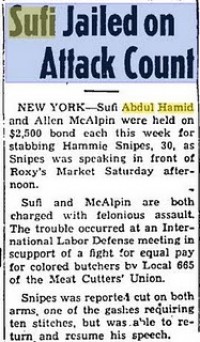
imageBy 1938, Hamid had his own private plane and a white secretary. His union had gone through many names, from the Negro Industrial and Clerical Alliance to the Afro-American Federation of Labor. Adam Clayton Powell briefly joined forces with Sufi Abdul Hamid in labor protests and store boycotts, but Hamid was too power hungry to work with anyone for long. His rhetoric moved beyond anti-white and anti-Jewish racism to targeting light skinned blacks. Violent clashes with rival black unions led to Hamid’s arrest for stabbing Hammie Snipes, a former follower of Marcus Garvey turned Communist labor union organizer. And the courts barred Hamid from his picketing and forced him to focus his energies on his mosque. But in between, Hamid would play a role in Harlem’s first race riot.

The Harlem riot of 1935

The Harlem riot of 1935 had many of the characteristics of the type. False information about police brutality circulated by radicals looking to stir up a mob. Looting misrepresented as a civil rights protest. And a swelling undercurrent of bigotry portrayed as outrage. As Congresswoman Maxine Waters would call the LA riots, “a revolution” and a “a spontaneous reaction to a lot of injustice”—Nannie H. Burroughs compared the Harlem riot to the Boston Tea Party and claimed that it was the duty of the oppressed to revolt.

The tactic was an old one, to unleash violence and then claim to be the only ones who could bottle it up again. Hamid had begun by intimidating storeowners with the threat of racial violence, but the race riot of 1935 would begin the intimidation of the entire neighborhood and eventually the entire city. Once unleashed and legitimized, the violence could no longer be bottled up again. A race riot before 1935 was an unusual phenomenon in Harlem. After 1935, it became far less commonplace. Next year when Joe Louis lost his first fight against Max Schmeling, Harlem rioters attacked white men in the street and dropped bricks from buildings on passing cars.

The 1935 riot would destroy as many black businesses as white ones. But that was the goal of the Communists who had played a major role in organizing the riot, who did not want to see black men reach the middle class, and of Sufi Abdul Hamid, who wanted to increase the scope of his protection racket. The courts had taken a dim view of his labor organizing tactics, but a race riot meant that stores could be hit up in a whole new way.

The riots and arsons went on for three days. Two hundred stores were destroyed and many more were looted, fires were set to cries of “Let it burn”. Entire businesses were wiped out. Some never recovered. The damage to Harlem’s business district was estimated at one million dollars. Bodies went to hospitals and morgues.

After the riot, Hamid began transitioning to a more moderate image. In an interview with the liberal Nation magazine, he disavowed bigotry and claimed to be a champion of the underprivileged. Liberal newspapers were all too eager to accept the nation that the riot was caused by oppression and economic conditions. The New York Times championed an aid package for Harlem. While some Jewish newspapers called the attacks a ‘Pogrom’, the socialist left wing Forward insisted on whitewashing the attacks as a protest against the authorities.

The judicial crackdown on Hamid’s labor extortion project refocused his attention on his mosque, the Universal Holy Temple of Tranquility

The judicial crackdown on Hamid’s labor extortion project refocused his attention on his mosque, the Universal Holy Temple of Tranquility, where he dubbed himself a Bishop. His nickname migrated from the Black Hitler to the Black Mufti. He married Queenie St. Clair, who ran Harlem’s numbers racket. Their marriage however ended badly when Queenie shot him, but failed to kill him. Hamid married again and bought a private plane, an obscene luxury at a time when many of those he claimed to help didn’t have enough to eat. But Hamid frugally kept it low on gas. The plane ran out of fuel over Long Island and crashed. Hamid died, survived by his white secretary who suffered only a broken elbow.

His new wife, a candle shop owner and fortune teller named Dorothy Hamid, who styled herself Madame Fu Futtam, and improbably claimed to be Asian, attempted to keep Hamid’s mosque going with visits that he reportedly made to her nightly from beyond the grave. Her prediction that Hamid would return from the grave in sixty days did not come true. Not long after the mosque had become a dance hall featuring a one legged dancer. Today the site at 103 Morningside Avenue is the home of St. Luke’s Baptist Church.

But though Sufi Abdul Hamid is mostly forgotten today, his legacy lives on

60 years later back on 125th street where the Black Hitler had delivered his stepladder harangues, the smashed windows and burning stores would find another ominous echo. In the winter of 1995—Al Sharpton and his National Action Network went to Harlem to lead a protest against another Jewish store, Freddie’s Fashion Mart. Sharpton denounced Freddie’s owner as a “White Interloper” in Harlem, protesters mimed tossing matches into the store, and one of them threatened to  “Burn the Jew Store Down”. Finally one of the protesters pulled out a gun, ordered the black customers to leave and set the store on fire.  Seven of the store’s mostly Hispanic employees died in the blaze.

Sharpton’s prominence was a testament to how mainstream Sufi Abdul Hamid’s tactics had become. When Obama visited Sharpton last week to celebrate the 20th anniversary of his National Action Network, he was commemorating not just the 20th anniversary of the Crown Heights Pogrom, but an organization which had ominous similarities to Hamid’s own.

The Freddie’s protests had been led by Morris Powell, who had been accused of Nazi type tactics. Powell ran the National Action Network’s Buy Black Committee, which echoed Hamid’s Don’t Buy campaign. Powell’s tactic of standing  outside and screaming hatefilled slurs at passerby would have been entirely familiar to Hamid. “Keep going right on past Freddy’s, he’s one of the greedy Jew bastards killing our people. Don’t give the Jew a dime.”

Powell’s record goes back to 1984 when he broke the head of a Korean woman during one of his pickets. There is no doubt that Sharpton knew exactly whom he was bringing on board.

Sharpton too has more than a little in common with the Black Hitler. Like Hamid, Sharpton started out with a flamboyant personality, playing on bigotry while terrorizing storeowners and entire communities, building the perception of being the man who could unleash or tamp down racial violence, and then toned down the tactics which had power in exchange for political influence. Hamid never lived long enough to gain that kind of influence.. but Sharpton has become a major power broker in the city, the state and even nationwide, with Bloomberg funneling money to his National Action Network and Obama using him as his messenger to the black community.

The lesson of the Black Hitler is that such tactics pay off. Today Hamid is remembered as a pioneering union organizer. And Sharpton has been to the White House more often than any black leader. Sharpton’s gold medallion and Hamid’s turban and cape were showpieces. Their bigoted rhetoric and mob pickets a way of playing on violent populism. Self-interested protests whose goal is to boost the profile of a leader and the bank accounts of his organization have become the bread and butter of more mainstream leaders like Jesse Jackson. Their occasional outbursts of bigotry are forgiven for the power, protection and influence that they can bring to the table.

Even after the fire, Powell returned to Freddie’s screaming, “Freddie Ain’t Dead Yet”. The Black Hitler ain’t dead yet either. Not until his tactics are disavowed for good.


Daniel Greenfield -- Bio and Archives

Daniel Greenfield is a New York City writer and columnist. He is a Shillman Journalism Fellow at the David Horowitz Freedom Center and his articles appears at its Front Page Magazine site.

Fight ELITIST SUPPRESSION—Make CFP Your Go-To Home Page!

Friday, August 21, 2020

Sunday, August 16, 2020

What you see here is battle hardening of the Bolshevik troops


Chicago police officers and violent rioters collided on Saturday as riots broke out in the Windy City. According to Chicago Police, at least 24 people were arrested during the protests that escalated into violence. Four people were arrested and charged with battery of officers, which is a felony. 


"This group deployed large black umbrellas, changed their appearance and began pushing our officers and eventually assaulting them," Chicago Police Superintendent David Brown said.

During the riots, two civilians were injured and 17 police officers were treated for injuries. Police responded with pepper spray and some hit demonstrators with batons. 

Brown said one of the cops injured was an officer who was "beaten in the head several times with a skateboard." The official Twitter account for the Chicago Police shared video of the assault. 

The situation became so uncontrollable that the city was forced to raise the area bridges to limit access. The same defensive tactic was implemented by the city last Sunday during the riots and widespread looting.

"It wasn't until later this afternoon during a separate protest downtown where multiple agitators hijacked this peaceful protest," Brown said.

Chicago Mayor Lori Lightfoot (D) appeared on CBS' "Face the Nation" on Sunday and downplayed the violent riots in her city.  

"What we've seen in cities all across the country, not just Chicago, is a continuing wave of protests," Lightfoot told host Margaret Brennan. "The vast majority of these have been peaceful. But what we've also seen is people who have embedded themselves in these seemingly peaceful protests and come for a fight."

Lightfoot reiterated her opinion that the riots and looting that happened in Chicago last Sunday night were "a planned attack." "It's not spontaneous when you bring U-Haul trucks, cargo vans, and high-end robbery tools," Lightfoot said. 

Lightfoot also said that the city is "never going to get everything that we need from the federal government." She added, "If we waited for them, we'd be in dire straits."

As of Sunday morning, there were also nearly 30 people shot in Chicago this weekend, according to Chicago Police

The extremely concerning trend of teens and children being the victims of gun violence continued this weekend in Chicago. Of those who were shot this weekend, the victims include a 12-year-old boy, a 14-year-old boy, and two 16-year-old boys.


Trivializing Hitler and the Holocaust...these ignorant fools want to steal the high ground of virtue and deny the Holocaust at the same time. There is no rational comparison.

Isn't she in essence calling America a Nazi Stat?


Is Racism in America Worse than in Nazi Germany?

Oprah’s new favorite writer thinks so.


As Shelby Steele has famously pointed out, there are two basic approaches that black American public figures take when addressing whites. There are “challengers,” such as Al Sharpton and Jesse Jackson, who “say you are racist until you prove otherwise.” Then there are “bargainers,” who send white Americans a message to the effect that “I won’t rub America’s racism in your face if you won’t hold my race against me.” Writing in 2007, Steele identified Oprah Winfrey and then presidential candidate Barack Obama as bargainers. Of course, after the election Obama flipped, transforming into a world-class racism scold. That left Oprah, who for a long time was America’s #1 bargainer, and who owes her popularity – and hence her status as the richest black person in America – largely to her longtime tendency to celebrate America for the opportunities it offers rather than to excoriate it for its sins.

Oprah remained a bargainer, more or less, until very recently, when, in a transparent effort to play catch-up with the Black Lives Matter movement, she put Breonna Taylor – who was shot to death on March 13 by Louisville police officers – on the cover of O Magazine and paid for 26 billboards demanding the perpetrators’ arrest. Continuing down the same path, Oprah has now glowingly endorsed Isabel Wilkerson’s Caste: The Origins of Our Discontents, the latest in the current wave of bestselling, poorly written jeremiads depicting America as a cesspit of race hatred. Announcing on August 5 that Caste was her new Book Club selection, Oprah gushed: “I don’t think that there has ever been another pick that has been as vital as this one. This book might well save us.”

Is Wilkerson’s book the key to America’s salvation? On the contrary, Wilkerson, a former Chicago bureau chief of the New York Times and author of the Pulitzer Prize-winning The Warmth of Other Suns: The Epic Story of America's Great Migration, has written a truly execrable and genuinely dangerous tome which, along with Robin DiAngelo’s White Fragility and Ibram X. Kendi’s How to Be an Antiracist, seems destined to further Obama’s wicked work of sowing racial discord in the least racist county on earth. Wilkerson’s thesis is that America is a country divided by caste and that in the U.S. the lowest caste is and always has been black people. As examples of countries with comparable caste systems, she offers up India and Nazi Germany. Noting that Martin Luther King Jr., Gunnar Myrdal, and Ashley Montagu before her have spoken of America as having a caste system, Wilkerson insists on the relevance of the concept in describing American society: “Caste is more than rank, it is a state of mind that holds everyone captive, the dominant imprisoned in an illusion of their own entitlement, the subordinate trapped in the purgatory of someone else’s definition of who they are and who they should be.”

One problem with Wilkerson’s premise is that the language of caste isn’t useful in describing the position of Jews in Nazi Germany. Before Hitler came along, many Jews were in the top rung of German society: nowhere in all of human history, indeed, had Jews ever been so privileged and so free, which was precisely why the Nazis hated them so much. Far from being an underclass, Jews were pulled down from positions of extraordinary prestige and power and sent off to be exterminated like rats. Why, then, does Wilkerson insist on dragging Nazi Germany into her book on caste? Obviously, so she can have an excuse to tell us that American race law, under which a single drop of black blood  was enough to categorize a person as black, was stricter than Nazi race law; that segregation laws in the states of the American South were consulted by participants at the infamous Wannsee Conference, where the Final Solution was agreed upon; and that “Nazi Germany and the American South devised shockingly similar means of punishment to instill terror in the subordinate caste.”

There’s another problem with Wilkerson’s thesis. Yes, the social structure of the antebellum American South, and indeed of the American South right up through Jim Crow, can well be likened to a caste system, if one wishes. But in today’s America the ruling classes – politicians, academics, news media, publishers, entertainment figures, business leaders – all firmly reject black subordination and embrace an ideology that valorizes officially recognized victim groups, supreme among them blacks. In today’s America, affirmative action is ubiquitous, allowing black people of modest attainments to rise with relative ease to positions such as, say, the Chicago bureau chief of the New York Times and giving black authors a leg up when it comes to winning things like the Pulitzer Prize (especially if they write from a politically correct perspective about subjects like the massive black migration from the South to the North).

The starting point of any honest book about race in America should be that this country, in recent decades, has heroically overcome racial inequality, and had pretty much healed its racial wounds until Obama and, later, BLM deliberately sought to rip them back open. But Wilkerson doesn’t accept these facts. She insists on a continuity between America’s past and present, serving up gruesomely detailed accounts of lynchings and unpleasant stories about the brutal enforcement of segregation at public pools. It’s not enough for Wilkerson to say that slavery in the American South was monstrously bad; she feels compelled to paint it as a uniquely “American innovation,” a point she underscores by quoting historian Ariela J. Gross’s absurd claim that American colonists created “an extreme form of slavery that had existed nowhere in the world.” Caste often recalls Howard Zinn’s A People’s History of the United States, which highlights the ugliest chapters of American history and buries the most inspiring ones in order to make students hate their own country.

Yes, you can certainly fill hundreds of pages with horrific tales of whites doing evil things to blacks in the 1870s or 1930s or whenever. You could also fill hundreds of pages with equally horrific case studies in black-on-white or black-on-black crime in Chicago or Detroit or Baltimore during the last five years. But to what end? Wilkerson’s implicit argument is that America still hasn’t faced up to and atoned for its centuries of crimes against its black underclass. “In Germany,” she notes with approval, “displaying the swastika is a crime punishable by up to three years in prison”; by contrast, “In the United States, the rebel flag is incorporated into the official state flag of Mississippi.” Her point: today’s Germany overtly rejects Nazism; America still embraces the Confederacy, and hence the legacy of chattel slavery.

You or I might see the election of Obama as a sign that the American caste system, if it ever existed, was, by November of 2008, patently dead. No, Obama got elected, according to Wilkerson, not because of his race but in spite of it – he was so unprecedented in his sheer magnificence that some white people (though not, she emphasizes, a majority!), even though opposed for reasons of caste condescension to the idea of a black president, felt they just had to vote for this miraculous creature. If his presidency was less than a great success, moreover, it’s because the caste system “handcuffed the president as it had handcuffed the African-Americans facedown on the pavement in the videos that had become part of the landscape.” Moving on, if the 2012 election didn’t so much as hint at a waning of racism, the 2016 election, for Wilkerson, was clearly all about racism – about, that is, “[m]aintaining the caste system.” She cites random post-election incidents in which white people killed blacks, Jews, Indians, and Muslims as if Trump were responsible for these crimes. And she outrageously misrepresents Trump’s record on blacks, ignoring prison reform and record high black employment statistics.  

Don’t believe that anti-black caste thinking is still alive and well in America? To prove otherwise, Wilkerson serves up accounts of various purported microaggressions which took place in recent years and which were supposedly motivated by an attitude of caste superiority. A black professor is mistaken for a mailman; a cardiologist’s black wife is mistaken for the lady from the cleaners. A black marketing consultant is suspected of being an intruder into his own apartment building; a black youth pastor in a car with white kids is suspected of being a kidnapper. The Oscar-winning actor Forest Whitaker is stopped and frisked at a gourmet deli in New York by an employee who doesn’t recognize him. Members of a black women’s club are kicked off an Amtrak train in California for being rowdy – but Wilkerson is sure it’s racism. Another group of black women are kicked off a Pennsylvania golf course for moving too slowly – but again, Wilkerson attributes the action to racism.

Sorry, but these are the sorts of things that happen all the time to people of every race. Just the other day, I was asked by a fellow patron in a shop if I worked there. I smiled and said no, and that was that. Should I have been offended? Should I read something caste-related into the man’s question? I’m not black, but did my behavior or dress suggest to him that I was somehow of a lower order than he is? Besides, you could use Wilkerson’s anecdotes to make an opposite point – namely, that it’s pretty terrific that a black person in the United States can become a cardiologist or a professor or a movie star.

Most of the stories Wilkerson advances to demonstrate the enduring power of caste are about herself. Some of them go on for pages. Because she’s black, she complains, some people who come to the door think she’s a maid – which tells me that she lives lavishly enough that strangers approaching her home imagine she has a maid. (As a fellow writer who lives in a flat where nobody would ever expect to find a maid, I’d gladly change places with her.)

Then there was the time she was stopped at the Detroit airport by DEA agents who, after asking if she was carrying drugs, followed to her car.  For Wilkerson this wasn’t just a brief unpleasantness; it was “a societal disruption, a tear in the daily workings of human interaction.” Such intrusions, she pontificates, “serve to reinforce caste by derailing lower-caste people, subverting their work lives in an already competitive society, imposing additional burdens not borne by their dominant-caste colleagues as they go about their work.” What the DEA agents manifested, she charges, was “the thievery of caste, stealing the time and psychic resources of the marginalized, draining energy in an already uphill competition.” Wilkerson claims that “[t]he quiet mundanity” of the “terror” she experienced at the hands of those DEA agents “has never left me, the scars outliving the cut.”

Sometimes the nightmare occurs not at the airport but on the plane itself. “Because I fly so often,” Wilkerson writes, “I frequently have cause to be seated in first or business class, which can turn me into a living, breathing social experiment without wanting to be.” One time, for example, a flight attendant actually assumed that Wilkerson was in coach! Another time, the man seated behind her got angry when she leaned her seat back, pushing his laptop into his stomach. Then there was the occasion on which she asked a flight attendant to help her with a carry-on and was ignored (or unheard?). After this humiliation, Wilkerson “went back and sat up straight, across the length of the country. The caste system had put me in my place.” Bottom line: she really thinks she has it bad. She recalls describing herself to an Indian man, without a trace of irony, as the American equivalent of a Dalit, or Untouchable. This took place at a London conference that Wilkerson had flown across the Atlantic for the day to attend.

Reading Wilkerson’s airline anecdotes, I thought: haven’t I read this stuff before? Then I remembered that in a recent piece I’d referenced another professional racism scold, Yale professor Claudia Rankine, who in an article for the New York Times Magazine last summer explained that when she flies around the world giving talks, she’s surrounded by white men “in airport lounges and in first-class cabins” who are always, in one way or another, reminding her of her inferior racial status. For example, at one airport, “a white man stepped in front of me” in line, which Rankine interpreted as a reaction by the man to the presence of a black body in his “white space.” She seems never to have imagined that such things happen at airports all the time to people who aren’t black.

But Rankine, ridiculous though she is, doesn’t hold a candle to Wilkerson. I’ve never seen anything to compare with Wilkerson’s unselfconscious narcissism, her apparently photographic memory for every last occasion on which she’s been looked at the wrong way or hasn’t been waited on quickly enough, her certainty that even the slightest of slights that she’s endured is on a par with the Bataan Death March and has to do with her skin color and never anything else. Why hasn’t it ever occurred to me that my own less-than-satisfactory encounters with flight attendants, plumbers, delivery people, and so on could be turned into a book, if only I could find some overarching societal ill to blame them on? Hey, Ms. W., dig this: just before the COVID lockdown, I was taken off a plane at the Oslo airport and strip-searched on the entirely baseless suspicion that I was trafficking narcotics. Eat your heart out!

Needless to say, this woman’s endless whining about horrors in first class are an insult to real suffering by generations of black Americans and real Untouchables and, above all, by the Jews who perished in the Shoah. Instead of appreciating the remarkable progress that has enabled her to spend so much time ordering serfs around in first class, and appreciating the people, white and black, dead and alive, to whom she owes so much for that progress, all Wilkerson can do is to take her privileges for granted, complain endlessly, and insist on her own rightful place in the sacred company of the actual victims of racism, class oppression, and murderous anti-Semitism.  “The friction of caste is killing people,” Wilkerson asserts. “Societal inequity is killing people.” No, it’s not, Ms. Wilkerson. Not in America. You’re not dying. You’re living it up. You’ve made it. You’re jet set. Quit this destructive nonsense and start showing some gratitude and giving some praise.

If I haven’t already made it clear, I found this book utterly sickening to read. Toward the end, as if she hasn’t already thrown enough mud, Wilkerson serves up a disgusting Aaron Sorkin-like litany of cherry-picked statistics designed to make the U.S. sound like the worst place on earth. (No mention that, say, black Americans are the best-off blacks on the planet, or that America is still the top dream destination of the world’s immigrants.) Caste is also stupendously pretentious, awash in bad pseudo-poetic prose: “As we go about our daily lives, caste is the wordless usher in a darkened theater, flashlight cast down in the aisles, guiding us to our assigned seats for a performance.”  And: “We cannot fully understand the current upheavals or most any turning point in American history, without accounting for the human pyramid [of caste] encrypted into us all.”

But what’s by far the worst thing about this book is the mischief it can do, with the dismaying connivance of Oprah Winfrey. It’s a shame. Just the other day I watched Oprah in The Butler, and was moved to tears by her powerful portrayal of the troubled wife who, when her Black Panther son dismisses her husband, a veteran White House butler, as an Uncle Tom, furiously smacks the boy’s face and says to him with deadly seriousness: “Everything you are, and everything you have, is because of that butler!”  There was a time when it was possible to view Oprah Winfrey as the stirringly effective embodiment of a healthy and harmonious post-racial America. No more. By promoting Isabel Wilkerson’s Caste, Oprah has enlisted in the army of division and destruction. Shame on her.


The American public are being played by their own intelligence agencies and corporate media with covert agendas that are deeply anti-democratic.

Via The Strategic Culture Foundation,

William Binney is the former technical director of the U.S. National Security Agency who worked at the agency for 30 years. He is a respected independent critic of how American intelligence services abuse their powers to illegally spy on private communications of U.S. citizens and around the globe. 

Given his expert inside knowledge, it is worth paying attention to what Binney says.

In a media interview this week, he dismissed the so-called Russiagate scandal as a “fabrication” orchestrated by the American Central Intelligence Agency. Many other observers have come to the same conclusion about allegations that Russia interfered in the 2016 U.S. elections with the objective of helping Donald Trump get elected.

But what is particularly valuable about Binney’s judgment is that he cites technical analysis disproving the Russiagate narrative. That narrative remains dominant among U.S. intelligence officials, politicians and pundits, especially those affiliated with the Democrat party, as well as large sections of Western media. The premise of the narrative is the allegation that a Russian state-backed cyber operation hacked into the database and emails of the Democrat party back in 2016. The information perceived as damaging to presidential candidate Hillary Clinton was subsequently disseminated to the Wikileaks whistleblower site and other U.S. media outlets.

A mysterious cyber persona known as “Guccifer 2.0” claimed to be the alleged hacker. U.S. intelligence and news media have attributed Guccifer as a front for Russian cyber operations.

Notably, however, the Russian government has always categorically denied any involvement in alleged hacking or other interference in the 2016 U.S. election, or elections thereafter.

William Binney and other independent former U.S. intelligence experts say they can prove the Russiagate narrative is bogus. The proof relies on their forensic analysis of the data released by Guccifer. The analysis of timestamps demonstrates that the download of voluminous data could not have been physically possible based on known standard internet speeds. These independent experts conclude that the data from the Democrat party could not have been hacked, as Guccifer and Russiagaters claim. It could only have been obtained by a leak from inside the party, perhaps by a disgruntled staffer who downloaded the information on to a disc. That is the only feasible way such a huge amount of data could have been released. That means the “Russian hacker” claims are baseless.

Wikileaks, whose founder Julian Assange is currently imprisoned in Britain pending an extradition trial to the U.S. to face espionage charges, has consistently maintained that their source of files was not a hacker, nor did they collude with Russian intelligence. As a matter of principle, Wikileaks does not disclose the identity of its sources, but the organization has indicated it was an insider leak which provided the information on senior Democrat party corruption.

William Binney says forensic analysis of the files released by Guccifer shows that the mystery hacker deliberately inserted digital “fingerprints” in order to give the impression that the files came from Russian sources. It is known from information later disclosed by former NSA whistleblower Edward Snowden that the CIA has a secretive program – Vault 7 – which is dedicated to false incrimination of cyber attacks to other actors. It seems that the purpose of Guccifer was to create the perception of a connection between Wikileaks and Russian intelligence in order to beef up the Russiagate narrative.

“So that suggested [to] us all the evidence was pointing back to CIA as the originator [of] Guccifer 2.0. And that Guccifer 2.0 was inside CIA… I’m pointing to that group as the group that was probably the originator of Guccifer 2.0 and also this fabrication of the entire story of Russiagate,” concludes Binney in his interview with Sputnik news outlet.


This is not the first time that the Russiagate yarn has been debunked. But it is crucially important to make Binney’s expert views more widely appreciated especially as the U.S. presidential election looms on November 3. As that date approaches, U.S. intelligence and media seem to be intensifying claims about Russian interference and cyber operations. Such wild and unsubstantiated “reports” always refer to the alleged 2016 “hack” of the Democrat party by “Guccifer 2.0” as if it were indisputable evidence of Russian interference and the “original sin” of supposed Kremlin malign activity. The unsubstantiated 2016 “hack” is continually cited as the “precedent” and “provenance” of more recent “reports” that purport to claim Russian interference.

Given the torrent of Russiagate derivatives expected in this U.S. election cycle, which is damaging U.S.-Russia bilateral relations and recklessly winding up geopolitical tensions, it is thus of paramount importance to listen to the conclusions of honorable experts like William Binney.

The American public are being played by their own intelligence agencies and corporate media with covert agendas that are deeply anti-democratic.


    Saturday, August 15, 2020

    Friends of the Iranian terror state.

    UN Security Council rejects Iran arms embargo extension

    The US-sponsored resolution only got two "yes" votes at the UN Security Council, falling far short of the nine it needed to be adopted. China and Russia rejected the proposal, while Germany abstained.


    Here are the members of the UN Security Council:


    The Council is composed of 15 Members:

    Five permanent members: ChinaFranceRussian Federationthe United Kingdom, and the United States, and ten non-permanent members elected for two-year terms by the General Assembly (with end of term year):