The 2019 legislative session ended Friday, having provided proof positive that “moderate” suburban state senators do little but enable the extremists.
The Senate joined the longtime-progressive Assembly in passing a host of badly thought-out, far-left bills that will hit New York hard for years to come. And Gov. Cuomo, who has long painted himself as a voice of reason, was a willing accomplice.
The malpractice began with a budget in March that (beneath the fiscal gimmicks) brought a nearly 5 percent spike in state-funded spending, the Citizens Budget Commission reported. That’s twice what Cuomo pledged and three times inflation.
Lawmakers also decided that New Yorkers, already bearing the highest state- and local-tax burden in America, must pay more — via fresh hits like the mansion tax and a new Internet sales tax. They also imposed hefty new tolls on Manhattan motorists.
The damage went far beyond budget items: Botched criminal-justice reforms, for instance, will put more bad guys on the streets, handing white-collar criminals “a get-out-of-jail-free card,” as Manhattan DA Cy Vance has warned.
Scrapping the requirement to post bail for all but a few violent crimes, he added, will boost the “racial and socioeconomic disparity in our jail population.”
Plus, new rules for prosecutors to collect and share evidence will mean heavy new costs (with no new funding) and make it far harder to protect witnesses who put their lives on the line to testify.
And that was just the start of the leftward sprint. In the waning weeks of the session, lawmakers:
l Rushed through rent-control “reforms” sure to discourage future development, repairs and upgrades of apartment buildings. They’ll also push up rents of non-regulated units, making it harder for average folks to find a place. The new law also locked in this lunacy by scrapping the “sunset dates” that rent laws have featured for decades.
l Passed the Climate and Community Protection Act, which hands state agencies massive new power over New York’s economy and promises to impose untold billions in costs and fees.
And if devastating the state economy does bring net-zero carbon emissions by 2050, the impact on world temperatures would be minuscule.
l OK’d driver’s licenses for illegal immigrants, thumbing their noses at the public, which, the Siena poll found, opposes the idea 53 percent to 41 percent. All to “normalize” people who broke the law by entering the country illegally.
l Gave striking union members a gift pushing through a bill making them eligible for unemployment-insurance benefits after just one week, instead of the current eight. That shifts the cost to employers — and makes strikes more likely.
l Failed to raise the cap on city charter schools, meaning no more can open — even though some 50,000 kids are desperate to escape the dysfunction at traditional public schools and get a seat at higher-performing charter.
l Refused to lift a finger to make state contracting and corporate subsidies more transparent, accountable and better scrutinized. Hey, why stop the waste and corruption?
Meanwhile, the legislative process was as chaotic, secretive and disgusting as ever, with deals struck behind closed doors, little debate and bills rushed through at the 11th hour.
For all its flaws, a Republican-run Senate stopped the worst lefty lunacy. Suburban Democrats had the power to do that this year, with their constituents’ support. That they instead caved to the radicals gives the GOP a serious chance for a comeback.
Bill de Blasio speaks to the graduates of the Boys and Girls High School in Brooklyn.AP
Mayor de Blasio vowed to “shake the foundations of New York City education” by showering 94 poorly performing public schools with taxpayer money to pay for an extra hour of daily instruction, special training for the teachers and extra social services for the kids.
Officially dubbed the “School Renewal Program,” de Blasio said he preferred a less-formal title when he announced the $150 million turnaround plan in November 2014.
“My name is simpler — it’s ‘No Bad Schools,’ ” he told a packed auditorium at East Harlem’s Coalition School for Social Change, one of those targeted for recovery.
Calling his vision a break from the past — when struggling schools were simply “written off” and shut down — de Blasio also said his hand-picked schools chancellor, Carmen Fariña, had already started evaluating administrators “to make sure our school leadership begins improving immediately.”
But that’s not quite how it turned out.
With a three-year deadline looming, progress has been spotty at best and the Department of Education has already given up on 17 schools. It plans to continue the program in September with 78 schools, including one that was created by merging two it shut.
Some supporters have started questioning the program, which critics blast as a costly sinkhole that’s entered a death spiral
Some supporters have started questioning the program, which critics blast as a costly sinkhole that’s entered a death spiral.
“Failed schools don’t reinvent themselves,” said Eric Nadelstern, a former deputy schools chancellor for instruction under Mayor Mike Bloomberg and currently a professor at Columbia University’s Teachers College. “Education will only get well if we reward success and penalize failure. The Renewal program does exactly the opposite.”
The annual cost of the program has risen to $186.5 million this school year, with total spending through the 2018-2019 year estimated at $754.2 million, according to the latest figures from the Independent Budget Office.
The Department of Education will not say where all the money goes. The Post has learned that $8.5 million is paid to 72 Office of Renewal Schools “directors” and “instructional coaches.” Since last school year, another $3.7 million went to “leadership coaches,” including many retired principals, each making $660 to $1,400 a day.
Meanwhile, DOE statistics show that:
Total enrollment at the 86 Renewal schools currently open has plummeted nearly 25 percent — from 49,391 to 37,146 — since the 2013-2014 school year, before the program began.
Average per-student spending at each Renewal school is $14,632 this school year, up nearly 35 percent from $10,847 in 2013-2014 — and more than twice the cost of educating students at the elite Stuyvesant and Brooklyn Tech high schools.
Only three Renewal schools met all their improvement goals last school year, while 61 showed declines in at least one category and 13 fell in three or more — even after the Renewal schools were given three years to hit targets for which other schools only got one.
In recent weeks, the Department of Education has mounted a public-relations blitz to boost the Renewal schools, releasing preliminary data showing their average four-year graduation rate rose to 58.5 percent last year — then revising that number up to 59.3 percent and saying the increase from 2015 was more than twice the citywide average.
At a Feb. 10 news conference trumpeting the 4.8-point jump, de Blasio claimed it “proves that real impact is being made through the Renewal School initiative.”
But his administration had to admit that the dropout rate at Renewal schools rose to 18.6 percent last year, even as the citywide rate declined to a record low of 8.5 percent.
City Hall also ignored the fact that declining enrollment means the Renewal high schools actually graduated 18 percent fewer students — or 750 kids — than they did in 2014, before the program began.
Even worse, DOE statistics show the rate of “college readiness” among Renewal grads — defined as meeting CUNY standards for avoiding remedial classes — was just 12.3 percent last year, one-third the citywide average of 37 percent.
And while the citywide college-readiness rate has risen steadily over the past three years, the Renewal schools saw a slight overall dip last year, when 10 showed declines from 2015 and one — Leadership Institute, which is slated for closure — sank to a dismal 2 percent.
In addition, nine Renewal high schools have seen their college-readiness rates fall since 2014, before the turnaround program began. “What this year’s data really shows is that the de Blasio administration is simply lowering standards to boost graduation rates,” said Jeremiah Kittredge of Families for Excellent Schools, a pro-charter group.
“While that may help the mayor’s approval rating, it does nothing for the thousands of students trapped in his failing Renewal Schools program who are graduating woefully unprepared for college.”
Chancellor Fariña also penned a Feb. 1 op-ed in the Daily News claiming that “Renewal Schools are seeing real progress” and pointing in part to higher scores on state tests and lower numbers of suspensions.
She failed to note that the 2016 state Common Core exams had fewer questions and no time limits, with state Education Commissioner Maryellen Elia cautioning, “It’s not an apples-to-apples comparison with previous years.”
‘At many of these schools, the bar was set so low, and some of them couldn’t get over the low bar’
Nor did Fariña mention that the drop in suspensions followed last year’s easing of disciplinary rules so that students in kindergarten to second grade can no longer be suspended and instead face unspecified, “positive” and “age-appropriate discipline techniques.”
A teacher at one Renewal high school, Richmond Hill, said teachers also faced pressure from administrators to limit suspensions of older kids to improve statistics.
“The kids run the schools,” the teacher said. “They know they can get away with pretty much whatever they want at this point. We’re in a position where we either allow chaos in the classroom or have administrators get pissed. It’s an unwritten rule now: Just let it go.”
A former state education official who helped oversee low-performing schools called the Renewal program a “colossal waste of money.”
“At many of these schools, the bar was set so low, and some of them couldn’t get over the low bar. How pathetic,” the ex-official said.
Two union leaders who initially supported the Renewal plan have since soured on it.
Ernest Logan of the Council of School Supervisors and Administrators was the first to break ranks. In January 2016, Logan wrote in his union’s newsletter that the DOE’s bureaucracy had turned the program into a “recipe for disaster” — then publicly denounced it at a November panel discussion, saying: “If I told you that we spent $14,000-plus a kid and you know what you only got is a 1 percent improvement, you’d run me out the country.”
United Federation of Teachers boss Michael Mulgrew said in January he was “clearly frustrated” by the lack of progress.
“Parents and teachers are leaving in droves. These schools are not being managed properly,” Mulgrew told NY1 News.
A retired educator familiar with the Renewal program blamed meddling by officials from the DOE’s seven Borough Field Support Centers, which Fariña established in 2015.
At the time, she claimed the 700-plus Support Center staffers would “ensure schools get the tailored supports they need,” including “teaching and learning, finance and human resources, operations, student services, special education and English language learners.”
But the source said, “These places are staffed by people who are not anywhere near experts in the field.
“In half the cases they were probably very good two-, three-, four-year teachers. But they’re not the people to be walking into a building telling [assistant principals] or principals what to do.”
The Class Size Matters advocacy group has also compiled data showing that about 40 percent of elementary and middle schools in the Renewal program — and nearly all of the high schools — have some classes with 30 or more students in them.
The group’s executive director, Leonie Haimson, called the situation “unconscionable” and noted how the DOE had repeatedly pledged to “focus class size reduction planning efforts on the School Renewal Program.”
“Because of the DOE’s refusal to reduce class size, the Renewal program is doomed to fail.”
DOE spokeswoman Toya Holness defended the program.“This is hard work, and there’s more to do, but students are making gains: graduation and attendance rates are up and chronic absenteeism, suspensions and serious incidents are down.”
Additional reporting by Selim Algar and Carl Campanile
It’s no secret that tickets bought by SunRail passengers pay only a tiny fraction of the commuter train’s bills, but less known is that ticket revenue doesn’t even cover the cost of selling tickets.
SunRail’s finances would be slightly stronger if riding was free. Put another way, the revenue of $1 to $7.50 per ticket is devoured by ticket machines, employees who support ticket sales and armored cars that collect fares, and does nothing to keep the train running.
“If we have to pay more money to collect revenue than we are actually collecting, why does it make sense to collect it at all?” asked Orlando Mayor Buddy Dyer, speaking this week as a member of the Central Florida Commuter Rail Commission.
The question, an aside during a budget review, was rooted in real-world experience. Orlando has operated free buses in the city’s core, now carrying about as many passengers as SunRail, for nearly 25 years.
SunRail’s ticket pricing was set in motion according to a mature commuter system, which remains years away.
In the last half of last year, ticket revenue was $914,572, while ticket costs were $932,690. Since SunRail began in 2014, ticket revenue of about $5.4 million was $147,872 less than ticket expenses.
“Are you serious?” was the response from Gloria Balaguer, when told of the ticket economics as she stepped off a train at Central Station with her 3-year-old son on Friday.
“Maybe they should do away with the ticket machines,” said Cathy Griffin, a retiree waiting for a train.
SunRail’s operator, the Florida Department of Transportation, had two responses: the commuter train would be wildly or even possibly too popular if there was no charge; and, when the current service of 31 miles is doubled in coming years, ticket income may exceed ticket expenses.
Dyer asked whether with a coming route expansion ticketing “will at least break even?”
“That would be hopeful,” said Nicola Liquori, DOT’s director of SunRail.
The unscheduled discussion popped up as SunRail faces a confluence of pressing challenges, including Florida DOT’s 2021 handing over of operations and costs to local governments.
Construction of a southern extension into Osceola County, adding four station and 17 miles, has fallen behind. Florida DOT had expected to finish it later this year but now fears work may not be done until summer next year.
“It’s very disappointing,” said Viviana Janer, a member of the commuter-rail commission and an Osceola County commissioner.
Also a worry for DOT and SunRail supporters is the uncertainty of a critically needed, and already once-denied, federal grant to build a northern extension of SunRail farther into Volusia County.
Florida DOT expects to apply for the grant this year, but Liquori said that amid early days of President Donald Trump she is waiting for direction from the Federal Transit Association.
“As you might you might expect with the new administration, they are not entirely certain what the timing of that opportunity is but they assured us they would let us know as soon as they knew something,” Liquori said.
A third source of stress for SunRail is flagging ridership. Below expectations from the start, train usage dropped to 887,070 riders in 2016 from 932,161 passengers the year before.
Average daily ridership bounced from 3,303 in November to 3,623 in December and down to 3,407 last month.
Florida DOT spokesman Steve Olson explained to the commuter-rail commission that SunRail has lost the “buzz” of its early days.
“How do we create that buzz again? How do we get that excitement out there?” Olson said.
Marketing consultant Carson Chandler described efforts by the commuter railroad to enlist local artists “to take a SunRail train and turn it into a rolling art gallery.”
Art would be affixed inside and outside train cars by mid-March, Chandler said.
One of SunRail’s effective drawing cards, Saturday service for major entertainment events, is about to end.
That occasional service began late last year, paid for by businesses and government entities at a rate of more than $20,000 for each Saturday.
Enough sponsorship money remains to run trains Saturday, March 18, for the popular Winter Park Sidewalk Art Festival and possibly once again in April.
Dyer has asked DOT to prepare projections of when revenue from ticketing would exceed costs of ticketing. “It would make sense to me just to offer free service,” he said.
But Orange County Mayor Teresa Jacobs, a member of the commission, said SunRail’s image would take a hit if tickets were suspended now, then brought back when the train’s route is extended.
Later, Dyer agreed with Jacobs.
“There is an optic to ‘oh, you’ve been giving free ridership and now you expand the service and you are going to charge us?’”
The latest numbers from the U.S. Treasury say the United State’s federal debt has risen by a trillion dollars in President Obama’s final year in office, while Republicans controlled both the House and Senate.
The debt at the end of 2016 was $19,976,826,951,047.80, a one-year increase of $1,054,647,941,626.91.
To put the number in perspective, in order to spend one trillion dollars, you would have to spend ten million dollars a day, every day for 273 years.
The new number continue the rising spiral of debt during the Obama administration. As CNS News reports:
During President Barack Obama’s time in office the federal debt has increased by $9,349,949,902,134.72—rising from $10,626,877,048,913.08 on Jan. 20, 2009, the day of Obama’s inauguration, to $19,976,826,951,047.80 on the last day of 2016.
That equals $78,553.84 for each of the 119,026,000 households in the country as of September.
President-elect Trump spoke out against the debt during the election, and made proposals such as the controversial idea of buying back bonds at a discount rate.
Many who had pulled out of poverty are now falling back in
‘It doesn’t feel like Christmas at all,’ one shop owner says
Few Brazilians will mourn the passing of 2016. The president was impeached, a vast corruption scandal dominated the headlines day after day and a devastating recession - the worst on record - crushed the hopes of millions.
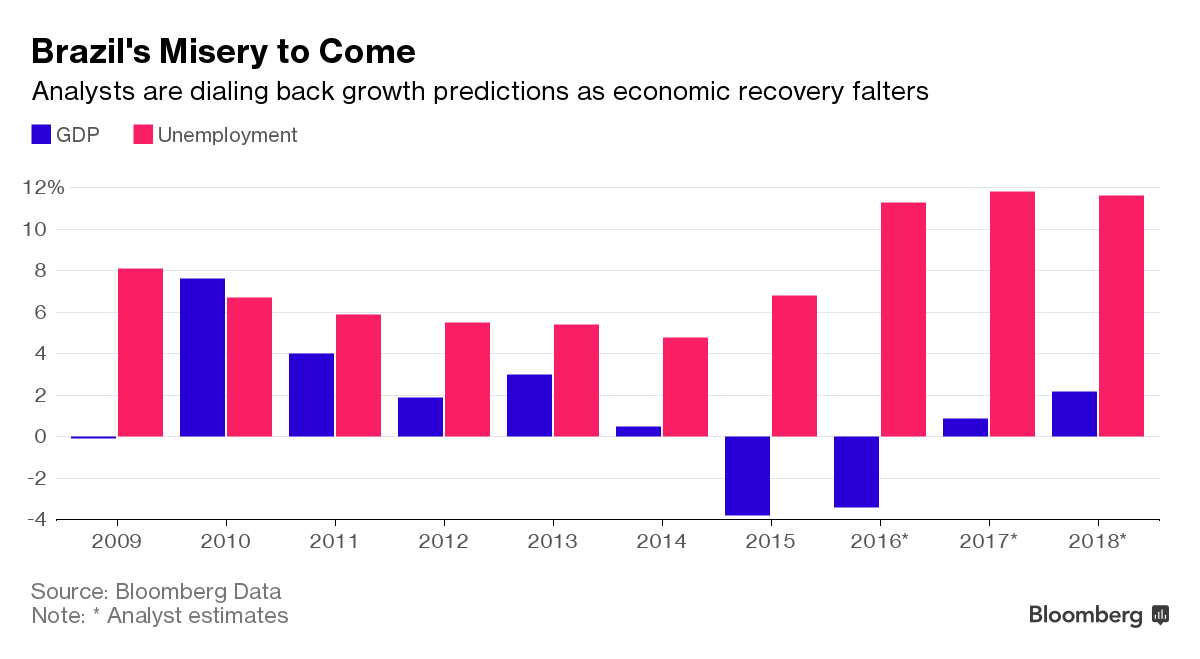
It is that last element that remains the most painful today. For while financial markets have rebounded as the new administration sought to calm jittery investors, the economy is showing precious few signs of improving. And most analysts are now dialing back 2017 growth predictions to almost zero.
In Brasilia, the capital city and home to the highest income per capita in this nation of 206 million, shop owners complain about one of the worst Christmas seasons ever. Asked how business was going at his electronics store, Antonio Renato Pires returned a blank stare and, after a long period of silence, said: "Terrible."
"It doesn’t feel like Christmas at all."
Signs of economic malaise abound throughout the country and across social classes as Brazil’s recession proves to be deeper and more persistent than most had expected. Gross domestic product is estimated to have fallen more than 7 percent in two years, causing unemployment to nearly triple. At least 10 percent of the 35 million people that emerged from poverty in the decade through 2014 have fallen back down the social ladder again.
Losing out
Mariana Nunes, who holds a Master’s Degree in marketing and worked at a major telecommunications company in Brasilia, until 2014 had a maid, private health insurance , and went out to a bar or a show once a week. She even traveled to the U.S. twice. Today, she lost all those perks, defaulted on 5,000 reais ($1,501) in credit card debt and sells home-made cakes to get by.
"I earned well and had a good life, and today I’ve lost out financially and psychologically," said the 35 year-old, who has been suffering from depression and panic attacks since she lost her job at a gym in late 2015. "There was a social and economic balance in the country. We knew the government was stealing but nobody wanted to deal with that because everybody had a job and lived well," she said while baking a cake at her mother’s house in a working-class district on the outskirts of Brasilia.
It has been particularly painful for those Brazilians who had just begun to taste the comforts of middle class-life before having to give them up again. "It’s harder to lose something you acquired than remaining where you are," said Marcelo Neri, director of the social policy center at the Getulio Vargas Institute, a business school and think tank.
The institute’s social policy center estimates that the country’s poverty rate jumped from 8.3 percent to 10 percent between 2014 and 2015, an increase that Neri says accelerated further this year.
Pedestrians pass in front of a newsstand in Sao Paulo.
The social security network that had provided some relief to the nation’s poorest is showing signs of crumbling as well, as the recession eroded tax revenue and forced several states to declare a state of financial emergency.
Battered by a debt crisis, Rio de Janeiro state recently shut down most of the so-called citizen restaurants that served a basic meal for 2 reais ($0.60). That puts an extra burden on Jordelio Ferreira, a 42-year-old street vendor, to feed himself and his family.
"I used to eat lunch there sometimes,” he said sitting on the street curb under a makeshift umbrella with his wife and toddler by his side. “Now we have to make do somehow." The standard box lunch with rice, beans and a small piece of meat costs upward of 15 reais ($4.5).
Brazil’s upper middle class is also feeling the recession, albeit on a different scale. At a private school in Brasilia’s upscale Lago Sul neighborhood parents recently organized a used-book sale for the first time ever to help meet the $750-per-child cost of new books.
Public services such as education and health, which had already been overburdened before the recession and became the focus of mass street protests in 2013, are struggling to cope with the influx of students and patients who could no longer afford private schools or health insurance.
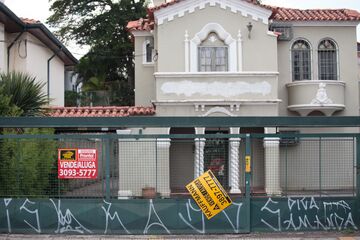
For Sale Signs are displayed in front of a vacant property in Sao Paulo
Taina Caldas, a 20 year-old psychology student from Rio de Janeiro, tried to keep her sore throat at bay for four days until a sleepless night drove her to a state-run first-aid unit, or UPA by its Portuguese acronym, for the first time in her life. Her mom had canceled the family’s private health insurance a few months after she lost her job managing a store.
“We couldn’t keep paying,” Caldas said during her two-and-a-half-hour wait. “I confess I didn’t want to come to an UPA. I always went to private hospitals. I asked my mom to come along to show me how to do everything.”
According to the clinic’s medical coordinator, Maria Christina Tavares, former private patients now account for roughly 25 percent of those attended to, adding an hour to the typical wait for low-risk patients. As part of further cost-cutting measures the unit is unable to provide drugs for patients who don’t stay overnight.
After the party, the hangover
One of the reasons Brazil’s crisis is deeper and longer than many had forecast is that much of the growth that preceded it, had been artificially sustained by subsidized loans, tax breaks, and price caps that fueled consumption but also staggering levels of debt that now prevent investment and consumption.
"Companies are in debt, families are in debt, and banks have cash but are unwilling to lend," said Carlos Thadeu de Freitas, chief economist at the National Commerce Confederation in Rio de Janeiro.
Economists surveyed by the central bank have slashed their 2017 growth estimates to 0.6 percent from 1.4 percent only three months ago. Credit Suisse and Bradesco forecast no growth and a 0.3 percent expansion next year, respectively.
Indeed for many people, Christmas may be grim next year too, according to Carlos Henrique Corseuil, an economist at the government-run economic think tank Ipea. He sees unemployment rising further in coming months before leveling off in the second half of next year. To experience a true economic rebound, he said, Brazilians will have to wait at least until 2018.
At the close of business on Monday, July 18, the total federal debt was $19,391,094,247,028.26, according to the Treasury. By the close of business on Tuesday, July 19, it had risen to $19,402,361,890,929.46.
On Friday, Oct. 30, 2015, Congress passed the “Bipartisan Budget Act,” which suspended the legal debt limit until March 15, 2017. President Obama signed that bill into law on Monday, Nov. 2, 2015
At the close of business on Oct. 30, the federal debt stood at $18,152,981,685,747.52.
In the less than nine months since then, the federal debt has increased by $1,249,380,205,181.94
Title IX of the Bipartisan Budget Act is entitled “Temporary Extension of Public Debt Limit.” The Congressional Research Service summary explains that part of the law this way: “The public debt limit is suspended through March 15, 2017. On March 16, 2017, the limit is increased to accommodate obligations issued during the suspension period.”
Prior to President Obama signing the Bipartisan Budget Act, the Treasury had been in a "debt issuance suspension period" that Treasury Secretary Jacob Lew had declared on March 16, 2015. During that "debt issuance suspension period" the Treasury took what it calls "extraordinary measures" to prevent the debt from exceeding what was then the legal limit.
(CNSNews.com) - Spending by the Social Security Administration--which includes payments for Social Security and disability benefits as well as Supplemental Security Income payments and the administrative costs for these programs--hit a record $944,143,000,000 in fiscal 2015, according to data published by the U.S. Treasury[1].
Even in constant 2015 dollars (with adjustments made using the Bureau of Labor Statistics inflation calculator[2]), that was up $33,748,280,000 from the $910,394,720,000 the Social Security Administration spent in 2015 dollars in fiscal 2014.
As of September, there were 59,737,817 beneficiaries getting Social Security or disability benefits, according to the SSA[3]. At the same time, according to the Bureau of Labor Statistics, there were 148,800,000 people who had either a full- or part-time job in the United States. That means there were only 2.49 people with jobs for each of the 59,737,817 Social Security and disability beneficiaries.
At the same time, there were only 121,839,000 people with full-time jobs in the United States in September, according to BLS. Those 121,839,000 full-time job holders equaled about 2.04 for each of the 59,737,817 people getting Social Security or disability benefits.
The $944,143,000,000 spent by the Social Security Administration in fiscal 2015 equaled about $6,345 for each of the 148,800,000 persons in the country with a job as of September. It equaled about $7,749 for each of the 121,839,000 people with a full-time job.
The $944,143,000,000 that the Social Security Administration spent in fiscal 2015 was also $381,637,000,000 (or about 68 percent) more than the $562,506,000,000 that the Treasury says the government spent on the Department of Defense and military programs during the year.
In Table 5 of the Monthly Treasury Statement for September, the Treasury itemized the various elements that led to the $944,143,000,000 in total spending by the Social Security Administration in fiscal 2015.
These included $733,716,000,000 in benefits payments from the Old-Age and Survivors Insurance Trust Fund, plus $3,505,000,000 in payments to cover administrative expenses for that fund and $4,258,000,000 in payments to the Railroad Retirement Account.
They also included $143,009,000,000 in disability benefit payments, $2,881,000,000 in payments for administrative expenses for the disability trust fund, and another $419,000,000 in payments to the Railroad Retirement Account.
The Social Security Administration’s expenditures also included $58,901,000,000 for the Supplemental Security Income Program.
“SSI, which went into effect in 1974, is a need-based program that provides cash payments assuring a minimum income for aged, blind, or disabled individuals who have very limited income and assets,” says the Congressional Research Service. “This program is often referred to as a ‘program of last resort’ since individuals who apply for benefits are also required to apply for all other benefits to which they may be entitled (such as Social Security retirement or disability benefits, pensions, or unemployment benefits).6 Although the SSI program is administered by SSA, it is funded through general revenues—not payroll taxes.”
The “SSI Annual Statistical Report, 2014,” published last month by the Social Security Administration, said there were 8,335,704 SSI recipients in 2014. That was down from 8,363,477 in 2013, but up from the 8,262,877 there were in 2012.
In October, the first month of fiscal 2016, the number of Social Security and disability beneficiaries climbed by 94,763, rising from 59,737,817 to 59,832,580.
The 59,832,580 beneficiaries in October included 39,968,311 retired workers, 2,330,148 spouses of retired workers, 641,654 children of retired workers, 6,077,209 survivors of deceased workers, 8,922,858 disabled workers, 143,164 spouses of disabled workers, and 1,749,236 children of disabled workers.
Keep these in mind as you contemplate the direction of the American government over the past 50 years and especially since the Obama election.
The Goals of Communism
(as read into the congressional record January 10, 1963, from "The Naked Communist" by Cleon Skousen)
1. U.S. acceptance of coexistence as the only alternative to atomic war.
2. U.S. willingness to capitulate in preference to engaging in atomic war.
3. Develop the illusion that total disarmament of the United States would be a demonstration of moral strength.
4. Permit free trade between all nations regardless of Communist affiliation and regardless of whether or not items could be used for war.
5. Extension of long-term loans to Russia and Soviet satellites.
6. Provide American aid to all nations regardless of Communist domination.
7. Grant recognition of Red China. Admission of Red China to the U.N.
8. Set up East and West Germany as separate states in spite of Khrushchev's promise in 1955 to settle the German question by free elections under supervision of the U.N.
9. Prolong the conferences to ban atomic tests because the United States has agreed to suspend tests as long as negotiations are in progress.
10. Allow all Soviet satellites individual representation in the U.N.
11. Promote the U.N. as the only hope for mankind. If its charter is rewritten, demand that it be set up as a one-world government with its own independent armed forces. (Some Communist leaders believe the world can be taken over as easily by the U.N. as by Moscow. Sometimes these two centers compete with each other as they are now doing in the Congo.)
12. Resist any attempt to outlaw the Communist Party.
13. Do away with all loyalty oaths.
14. Continue giving Russia access to the U.S. Patent Office.
15. Capture one or both of the political parties in the United States.
16. Use technical decisions of the courts to weaken basic American institutions by claiming their activities violate civil rights.
17. Get control of the schools. Use them as transmission belts for socialism and current Communist propaganda. Soften the curriculum. Get control of teachers' associations. Put the party line in textbooks.
18. Gain control of all student newspapers.
19. Use student riots to foment public protests against programs or organizations which are under Communist attack.
20. Infiltrate the press. Get control of book-review assignments, editorial writing, policymaking positions.
21. Gain control of key positions in radio, TV, and motion pictures.
22. Continue discrediting American culture by degrading all forms of artistic expression. An American Communist cell was told to "eliminate all good sculpture from parks and buildings, substitute shapeless, awkward and meaningless forms."
23. Control art critics and directors of art museums. "Our plan is to promote ugliness, repulsive, meaningless art."
24. Eliminate all laws governing obscenity by calling them "censorship" and a violation of free speech and free press.
25. Break down cultural standards of morality by promoting pornography and obscenity in books, magazines, motion pictures, radio, and TV.
26. Present homosexuality, degeneracy and promiscuity as "normal, natural, healthy."
27. Infiltrate the churches and replace revealed religion with "social" religion. Discredit the Bible and emphasize the need for intellectual maturity which does not need a "religious crutch."
28. Eliminate prayer or any phase of religious expression in the schools on the ground that it violates the principle of "separation of church and state."
29. Discredit the American Constitution by calling it inadequate, old-fashioned, out of step with modern needs, a hindrance to cooperation between nations on a worldwide basis.
30. Discredit the American Founding Fathers. Present them as selfish aristocrats who had no concern for the "common man."
31. Belittle all forms of American culture and discourage the teaching of American history on the ground that it was only a minor part of the "big picture." Give more emphasis to Russian history since the Communists took over.
32. Support any socialist movement to give centralized control over any part of the culture--education, social agencies, welfare programs, mental health clinics, etc.
33. Eliminate all laws or procedures which interfere with the operation of the Communist apparatus.
34. Eliminate the House Committee on Un-American Activities.
35. Discredit and eventually dismantle the FBI.
36. Infiltrate and gain control of more unions.
37. Infiltrate and gain control of big business.
38. Transfer some of the powers of arrest from the police to social agencies. Treat all behavioral problems as psychiatric disorders which no one but psychiatrists can understand.
39. Dominate the psychiatric profession and use mental health laws as a means of gaining coercive control over those who oppose Communist goals.
40. Discredit the family as an institution. Encourage promiscuity and easy divorce.
41. Emphasize the need to raise children away from the negative influence of parents. Attribute prejudices, mental blocks and retarding of children to suppressive influence of parents.
42. Create the impression that violence and insurrection are legitimate aspects of the American tradition; that students and special-interest groups should rise up and use united force to solve economic, political or social problems.
43. Overthrow all colonial governments before native populations are ready for self-government.
44. Internationalize the Panama Canal.
45. Repeal the Connally reservation so the United States cannot prevent the World Court from seizing jurisdiction over nations and individuals alike.






 Posts
Posts


