Many Hong Kongers are watching the scale of China's crackdown in Xinjiang with fear. A protest in support of the Uighurs was violently put down by riot police.
Hong Kong riot police on Sunday forcefully broke up a rally of pro-democracy protesters showing solidarity with China's oppressed Uighur minority.
Around 1,000 people gathered peacefully near Hong Kong's Harbourfront, waving Uighur flags and posters in the latest in nearly seven months of protests against China in the semi-autonomous city.
"We shall not forget those who share a common goal with us, our struggle for freedom and democracy and the rage against the Chinese Communist Party," one speaker shouted through the loudspeaker to the crowd.
Police later swooped in using pepper spray to disperse protesters, who countered by throwing glass bottles and rocks.
United Nations experts and human rights organizations have documented that China has imprisoned at least 1 million Uighurs and members of other largely Muslim minority groups in internment camps in the northwestern region of Xinjiang.
China claims the prison camps are "vocational training centers" necessary to combat terrorism in the restive province. Beijing has denied mistreating Uighurs and acted in defiance of a chorus of international criticism over the harsh crackdown.
Watch video02:08
Uighur researcher: China destroying cultural symbols
Hong Kong watches treatment of Uighurs
China runs Hong Kong under a "one country, two systems" model that grants the financial capital expanded freedoms not enjoyed on the mainland. Many Hong Kongers view China as encroaching on these freedoms and fear mainland policies will come to the city.
The huge scale of the surveillance and prison systemin Xinjiang has been closely watched in Hong Kong, with many fearful that similar measures could befall the city.
"The Chinese government are control freaks; they can't stand any opinions they disagree with," Katherine, a protester in her late 20s and a civil servant, told AFP before police moved in.
"In Xinjiang they are doing what they are doing because they have the power to do so. When they take over Hong Kong, they will do the same," she added.
In 2047, 50 years after Britain handed the city back to China, the deal granting Hong Kong special rights ends.
Turkish President Recep Tayyip Erdogan holds a map during his speech at the United Nations General Assembly in New York on Sept. 24. STEPHANIE KEITH/GETTY IMAGES
One of the many reasons Turkey’s recent incursion into Syria has been widely condemned is Turkish President Recep Tayyip Erdogan’s associated plan to deport and resettle large numbers of Syrian refugees. Erdogan has long proposed a so-called safe zone in Syria along the Turkish border, and at the United Nations General Assembly on Sept. 24 he outlined a plan to resettle 1 million to 2 million of the 3.6 million Syrian refugees his country is currently hosting.
The practical obstacles to this proposal are vast. But the biggest political problems are historical.First, consider the practical objectives. Turkey’s incursion and subsequentdealin October with Russia have left Ankara controlling a 75-mile strip of borderland between the Syrian towns of Tell Abyad and Ras al-Ain, with joint Turkish-Russian patrols extending 6 miles south and a U.S.-endorsed safe zone extending 20 miles from the border. This is far smaller than the huge 20-mile-deep corridor running 300 miles along the border that Erdogan was originally hoping for.
Erdogan reiterated his determination to carry out his plan as recently as Nov. 1. But Turkey has been left in control of an area so small—about 400 square miles—and desolate that most analysts doubt millions of refugees could fit there. “The practicalities of settling millions of refugees into what is a pretty narrow corridor of land are pretty ambitious, and I fail to see how Turkey has the capacity to do so,” said Ryan Gingeras, a Turkey expert at the Department of National Security Affairs of the Naval Postgraduate School.
Another major concern is that most of the resettled refugees would be Arab Sunni Muslims from Aleppo and Idlib—places far to the west of the safe zone, where the local population includes Arab, Kurdish, and Christian populations. Many critics accuse Ankara of attempting to demographically engineer the area to reduce the presence of Kurds and supporters of the Kurdish governing party, the Democratic Union Party (PYD), which Turkey considers an enemy.
Erdogan has long seemed comfortable using demographic engineering as a political tool. Indeed, he has threatened to use Middle Eastern refugees as a weapon against Europe, repeatedly warninghe could “open the gates” and flood Europe with the Syrians currently living in Turkey. He also seems quite comfortable opining on which groups belong where in Syria. “Arabs are most suitable for this area,” he told journalists during an interview on Oct. 24, apparently referring to the ethnically mixed north of Syria. “Those areas aren’t appropriate for Kurds’ lifestyles, because they’re desert.”
The Turkish president has already been accused of planning ethnic cleansing, including by former U.S. Ambassador to the U.N. Samantha Power, after about 300,000 mostly Kurdish residents fled northern Syria from Turkish forces and their Arab rebel allies. After the city of Afrin was taken by Turkish forces in March 2018, about 170,000 mostly Kurdish people were displaced, according to the U.N., and many Arabs from elsewhere reportedly moved into their homes.
Dareen Khalifa is the International Crisis Group’s senior Syria analyst, and she recently returned from a trip to northern Syria. “There was a lot of fear initially when the [resettlement] plan was announced, mainly because [local residents] think a lot of these people are going to be Arabs and they’re going to be relocated to predominantly Kurdish towns, so they think it’s a plan to alter the demography of the area,” she said.
Khalifa said it’s impossible to imagine how Turkey could move in large numbers of refugees to the new area, but she still believes Ankara may try: “I do think they’re going to try to at least push for the return of some refugees into these areas to be able to sell it domestically.” Turkey’s huge refugee population, the world’s largest, is widely resented by Turks, which was likely one of the reasons Erdogan’s party faced major losses in local elections in June. According to Amnesty International, Turkey has been forcibly, and often violently, deporting perhaps hundreds of Syrian refugees to Idlib, one of the country’s most dangerous regions, which is illegal under international law.
That brings us to the worrisome historical resonances of Erdogan’s proposed policy. State-facilitated or state-enforced population transfers have a long history in the former Ottoman Empire and have left an indelible imprint on northern Syria in particular. Known as surgun(“deportation” or “exile”) during Ottoman times, they were often used as a form of politically motivated demographic engineering.
For instance, in the 15th century, populations in Anatolia were moved to the Balkans to consolidate Ottoman rule. Later, Muslim refugees known as Muhacirs fled persecution and ethnic cleansing in the Balkans, Caucasus, and Crimea. Between the Russian Empire’s subjugation of Crimea in 1783 and the Second Balkan war in 1913, 5 million to 7 million Muslims escaped into Ottoman territories. They were soon once again subjected to forced migration when Ottoman authorities, seeing them as loyal Muslims, placed the refugees into border regions to secure them or into other areas to dilute religious minorities.
Syria has long been a target of demographic engineering and a destination of exile or refuge. Circassian Muhacirs fleeing a genocide at the hands of the Russians were eventually resettled by Ottoman authorities into the empire’s restless Syrian provinces to keep an eye on the rebellious Druze and Bedouin tribes. They left behind perhaps 100,000 descendants, many of whom have now fled the civil war.
The region’s most infamous incident of forced displacement was the Armenian genocide—not the firstmassacre of Armenians during Ottoman times—which was recently formally recognized by the U.S. House of Representatives to punish Turkey for its Syrian incursion. Under the guise of tehcir (relocation), most likely over a million Armenians were killed, the majority of them through death marches periodically interrupted by mass killings. Concentration camps in Syria’s Deir Ezzor were some of the final destinations for those who survived the marches.
Demographic engineering and forced displacement also played a central role in the development of the Turkish republic that emerged from the smoldering empire in 1923. “It’s something that was at the basis of the imposition of a unitary state over the whole of Anatolia. It was seen as a legitimate and effective device to impose a national culture over the entirety of the land and its people,” said Gingeras, who has written several books about the republic’s violent foundations.
The few Armenians, Assyrians, and Chaldeans in Turkey’s southeast who survived the various massacres of Christians during World War I soon found themselves in a country eager to finalize their erasure. Newspapers portrayed them as enemies and set deadlines for them to leave. Many ended up fleeing to northern Syria, then governed as a French mandate. The French, eager to support minorities deemed friendly in order to weaken the Sunni Arab majority, were only too happy to accommodate them. The Christian refugees’ descendants today, some of whom have reportedly fled Ras al-Ain, are vehemently opposed to Turkey’s operation, which has rekindled past traumas.
Having eliminated most Christians in the genocide and the 1923 forced population exchange with Greece, Turkey subsequently targeted the large Kurdish minority. Near-constant uprisings in the 1920s and 1930s in the fledgling republic’s Kurdish-majority southeast were answered with massacres and forced the relocation of tens of thousands of Kurds to western provinces, where Turkish identity and culture was imposed on them. Tens of thousands more fled to Syria’s northeastern Jazira region, only to be subjected to Baathist Arabization policies decades later and the Turkish onslaught today. The 1934 Resettlement Law aimed at Turkifying the country, or, in the words of then-Interior Minister Sukru Kaya, “to create a country speaking with one language, thinking in the same way and sharing the same sentiment.”
Turkey’s long record of forced relocations has continued well into recent history, with Kurdish people continuing to bear the brunt of it. “You see evidence of it relatively recently, as late as the ’90s and later. One could argue that demographic engineering was at the core of the counterinsurgency strategy against the PKK in 2015 and 2016,” Gingeras said, referring to the Kurdish militant group known as the Kurdistan Workers’ Party or PKK. Millions were displaced when Turkish forces evacuated and often burned down thousands of villages in the 1990s. After a cease-fire ended in 2015 and widespread fighting erupted in cities in the southeast, Amnesty estimated that almost half a million civilians were displaced.
It remains to be seen whether or not Ankara will go through with its plan to move Syrian refugees into the country’s new supposed safe zone. But it’s clear that this isn’t how those refugees, and the Syrians still at home, imagined that their country would one day be made whole—with the crimes of the war followed by potential new crimes in an ostensible time of peace.BY TABOOLA
The incident took place after Friday prayers when demonstrators gathered outside the building and stormed it. The demonstrators chanted hostile slogans and called for the church’s demolition, the diocese in Atfih said. The demonstrators destroyed the church’s contents and assaulted Christians inside before security personnel arrived and dispersed them.
The wounded were transferred to a nearby hospital but didn’t elaborate.
The church in Giza just outside of Cairo is yet to be sanctioned by the state but has been observing prayers for 15 years. The diocese said it had officially sought to legalize the building’s status under a 2016 law that laid down the rules for building churches.
Local authorities often refuse to give building permits for new churches, fearing protests by Muslim conservatives. That has prompted Christians to illegally build churches or set up churches in other buildings. In contrast, building a mosque results in few restrictions.
Christians constitute 10 percent of Egypt’s mostly Muslim population. Sectarian violence occasionally erupts, mainly in rural communities in the south.
Egypt’s Christian minority has often been targeted by Islamic militants in a series of attacks since December 2016 that left more than 100 dead and scores wounded. The country has been under a state of emergency since April after suicide bombings struck two Coptic Christian churches on Palm Sunday in an attack that was claimed by the Egyptian affiliate the Islamic State group.
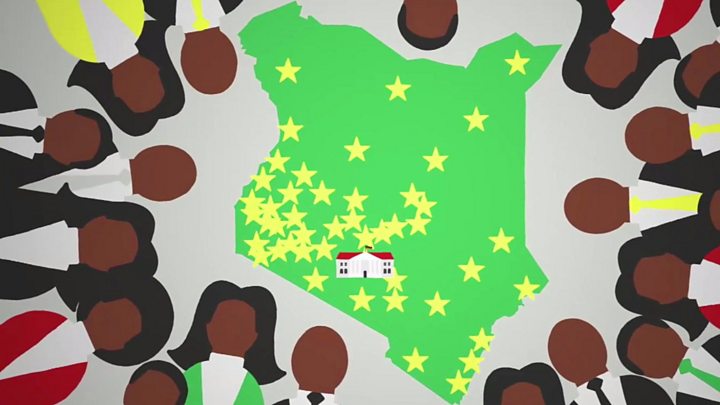
Ethnicity plays a big part in Kenya's elections, with many people voting along communal lines, and occasional outbreaks of political violence in which people are targeted according to their ethnic background. This can make life difficult for mixed ethnicity couples, as the BBC's Dickens Olewe in Nairobi found ahead of next week's election.
"Mommy, do you hate Raila or Uhuru?"
Naomi Wangui and Malaki Samson's young daughter shocked them recently by choosing this way to ask how they felt about the presidential candidates.
The question stunned Naomi and, even though she tried to explain to her daughter how political competition works, she was taken aback by her characterisation.
"Hate is a strong word, even for a six-year old. I think it's the perception she has picked from the TV stations who project political competition as a zero sum game, them versus us."
Malaki is a Luhya, a community that chiefly supports the opposition, while Naomi is from the Kikuyu community of President Uhuru Kenyatta, who is seeking re-election.
Mr Kenyatta and opposition leader Raila Odinga, who is a Luo, have harnessed support from several ethnic communities and it has become part of Kenyan political culture to presume that people from allied ethnic groups automatically back them.
These perceptions complicate the lives of mixed ethnicity couples.
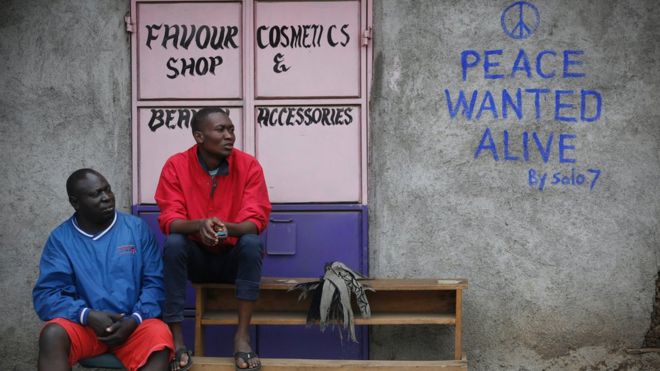
Malaki and Naomi live in Kinoo in the outskirts of the capital, Nairobi, an area that is dominated by the Kikuyu community.
Image captionMalaki Samson's family worry about his safety in a Kikuyu-dominated area
This set-up worries Malaki's family and they are concerned about his safety during the election.
"His brother called to see if he is planning to move during the election," Naomi says.
But Malaki has however no plans to relocate.
"We will cast our votes and come back home. We feel safe here," he says.
" I don't think the election will be violent as everyone is making it out to be."
Jitters again
Manuel Mikewa and his wife Elizabeth Njeri have different and more elaborate plans for election day.
"We will vote and then relocate with our two children to my mother's house in Kileleshwa [a middle-class estate in Nairobi]."
Manuel Mikewa is a Luo and his wife is Kikuyu, and they live in Muthiga, another area where Kikuyus are dominant.
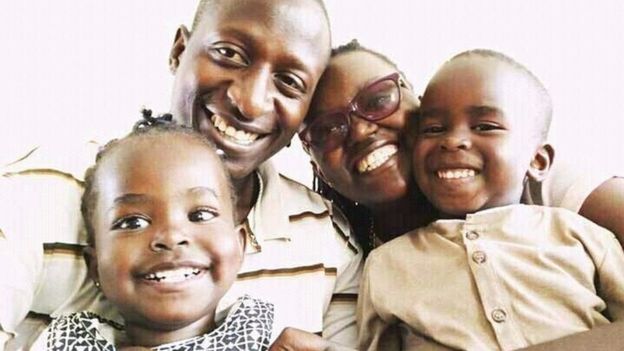
Image captionManuel Mikewa and his family are planning to stay with his mother and other relatives
Since post-election violence in 2007-08 in which more than 1,500 Kenyans were killed and an estimated 600,000 displaced, people have tended to be jittery around election time - and it's no different this year.
The last election passed without any major disruptive incident but there seems to be palpable fear and anxiety heading to this year's election, despite the government's reassurance on security and top politicians calling for peace.
"I just don't want to be here, especially with my children. I just want to feel safe," Manuel says and he has reasons to be worried.
Image copyright.
More on Kenya's elections:
Media captionKenya Election 2017: What you need to know
Full elections coverageHis aunt who is married to a Kikuyu man lives in Kibera, Kenya's biggest slum, which has been named as a potential hotspot.
In 2013, his uncle slept in a bar in Kibera that he owns for fear that his family's house would be attacked because of his perceived ethnic-political affiliation in an area dominated by the Luo community.
"My aunt and her family have started feeling that their neighbours, some whom they have known for a long time, are showing enmity towards them, so they are planning to be away from the area during the election," Manuel says.
"Just like in 2013, she will be moving to my mum's house with my cousins. She has enough space to accommodate us and it's good that way, because we will all feel safe."
Manuel says he plans to stay with his mother for at least a week after the election, "then we will assess when to go back".
Silent migration
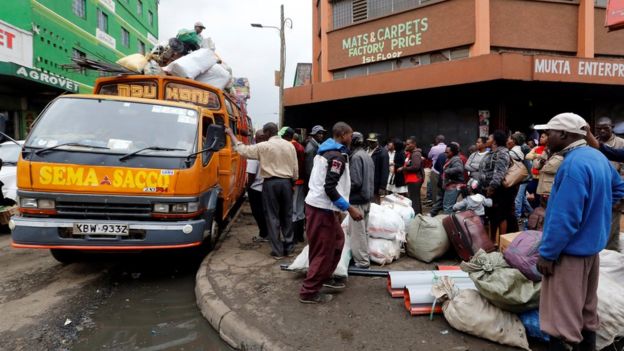
His plans are not unique. There's a silent migration from the city taking place, with people travelling to areas where their ethnic community is dominant.
"I think we will be safe in Kileleshwa because it is far removed from the informal settlement areas, like where my aunt lives, where there is high likelihood of violence to occur."
At the moment, Manuel says, the heightened political environment has "disrupted his work", but he adds that he is looking forward to vote.
"As a couple we have been open with each other and we have discussed the candidates we will vote for."
Image copyrightREUTERSImage captionPeople are already heading out of Nairobi
Another couple, George Obiero, a Luo, and Millicent Wanjiru, a Kikuyu, have been married for eight years and have two children. They say the election period is the most challenging part of their relationship.
"This is the most challenging time for mixed ethnicity couples because we suddenly find that our relationships are exposed to the negative effects of ethnic political competition," George says.
"There are couples who have separated because they couldn't handle the strain."
Millicent says that she has to deal with the fact that she "lives in an area where I feel safe but I can't say the same for my husband".
The couple say they have started thinking of contingency plans to move the family somewhere they will feel safe, but it has not been an easy topic to discuss.
"We live in an area where my community is a minority so I'm the one likely to be targeted by violence because of my ethnicity. Some people see me as supporting the opposition, which is not necessarily the case," George says.
"Reason would suggest that I move to a place where I will feel safe but I can't leave my family, I just can't.
"It's easy for couples who come from the same community to make quick decisions on what to do in these circumstances, for us it's a bit tricky."
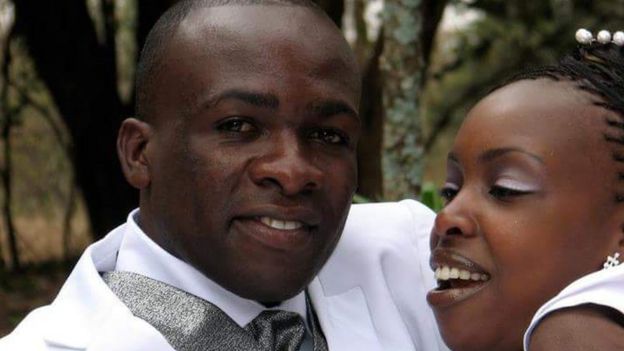
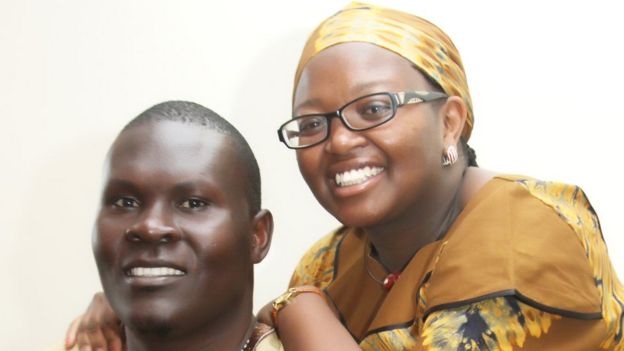
Image copyrightGEORGE OBIEROImage captionElection time is "challenging" for couples from different ethnic backgrounds, says George Obiero pictured his wife Millicent Wanjiru
The couples say they feel that the rhetoric in this year's election has been ratcheted up, more than any past election, by an active social media community.
"There's a lot of hate there. People say very hurtful things, and these are people you know, some you call friends," Millicent says.
But she says they cannot afford to despair. Instead they try to continue showing and preaching tolerance - especially to their children.
"We are sensitising them to be part of a global community and not be confined to an ethnic cocoon that Kenyan politics forces us into every five years," Millicent says.
"I'm hopeful because many in our generation are marrying from other cultures and I look forward to a less divisive future."
The Malakis and Obieros live in the same apartment block, which they say is home to "an incredibly diverse group of Kenyans".
The neighbours are planning a get-together party on election day "to light a bonfire to celebrate our diversity," Samson Malaki says.
Keep these in mind as you contemplate the direction of the American government over the past 50 years and especially since the Obama election.
The Goals of Communism
(as read into the congressional record January 10, 1963, from "The Naked Communist" by Cleon Skousen)
1. U.S. acceptance of coexistence as the only alternative to atomic war.
2. U.S. willingness to capitulate in preference to engaging in atomic war.
3. Develop the illusion that total disarmament of the United States would be a demonstration of moral strength.
4. Permit free trade between all nations regardless of Communist affiliation and regardless of whether or not items could be used for war.
5. Extension of long-term loans to Russia and Soviet satellites.
6. Provide American aid to all nations regardless of Communist domination.
7. Grant recognition of Red China. Admission of Red China to the U.N.
8. Set up East and West Germany as separate states in spite of Khrushchev's promise in 1955 to settle the German question by free elections under supervision of the U.N.
9. Prolong the conferences to ban atomic tests because the United States has agreed to suspend tests as long as negotiations are in progress.
10. Allow all Soviet satellites individual representation in the U.N.
11. Promote the U.N. as the only hope for mankind. If its charter is rewritten, demand that it be set up as a one-world government with its own independent armed forces. (Some Communist leaders believe the world can be taken over as easily by the U.N. as by Moscow. Sometimes these two centers compete with each other as they are now doing in the Congo.)
12. Resist any attempt to outlaw the Communist Party.
13. Do away with all loyalty oaths.
14. Continue giving Russia access to the U.S. Patent Office.
15. Capture one or both of the political parties in the United States.
16. Use technical decisions of the courts to weaken basic American institutions by claiming their activities violate civil rights.
17. Get control of the schools. Use them as transmission belts for socialism and current Communist propaganda. Soften the curriculum. Get control of teachers' associations. Put the party line in textbooks.
18. Gain control of all student newspapers.
19. Use student riots to foment public protests against programs or organizations which are under Communist attack.
20. Infiltrate the press. Get control of book-review assignments, editorial writing, policymaking positions.
21. Gain control of key positions in radio, TV, and motion pictures.
22. Continue discrediting American culture by degrading all forms of artistic expression. An American Communist cell was told to "eliminate all good sculpture from parks and buildings, substitute shapeless, awkward and meaningless forms."
23. Control art critics and directors of art museums. "Our plan is to promote ugliness, repulsive, meaningless art."
24. Eliminate all laws governing obscenity by calling them "censorship" and a violation of free speech and free press.
25. Break down cultural standards of morality by promoting pornography and obscenity in books, magazines, motion pictures, radio, and TV.
26. Present homosexuality, degeneracy and promiscuity as "normal, natural, healthy."
27. Infiltrate the churches and replace revealed religion with "social" religion. Discredit the Bible and emphasize the need for intellectual maturity which does not need a "religious crutch."
28. Eliminate prayer or any phase of religious expression in the schools on the ground that it violates the principle of "separation of church and state."
29. Discredit the American Constitution by calling it inadequate, old-fashioned, out of step with modern needs, a hindrance to cooperation between nations on a worldwide basis.
30. Discredit the American Founding Fathers. Present them as selfish aristocrats who had no concern for the "common man."
31. Belittle all forms of American culture and discourage the teaching of American history on the ground that it was only a minor part of the "big picture." Give more emphasis to Russian history since the Communists took over.
32. Support any socialist movement to give centralized control over any part of the culture--education, social agencies, welfare programs, mental health clinics, etc.
33. Eliminate all laws or procedures which interfere with the operation of the Communist apparatus.
34. Eliminate the House Committee on Un-American Activities.
35. Discredit and eventually dismantle the FBI.
36. Infiltrate and gain control of more unions.
37. Infiltrate and gain control of big business.
38. Transfer some of the powers of arrest from the police to social agencies. Treat all behavioral problems as psychiatric disorders which no one but psychiatrists can understand.
39. Dominate the psychiatric profession and use mental health laws as a means of gaining coercive control over those who oppose Communist goals.
40. Discredit the family as an institution. Encourage promiscuity and easy divorce.
41. Emphasize the need to raise children away from the negative influence of parents. Attribute prejudices, mental blocks and retarding of children to suppressive influence of parents.
42. Create the impression that violence and insurrection are legitimate aspects of the American tradition; that students and special-interest groups should rise up and use united force to solve economic, political or social problems.
43. Overthrow all colonial governments before native populations are ready for self-government.
44. Internationalize the Panama Canal.
45. Repeal the Connally reservation so the United States cannot prevent the World Court from seizing jurisdiction over nations and individuals alike.




 Posts
Posts

