
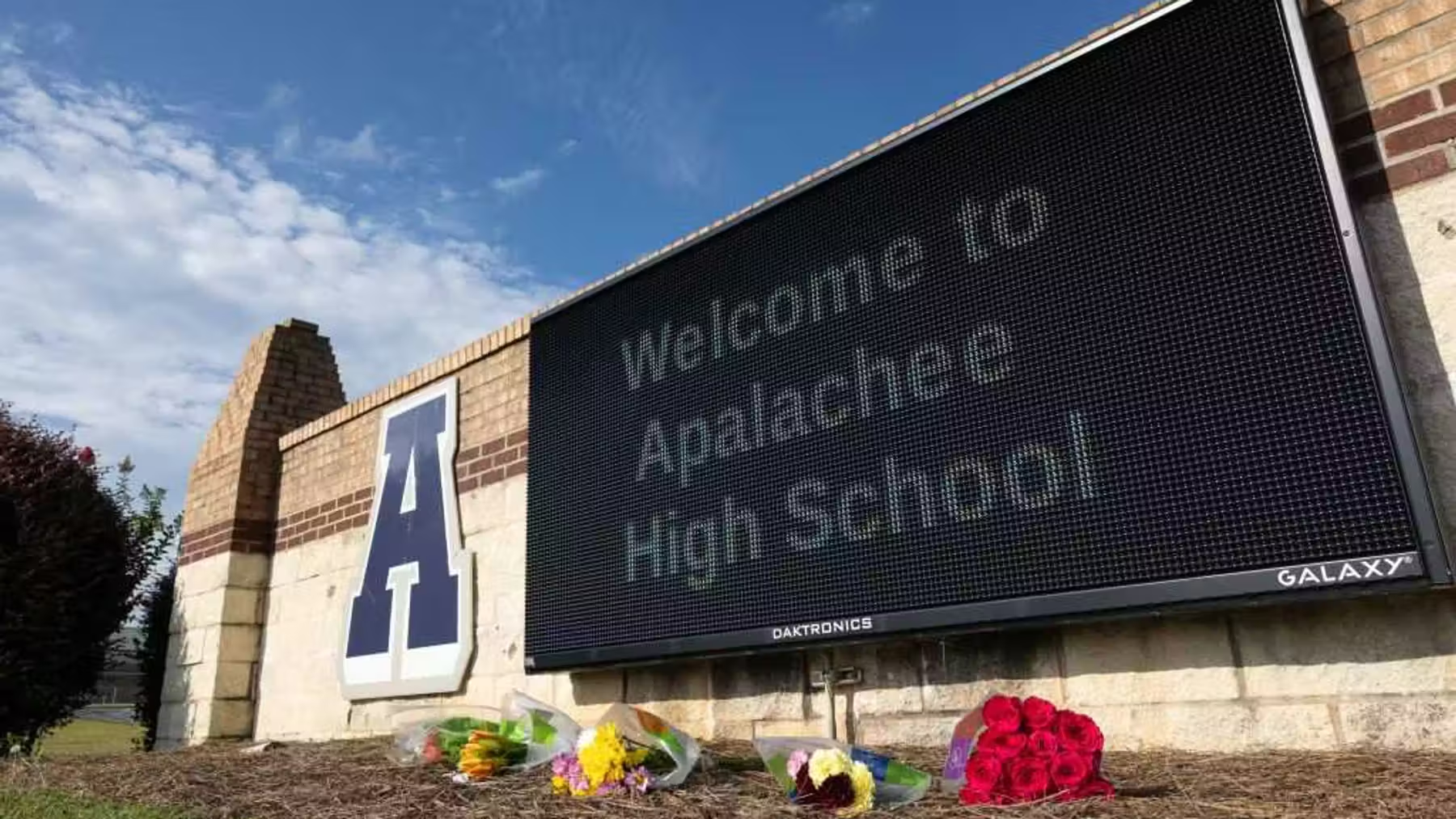
Two years ago, high school freshman Colt Gray shot up Apalachee High School in Georgia, killing two teachers and two students and wounding nine others. School resource officers quickly ended the rampage, and Gray was taken into custody before the death toll climbed higher. His father, Colin Gray, who bought him the gun, was later convicted of manslaughter and second-degree murder.
Colin Gray's prosecution drew much of the attention because it was a rare case of a parent being held criminally responsible for a child's violence. But Colt Gray's own punishment deserves attention too: life imprisonment without parole.
Healing is harder when justice is denied.
Gray’s age, troubled home life, and prior experience of being bullied could have been invoked as reasons for leniency. Instead, the judge concluded that his crime and his motives justified the harshest sentence available for a juvenile offender.
That’s significant because justice is not merely a tool for rehabilitation or deterrence. It also concerns what is owed to victims and to the community after an irreparable wrong.
Gray murdered four innocent people without anything resembling a justification. I would have no moral objection to the death penalty in a case like this. Because he committed the murders as a minor, however, life without parole is the most severe punishment available.
Even that cannot restore what was taken. As the older brother of one victim put it: “The defendant's family will still get to see their son, talk to him, and know he is breathing. ... My mother (and) my father don't get that privilege. The only way to visit Christian now is by standing over his grave.”
Aristotle defined justice in terms of giving each person what he is properly owed. Whatever one makes of that formulation, it captures something modern criminal-justice debates often neglect: Punishment is not only about what might improve the offender. It is also about recognizing the gravity of the offense.
A sentence cannot bring the dead back. But a legal system that treats grave crimes with proportionate seriousness tells victims, families, and the broader community that what happened to them was not trivial and will not be waved away.
RELATED: ‘Why do we have an FBI?’ Georgia school shooter was on FBI’s radar months before attack
Justice should also force us to confront the nature of the crime. As I wrote at the time, Gray displayed warning signs before he ever brought a gun to school. The lesson is not that every troubled teenager should be treated as a future murderer. It is that threats, fixation on mass killers, access to weapons, and other concrete warning signs should be taken seriously before tragedy makes hindsight easy.
The strongest objection to a sentence like this is that even terrible offenders, especially young ones, may be capable of change. That is a serious argument. But mercy and rehabilitation do not erase agency, nor do they undo the harm already done.
In Gray’s case, the record described an obsession with school shooters and a desire for notoriety. He was obsessed with school shooters. His home life may have been chaotic and his parents may have failed him badly. None of that means he lacked the capacity to understand that murdering classmates and teachers was wrong.
Judge Nicholas Primm made the point directly, saying the shooting “wasn’t done out of fear or anger” but “for the infamy of it.” As such, he doesn’t deserve another chance at living a “normal life.”
Gray may someday understand the evil of what he did. He may repent. He may even become, within prison, a radically different person. But none of those possibilities can make four murdered people less dead or obligate society to restore to him the freedom he deliberately took from others. Explanations are not the same as excuses.
This is where some accounts of restorative justice become inadequate. Restoration may have a place in criminal justice, especially where offenders can make meaningful amends. Murder imposes a limit on that logic because the central harm cannot be repaired.
RELATED: Jordan Salinas: Another ‘good guy with a gun’ ruins the gun control lobby’s narrative
The same caution applies beyond this case. It is a mistake to assume that every young violent offender is beyond redemption. It is equally mistaken to assume that redemption, if it occurs, necessarily entitles an offender to release. Recidivism among released prisoners is a real problem, though rates vary substantially by offense, age, and time horizon. The point is not that mercy is impossible. It is that mercy must be ordered to justice, not substituted for it.
By holding offenders accountable, courts can give victims and their families something no therapy program can supply on its own: a public judgment that the crime was real, grave, and deserving of punishment.
Assuming Gray’s punishment sticks, the Apalachee High School community will still have a long road ahead. Students and faculty can honor those they lost, support one another, and take warning signs more seriously in the future. None of that requires pretending punishment itself is healing. But healing is harder when justice is denied.
In this case, justice prevailed.


 Posts
Posts


No comments:
Post a Comment