Who’s afraid of the West Bank settlers?
Sure, the man’s a thug. But shouldn’t we talk about the fact that these monuments are normalised?
Andy Burnham is said to be weeks away from banning trade with the Israeli settlements. This is a policy demanded by more than 140 Labour MPs, championed by Ed Miliband at the Foreign Office, and destined to be waved through at conference in Liverpool next month by activists who, I very much suspect, could not find Ramallah on a map.
The Prime Minister has already apologised for his predecessor’s supposed support for Israel. (That’s right, he meant Keir Starmer, the chap who recognised a State of Palestine while Israeli hostages languished in the tunnels.) This would appear to be another similar downpayment for begrudging backbench support.
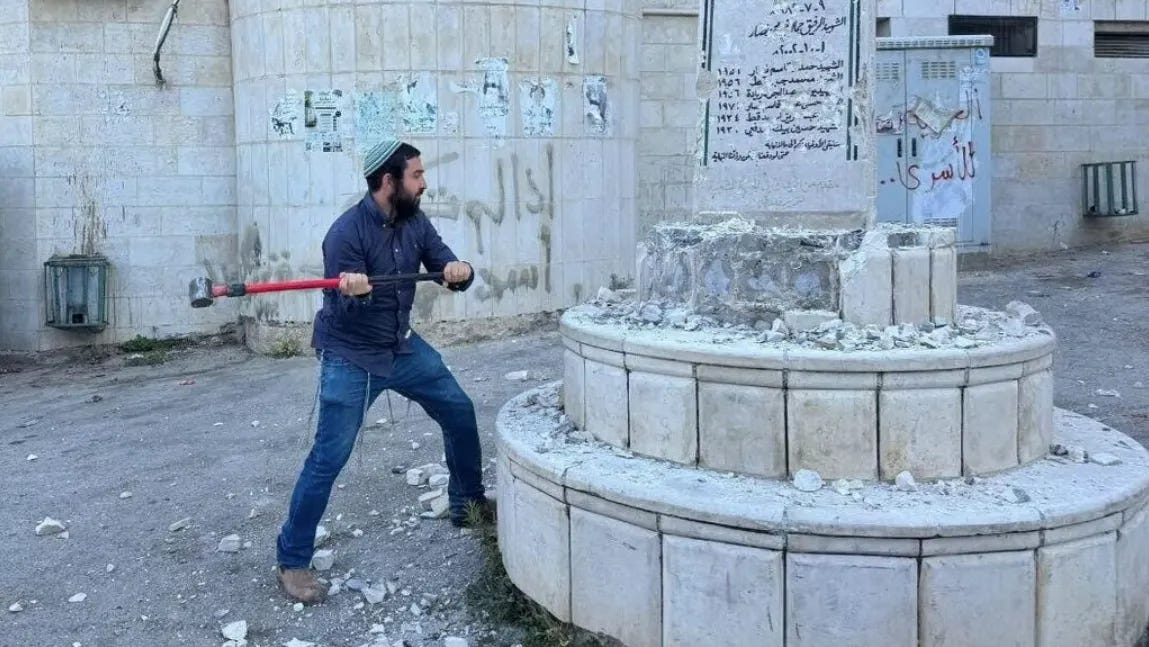
But when the case for sanctions is made, the image that many leftwing outriders will likely reach for is that of a man with a sledgehammer, which was the latest gift from the Israeli far-Right to the world’s Very Online antisemites.
Last week, the Religious Zionism MK Zvi Sukkot, under IDF escort, took a hammer to a stone memorial in the Palestinian village of Madama, near Nablus, on the West Bank. The footage travelled the world within hours. It made for the perfect propaganda image: a politician, protected by soldiers, vandalising a Palestinian monument to the dead.
Yet almost nobody bothered to report what was carved on the stone that he demolished. Why? That is the dangerous question that opens up the truth of all this. Let’s look at what it said.
The monument listed 10 names, with dates of death ranging from 1930 to 2004. At its base was an inscription recording that it had been presented by “the comrades in the Popular Front”. That is the Popular Front for the Liberation of Palestine, the Marxist-Leninist outfit whose armed wing assassinated the Israeli cabinet minister Rehavam Ze’evi in a Jerusalem hotel in 2001.
Sukkot claims that one of the men commemorated is Yaman Tayeb Ali Faraj, who he says was involved in the suicide bombing at the Geha Junction bus stop in Petah Tikva on Dec 25, 2003, which killed four Israelis and wounded more than 20. That attack was carried out by the Abu Ali Mustafa Brigades, the PFLP’s military wing.
Another of the 10, according to Israeli reporting, is Shadi Nassar, who blew himself up at the Eshel HaShomron hotel in Ariel in 2002, injuring 14.
You would not know any of this from the BBC, which told its readers the memorial honoured Palestinians killed at the battle of Karameh in 1968 and in the two intifadas, “whatever their political affiliation”. Right. The monument says who put it up. It is literally carved in stone.
The Popular Front for the Liberation of Palestine is designated a terrorist organisation by the United States, which proscribed it in October 1997, and is listed as such by the European Union. It is not proscribed in the United Kingdom; Britain bans the PFLP-General Command, a separate splinter, and the Home Office list goes out of its way to say so.
So we are now contemplating trade sanctions against Israelis; while an extremist destroys a monument erected by a terrorist organisation that this country, alone among its allies, cannot bring itself to outlaw; in a Palestinian territory where every town makes heroes of murderers. Perhaps somebody might raise that with Number Ten? Haha. Sorry.
None of this excuses Sukkot’s behaviour. Smashing up a village war memorial is the behaviour of a thug, not a legislator, and the outrage inside Israel tells you where its heart is. Benjamin Netanyahu’s own office called taking the law into one’s own hands “a reprehensible practice”. Gadi Eisenkot, the former chief of staff now leading the polls against him, called it “a disgrace for anyone who claims to represent the public”.
The IDF said that Sukkot had obtained his escort deceptively and acted without authorisation, and removed him from the village. A serving Israeli general has warned the Prime Minister that settler violence risks igniting a wider conflagration (he’s right).
Yet Israelophobes around the world have taken this incident and, entirely predictably, run with it. Suddenly, the widespread condemnation in Israel has become evidence that the country is equivalent to the Nazis. Suddenly, the behaviour of Sukkot – with the details of the monument removed – has become typical of all settlers, even all Jews.
This is what they call taking things out of context. Try to imagine the equivalent in Ramallah. Try to imagine Mahmoud Abbas ending the payments – perish the thought! – to the families of men who murder Israeli civilians. Try to imagine him clamping down on the lionisation of terrorists across the West Bank; anybody who has visited can attest to the thousands of posters, portraits, graffiti and tributes to murderers in almost every town and city. We live in a world where such depravity is normalised, while far-Right thugs who hit back are condemned.
The root of the Israeli-Arab conflict is quite simple. As former prime minister Golda Meir memorable put it, “they say we must be dead. And we say we want to be alive. Between life and death, I don’t know of a compromise.” The sacralisation of bloodshed and sanctification of killers is the main reason why this conflict is so intractable. The monument is part of that story, yet everybody is ignoring it.
Indeed, as reprehensible as Jewish extremists may be, they are tiny in number, widely reviled in Israel and wreak relatively far less havoc than the jihadis on the other side. Consider the numbers. There were 541,085 Israeli civilians living in Judea and Samaria as of January this year. The Israeli army’s own assessment, published that same month, identified roughly 300 Jewish extremists involved in nationalist crime, of whom about 70 are hardcore. Seventy. Out of more than half-a-million.
That is a rate of violent fanaticism so low that most European police forces would regard it as a rounding error, and it is on the strength of those 70 that Britain proposes to punish the other 540,930.
Compare the ledger. The UN’s own human rights office found that of 1,001 Palestinians killed in the West Bank in the two years after Oct 7, some 968 were killed by Israeli security forces in the course of counter-terrorist operations, and 33 by settlers or settlers acting alongside soldiers. That amounts to around 3 per cent.
Meanwhile, the Institute for National Security Studies counted 46 Israelis murdered in terror attacks in 2024 alone, excluding the Gaza front entirely. One set of killers, in other words, is a criminal fringe reviled by its own state; the other is a salaried programme.
Nobody is seeking to pretend that Israeli law enforcement in the West Bank is not genuinely poor. The leftwing monitoring group Yesh Din has found that 93.6 per cent of investigations into settler violence between 2005 and 2025 closed without an indictment, and only about 3 per cent produced a conviction. That is a disgrace; indeed, Israelis say so themselves, loudly, in their own newspapers, which is another hallmark of a free society.
Moreover, the rise of the far-Right within the Israeli cabinet, and the tolerance showed towards the West Bank extremists as a result, is of genuine concern. As Simon Sebag Montefiore argued when Andrew Fox and I interviewed him on The Brink this week – if you missed it, you must catch up, it was fascinating – history shows that a small number of radical ideologues can precipitate the fall of states. I don’t mean to downplay this threat for a moment; all hopes are pinned to the upcoming election in October to rid Israel, which is a victim of its own proportional representation, of these firebrands (start praying now).
But they are not representative of the heart of Israel. Look back over the decades and it is apparent that when the state does move, it moves hard. In 1984, the Shin Bet dismantled the Jewish Underground terror group and locked up its leaders for the murder of students at Hebron’s Islamic College. Within weeks of Baruch Goldstein’s sickening massacre in 1994, Israel outlawed Kach and Kahane Chai as terrorist organisations, a designation the United States later adopted.
After Jewish extremist Yigal Amir murdered Yitzhak Rabin in 1995, the head of the Shin Bet resigned. Amiram Ben-Uliel is serving three life sentences for the Duma arson that killed a Palestinian toddler and his parents in 2015, his appeal rejected by the Supreme Court. In June this year, six Israelis were charged with terrorism over an arson attack on a mosque at Deir Dibwan; this month, a settler was indicted for manslaughter over the killing of a Palestinian activist. No other country in that region prosecutes its own zealots for murdering the neighbours. The Palestinians even pay blood money for it.
As for the half-million “settlers” who find themselves tarred with the brush of extremism, the caricature bears almost no relation to the people. Roughly 53,000 Palestinians work in Israel and the towns in Judea and Samaria, and according to the Palestinian Authority’s own statistics bureau, they earned an average of 263 shekels a day in the second quarter of this year, against 134 shekels in the PA’s domestic labour market. That’s nearly double, from the very employer that the Western boycotters wish to shut down.
Indeed, in 2015, when the BDS (Boycott, Divestment and Sanctions) movement forced SodaStream out of Mishor Adumim, 500 Arabs lost their jobs. Visualise the scene: Palestinian workers wept at the factory gates while activists in London celebrated. Labour Friends of Israel is right that the impact of an embargo cannot in practice be confined to settlers, and it is often the Arab workers who get hurt first.
Then there’s the history. On the morning of June 5, 1967, Israeli prime minister Levi Eshkol sent a message to King Hussein through the UN truce supervisors: “We are engaged in defensive fighting on the Egyptian sector, and we shall not engage ourselves in any action against Jordan, unless Jordan attacks us. Should Jordan attack Israel, we shall go against her with all our might.” Hussein shelled Jerusalem anyway.
That is how the West Bank went from a Jordanian occupation – that had expelled every Jew from the Old City in 1948, and that almost no state on earth recognised – to an Israeli possession. Whatever one thinks should happen next, the land was not stolen. It was won from an aggressor that had been warned in writing.
So the position we are drifting towards is this. Britain will likely impose a trade embargo, harming Palestinian wage-earners most, over the conduct of 70 fanatics out of 541,000 Jewish residents of the West Bank, in a country whose courts jail such men, at the behest of a party that will not proscribe the terrorist organisation memorialised on that blasted monument.
The damage this will do to British-Israeli relations will be significant, and London will be the loser. Bilateral trade stood at £5.9 billion in the year to the first quarter of 2026, on which Britain runs a healthy surplus – we sold them £3.5 billion of goods and services and bought £2.4 billion back – and which, to the visible distress of the boycott movement, grew by 3.7 per cent over the previous year.
Twenty-two Israeli-linked companies are listed in London with a combined market capitalisation of $11.5 billion; nineteen more established or expanded British operations in 2024 and 2025, with 866 jobs projected to follow.
One in seven prescriptions dispensed in this country is filled by Teva, which employs more than 1,500 people here. The capsule camera that NHS England began rolling out to 11,000 patients in 2021, sparing them the indignity of a colonoscopy, was dreamed up by an Israeli missile engineer who repurposed the imaging technology from a guided warhead.
When Challenger 3 enters service next year, our tank crews will be protected by Trophy, the Rafael-built system that shoots incoming anti-tank rounds out of the air, bought under a £20 million contract in 2023; the Watchkeeper drone was built in Leicester by a joint venture with Elbit, whose British arm employs more than 680 people across 16 sites.
And in 2015, according to a Sunday Telegraph investigation, MI5 and the Met recovered three tonnes of ammonium nitrate concealed in ice packs across four properties in north-west London – a Hezbollah bomb factory in a residential street – after a tip-off from Mossad. That is just one example of countless times Israeli spies have kept Britons safe, most of which have gone unreported.
Spain has already run the experiment Burnham proposes: its embargo cost it close to a billion euros of Israeli kit, including the Spike missiles its own army had asked for and the laser-guidance pods for its Eurofighters. Given the state of our defences, Britain simply cannot afford to do the same.
Clearly, breaking our ties with Israel will make British taxpayers poorer and British lives less safe, yet neither fact will trouble the delegates in Liverpool. Sukkot may have swung a hammer at a stone, but Andy Burnham is preparing to swing one at himself.


 Posts
Posts


No comments:
Post a Comment