Showing posts with label Women's Rights. Show all posts

Sunday, March 8, 2020

Women's safety be damned in the name of women's safety. The greed of abortionists


Abortion Industry To Supreme Court: Women Don’t Need Safety Standards When Their Wombs Are Being Scraped Out

The lawyers representing the abortion providers cemented a new reality: that the abortion industry doesn’t want ‘safe, legal, and rare,’ it wants ‘unsafe, legally.’

On Wednesday, the Supreme Court heard oral arguments in its first abortion case since the confirmation of Justices Neil Gorsuch and Brett Kavanaugh. While outside the high court Sen. Chuck Schumer stoked the anger of abortion apologists by threatening the newest justices, inside the courtroom the lawyers representing the abortion providers cemented a new reality: that the abortion industry doesn’t want “safe, legal, and rare,”—it wants “unsafe, legally.”
That reality became clear in an exchange with Justice Kavanaugh about the Louisiana law under review in June Medical Serv. v. Russo, Sec. LA Dep’t of Health. That law requires abortion providers to have admitting privileges at a nearby hospital.
A lower court had struck the Louisiana law, holding the Supreme Court’s 2016 decision in Whole Woman’s Health v. Hellerstedt controlled. That decision held a Texas law requiring abortionists to maintain admitting privileges at a hospital within 30 miles of the clinic was unconstitutional. But on appeal, the Fifth Circuit Court of Appeals set aside Hellerstedt, reasoning that unlike the situation in Texas, the Louisiana law would not create an unconstitutional burden on a women’s “right” to abortion.
On appeal to the Supreme Court, the abortion providers argued that the Louisiana law, like the Texas law, placed an undue burden on women’s ability to access abortions. But Kavanaugh pushed their attorneys in a different direction: “If a state passed an admitting privileges law there, and suppose a state had ten clinics and two doctors for each clinic, but all 20 doctors could easily get the admitting privileges, so that there would be no effect on the clinics, no effect on the doctors who perform abortions, and, therefore, no effect on the women who obtain abortions,” Justice Kavanaugh hypothesized, “would a law be constitutional in that state?”
At first, Julie Rikelman, an attorney for the Center for Reproductive Rights arguing on behalf of the abortionists, deflected: “That law would have no benefit, Your Honor, and it may pose a much harder question than this case.” But when pushed, Rikelman made clear that abortion advocates see no valid purpose for admitting-privilege laws of the kind at issue and thus all similar laws would be unconstitutional.
Such an argument is shocking because, as Elizabeth Murrill, the attorney who argued on behalf of the Louisiana Department of Health and Hospitals, made clear, Louisiana requires doctors who perform a dilation and curettage (D&C) after a miscarriage—a procedure Justice Ruth Ginsburg declared “very much alike” the typical surgical abortion—to have admitting privileges at a hospital within a 30-mile radius of the clinic, unless the doctor held “a residency in the proper scope of care.”
So, while states can and do regulate doctors who perform a D&C following a miscarriage to ensure patients’ safety, abortion advocates maintain similar laws are unconstitutional when the D&C is performed on a woman carrying a still living human being. Yet, as the record in this case shows, such admitting privileges benefit women who suffer complications, such as the patients of Doe 3—one of the unnamed plaintiffs—who testified he had to transfer four patients to a nearby hospital for treatment of punctured uteruses and hemorrhaging. Doe 3, who held admitting privileges, provided the care at the hospitals.
Further, if anything, the facts of this case show the state has an even stronger interest in regulating the other abortion doctors involved in this case. For instance, one of the doctors, anonymously named Doe 1, is not an obstetrician or a gynecologist, but a graduate of the Saba University medical school in the Dutch Caribbean, where he studied “Family Medicine and Addiction Medicine,”—although he also has never actually practiced family medicine.”
Additionally, “Doe 1 conceded he had no training in abortion practice during his medical school or residency; instead he was principally taught on-the-job by Doe 3.” Doe 3 also “admitted he hired a radiologist and an ophthalmologist to perform abortions.” These are the doctors the abortion industry wants women to see unimpeded by state regulations.
No wonder Justice Samuel Alito found it “amazing” that the abortion providers would claim they had standing to challenge the Louisiana law on behalf of the women of the state, when their interests “are directly contrary to those of the—those individuals on whose behalf the plaintiff is claiming to sue, . . ” But, as the liberal justices pointed out during argument, the Supreme Court has long allowed abortion providers to challenge laws regulating abortions on behalf of their patients.
Yet the Supreme Court has never directly addressed whether that should be the case given the conflict in interests at issue. Alito seemed the only justice gravely concerned by this conflict, although Kavanaugh made a passing comment in concurrence of the concern. The remainder of the right-leaning bench stayed silent on the issue of standing.
While the right of t he bench remained reticent, clear from oral argument was that the four liberal justices remain in lockstep. And should they lock up one more vote, the abortion providers will score a victory—but it will be a loss to life and to women’s health.
Margot Cleveland is a senior contributor to The Federalist. Cleveland served nearly 25 years as a permanent law clerk to a federal appellate judge and is a former full-time faculty member and current adjunct instructor at the college of business at the University of Notre Dame. The views expressed here are those of Cleveland in her private capacity.

Thursday, August 29, 2019

Where is the woman's movement? Same place the left is about Hong Kong.

Iranian civil rights activist gets prison for taking off hijab in public


Iranian civil rights activist Saba Kord Afshari has been sentenced to 24 years behind bars, including a 15-year term for taking off her hijab in public — an act that authorities say promoted “corruption and prostitution.”
Afshari, 20, was handed the sentence by Tehran’s Revolutionary Court on Tuesday — after standing trial last week on charges of “spreading corruption and prostitution by taking off her hijab and walking without a veil,” “spreading propaganda against the state,” and “assembly and collusion,” the Iran Human Rights Monitor reported.
Her sentences were increased by one-half because of “numerous charges and previous records,” according to the report.
Both Afshari and her mother, Raheleh Ahmadi, were involved in White Wednesday protests, in which girls and women remove their compulsory hijabs and reveal their hair in public, the Daily Mail reported.
The duo often posted videos of themselves walking around the capital city without their headscarves — in an effort to encourage other women to leave their hijabs at home, according to the report.
Enlarge ImageYasaman Aryani and Saba Kord Afshari (right)
Yasaman Aryani and Saba Kord Afshari (right)Twitter
Authorities allegedly pressured Afshari to make confessions on video — but she vehemently refused, according to the Monitor.
So the Intelligence Ministry took her mother into custody to further coerce her into making false confessions, according to the report.
Afshari was first arrested during a protest rally in early August last year, and ultimately ended up in the Evin women’s prison, the outlet reported.
After that arrest, Afshari, among other detainees, posted an online message about their experience and used a cellphone to call for help from inside a state security force van, according to the report.
Afshari was granted amnesty and released in February, with only two months left until the end of her sentence — an act that she and another activist said was only a spectacle by government officials, the outlet reported.
Enlarge ImageSaba Kord Afshari
Saba Kord AfshariTwitter
“When I saw the situation of prisons closely … I came to the conclusion that we in Iran only have the name of human rights,” Afshari told the women’s committee of the National Council of Resistance of Iran at the time. “In fact, in Iran, there are no rights for humans, let alone respecting human rights in the prisons.”
After her release, she continued to protest against human rights abuses under the Iranian regime, and was arrested again in early June. She ended up back at the same prison.
Shima Babaii, Mojgan Lali and Shaghayegh Mahaki — also women’s rights activists — were jailed as well, according to the Daily Mail.
They face six years each for “association and collusion against national security” and “propaganda against the state.”

Thursday, April 18, 2019

Women's rights in Islamic countries.

Nusrat Jahan Rafi: Burned to death for reporting sexual harassment

  • 18 April 2019
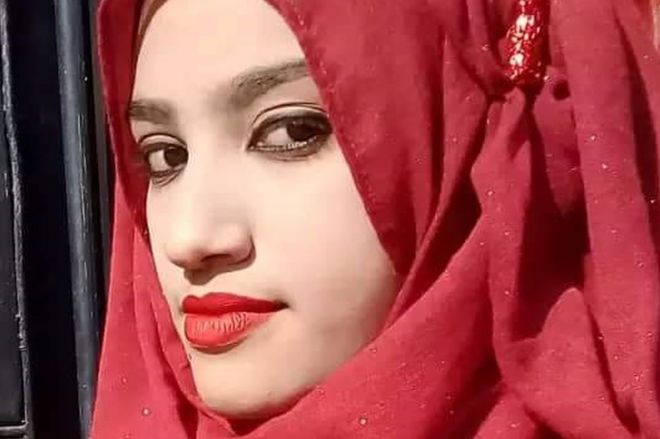
A picture of Nusrat Jahan RafiImage copyrightFAMILY HANDOUT
Nusrat Jahan Rafi was doused with kerosene and set on fire at her school in Bangladesh. Less than two weeks earlier, she had filed a sexual harassment complaint against her headmaster. 
Her courage in speaking out against sexual assault, her death five days after being set alight and everything that happened in-between has gripped Bangladesh and brought attention to the vulnerability of sexual harassment victims in this conservative South Asian country. 
Nusrat, who was 19, was from Feni, a small town 100 miles (160km) south of Dhaka. She was studying at a madrassa, or Islamic school. On 27 March, she said the headmaster called her into his office and repeatedly touched her in an inappropriate manner. Before things could go any further she ran out.
Many girls and young women in Bangladesh choose to keep their experiences of sexual harassment or abuse secret for fear of being shamed by society or their families. What made Nusrat Jahan different is that she didn't just speak out - she went to the police with the help of her family on the day the alleged abuse happened.
At the local police station she gave a statement. She should have been provided with a safe environment to recall her traumatic experiences. Instead she was filmed by the officer in charge on his phone as she described the ordeal. 
In the video Nusrat is visibly distressed and tries to hide her face with her hands. The policeman is heard calling the complaint "no big deal" and telling her to move her hands from her face. The video was later leaked to local media.

'I tried to take her to school'

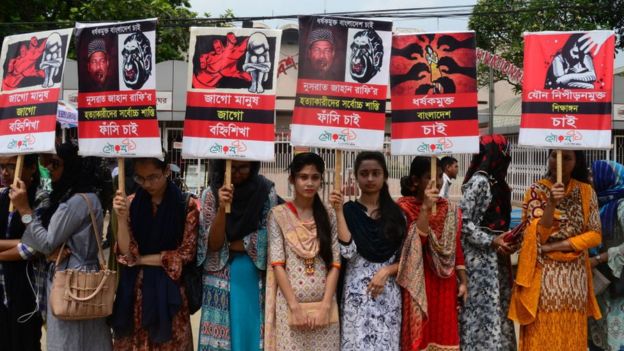
Different organization held a protest rally against the murder of Nusrat Jahan Rafi, a madrasa girl from Feni who was burnt in reprisal after sexual abuse charges against the principal, in Dhaka, Bangladesh, on April 12, 2019Image copyrightNURPHOTO/GETTY IMAGES
Image captionProtests have been held in Dhaka and in Feni - Nusrat's hometown
Nusrat Jahan Rafi was from a small town, came from a conservative family, and went to a religious school. For a girl in her position, reporting sexual harassment can come with consequences. Victims often face judgement from their communities, harassment, in person and online, and in some cases violent attacks. Nusrat went on to experience all of these. 
On 27 March, after she went to the police, they arrested the headmaster. Things then got worse for Nusrat. A group of people gathered in the streets demanding his release. The protest had been arranged by two male students and local politicians were allegedly in attendance. People began to blame Nusrat. Her family say they started to worry about her safety. 
Nevertheless, on 6 April, 11 days after the alleged sexual assault, Nusrat went to her school to sit her final exams. 
"I tried to take my sister to school and tried to enter the premises, but I was stopped and wasn't allowed to enter," said Nusrat's brother, Mahmudul Hasan Noman.
"If I hadn't been stopped, something like this wouldn't have happened to my sister," he said.
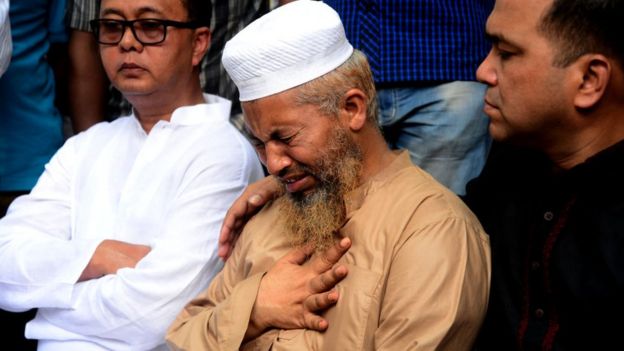
Nusrat Jahan's brother grieves at her funeralImage copyrightSHAHADAT HOSSAIN
Image captionNusrat Jahan's brother grieves at her funeral
According to a statement given by Nusrat, a fellow female student took her to the roof of the school, saying one of her friends was being beaten up. When Nusrat reached the rooftop four or five people, wearing burqas, surrounded her and allegedly pressured her to withdraw the case against the headmaster. When she refused, they set her on fire. 
Police Bureau of Investigation chief Banaj Kumar Majumder said the killers wanted "to make it look like a suicide". Their plan failed when Nusrat was rescued after they fled the scene. She was able to give a statement before she died. 
"One of the killers was holding her head down with his hands, so kerosene wasn't poured there and that's why her head wasn't burned," Mr Majumder told BBC Bengali.
But when Nusrat was taken to a local hospital, doctors found burns covering 80% of her body. Unable to treat the burns, they sent her to Dhaka Medical College Hospital. 
In the ambulance, fearing she might not survive, she recorded a statement on her brother's mobile phone.
"The teacher touched me, I will fight this crime till my last breath," you can hear her say. 
She also identified some of her attackers as students at the madrassa. 
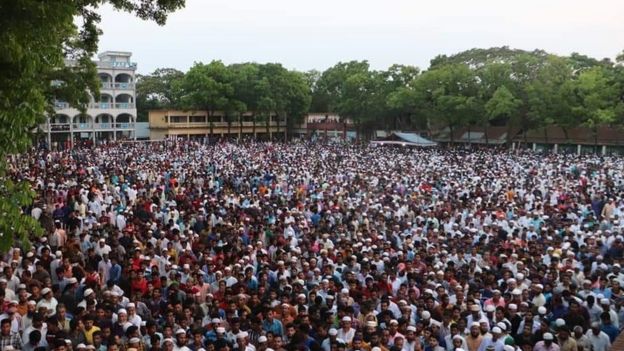
News of Nusrat's health dominated Bangladeshi media. On 10 April, she died. Thousands of people turned out for her funeral in Feni.
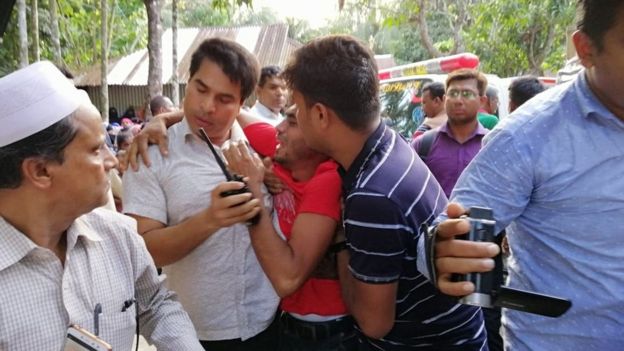
Police have since arrested 15 people, seven of them allegedly involved in the murder. Among those arrested are the two male students who organised the protest in support of the headmaster. The headmaster himself remains in custody. The policeman who filmed Nusrat's sexual harassment complaint has been removed from his post and transferred to another department.
Prime Minister Sheikh Hasina met Nusrat's family in Dhaka and promised that every person involved in the killing would be bought to justice. "None of the culprits will be spared from legal action," she said.
Hundreds of mourners gather at Nusrat's funeralImage copyrightSHAHADAT HOSSAIN
Image captionHuge crowds gathered in Nusrat's hometown for her funeral
Nusrat's death has sparked protests and thousands have used social media to express their anger about both her case and the treatment of sexual assault victims in Bangladesh. 
"Many girls don't protest out of fear after such incidents. Burqas, even dresses made of iron cannot stop rapists," said Anowar Sheikh on BBC Bengali's Facebook page. 
"I wanted a daughter my whole life, but now I am afraid. Giving birth to a daughter in this country means a life of fear and worry," wrote Lopa Hossain in her Facebook post.
According to women's rights group Bangladesh Mahila Parishad, there were 940 incidents of rape in Bangladesh in 2018. But researchers say the real number is likely to be much higher.
"When a woman tries to get justice for sexual harassment, she has to face a lot of harassment again. The case lingers for years, there is shaming in society, a lack of willingness from police to properly investigate the allegations," said Salma Ali, a human rights lawyer and former director of the Women Lawyers' Association.
"It leads the victim to give up on seeking justice. Ultimately the criminals don't get punished and they do the same crime again. Others don't fear to do the same because of such examples."
Now people are asking: Why did Nusrat's case only get attention after she was attacked? And will her case change the way people view sexual harassment in Bangladesh?
Relatives of Nusrat Jahan Rafi are crying during the authorities of Dhaka Medical College and Hospital, or DMCH, have handed over the body of Nusrat Jahan Rafi in Dhaka, Bangladesh, on April 11, 2019Image copyrightGETTY IMAGES
Image captionNusrat's family have been left distraught
In 2009, the country's Supreme Court passed an order to establish sexual harassment cells in all educational institutions where students can take their complaints, but very few schools have taken up the initiative. Activists are now demanding the order be implemented and enshrined in law to protect students. 
"This incident has shaken us, but as we have seen in the past, such incidents get forgotten in time. I don't think there will be a big change after this. We have to see if justice gets done," said Professor Kaberi Gayen of the University of Dhaka. 
"Change has to come in, both psychologically and in implementing the rule of law. Awareness about sexual harassment should be raised from childhood in schools," she said. 
"They have to learn what is right and wrong when it comes to sexual harassment."

Tuesday, May 17, 2016

Germany has chosen illegal Muslim immigrants over their own women.

Girl, 17, who was sexually assaulted FIVE TIMES 'by migrants' in Cologne on New Year's Eve blasts 'pathetic' German prosecutors as only suspect is FREED


  • Zilara Zajarskaite was molested by male migrant gang in New Year attacks
  •  
  • The 17-year-old and her friend described it as 'the worst night of our lives'

  • She said worst part was witnesses, including police, did nothing to stop it

  • Six months on, brave Zilara is fighting back by taking self defence classes

  • Fortnight ago she fought back when man grabbed her and felt empowered

  • A teenage victim of the Cologne New Year's Eve's sex attacks has branded a 'scandal' the German authorities' failure to apprehend the rapists and gropers that terrorised up to 1,000 women.
    But student Dilara Zajarskaite - who was assaulted countless times during five separate attacks by Arab men - is fighting back, one of a growing number of young German women taking self defence classes to protect themselves against unwanted sexual advances.
    Dilara, 17, and her best friend had taken the train into Cologne central station to revel in the traditional New Year celebrations. 
    But within minutes the pair were harassed, molested, assaulted and almost abducted as passers-by – including police officers – walked on by, she claims.
    Groped: Dilara, 17, and her best friend were harrassed, groped and molested by a migrant sex mob at Cologne train station on New Year's Eve while many, even some police officers, she claims
    Groped: Dilara, 17, and her best friend were harrassed, groped and molested by a migrant sex mob at Cologne train station on New Year's Eve while many, even some police officers, she claims
    Fight back: But now Dilara is literally hitting back by taking self defence classes to hone her boxing skills in classes, set up in response to the New Year attacks
    Fight back: But now Dilara is literally hitting back by taking self defence classes to hone her boxing skills in classes, set up in response to the New Year attacks
    Attacks: More than 1,000 women complained to police they were 'hand raped' when the migrant sex mob attacked them outside Cologne central train station on New Year's Eve
    Attacks: More than 1,000 women complained to police they were 'hand raped' when the migrant sex mob attacked them outside Cologne central train station on New Year's EveBravely waiving her right to anonymity, Dilara told MailOnline: 'We were attacked separate five times and no one stopped to help us. These Arab men touched me and hurt me. They tried to kidnap my best friend. It was terrifying.
    'I told a policeman what had happened to us that night but he said it was not worth making a complaint because I could not name any of the attackers.
    'It is a scandal the police have not captured any of the men who did this.'
    Dilara and her best friend, who has asked not be named, were left traumatised by the multiple sexual assaults the pair suffered and were left too terrified to go out on their own. 
    But now she has literally hit back, fighting off a sexual assault at Cologne central station two weeks ago, using boxing skills she learned at women self defence classes, set up in response to the New Year attacks.
    She told MailOnline: 'I was by the cathedral in the evening a few weeks ago and this [Arabic-speaking] guy grabbed me and put his arm around me and tried to pull me towards him.
    'But I remembered what I had learnt at the self defence course and I punched him hard in the ribs.
    'He tried to hit me back so I put my hand behind his neck and slammed his face into my knee.
    'It felt so good to fight back. Now I can protect myself.
    Women who have been sexually assaulted by migrants speak out
    Progress: 0%
    0:00
    Play
    Mute
    Current Time0:00
    /
    Duration Time1:57
    Fullscreen
    Need Text
    Freed: An illegal immigrant known in Germany only as Farouk B was the only suspect charged with sexual assault over the Cologne attacks
    Freed: An illegal immigrant known in Germany only as Farouk B was the only suspect charged with sexual assault over the Cologne attacks
    Collapse: But the case against him Farouk B (pivtured in the white t-shirt) collapsed after prosecuting witnesses failed to identify him in court
    Collapse: But the case against him Farouk B (pivtured in the white t-shirt) collapsed after prosecuting witnesses failed to identify him in court
    Sex mob: Farouk B was cleared of any involvement in the sex attacks that shocked the world and led to Cologne Police Chief Wolfgang Albers being sacked in January over his handling of the investigation
    Sex mob: Farouk B was cleared of any involvement in the sex attacks that shocked the world and led to Cologne Police Chief Wolfgang Albers being sacked in January over his handling of the investigation
    'For the first time I felt safe, I had never felt so confident, so sure in my ability to protect myself.'
    She added: 'It is every woman's right to be able to walk the streets in the evening without fear of being sexually assaulted.'
    Despite the women being 'hand raped' that night by young migrant men, Dilara says the worse aspect was that people, including police officers she claims, walked on by as she cried for help.
    'There were groups of Arabs everywhere,' she told MailOnline.
    'They appeared to be organised. Some were drunk, some were stoned and they were coming at us from different directions.
     One man grabbed my breasts and my bottom. They had their hands all over me. It was horrible. There was nothing I could do to stop them.
    New Year's Eve sex mob victim 
    'One man grabbed my breasts and my bottom. They had their hands all over me. It was horrible. There was nothing I could do to stop them.
    'Finally I managed to fall to the ground and I crawled away. One man had grabbed my friend and tried to through her over his shoulder.
    'That was the last time I saw her being dragged away. I made my way to a bus stop and I found her. She was crying.
    'The Arabs had got hold of her and tried to get her into a car but she was screaming and somehow she managed to get away. 
    'What hurt me most was the fact that people, even policemen, walked by and did not help, even though they could see we were in trouble.'
    While Dilara has refused to let the events of six months ago hold her back her best friend continues to be traumatised.
    The young woman, also a student, told MailOnline: 'It was the worst thing that has ever happened to me. I was, and still am, deeply shocked at what people are capable of doing.
    'Because of these experiences I am now afraid to go out at night alone. I know something like this can happen again.'
    New footage of the sex mob showing how police struggled to contain the large crowds as hundreds of assaults were committed emerged this week.
    The previously unseen video sees police scuffle with a number of young men, while fireworks are being set off into the crowd, and a woman can be heard screaming 'you mustn't touch me, you mustn't touch me'.
    Outrage: Dilara is furious with the German authorities that, six months on, no one has been brought to justice for what her and her friend say was the 'worst night of our lives'
    Self defence: She is now learning how to defend herself properly in the wake of December's attacks
    Self defence: She is now learning how to defend herself properly in the wake of December's attacks
    Hitting back: She told MailOnline: 'I remembered what I had learnt at the self defence course and I punched him hard in the ribs. 'He tried to hit me back so I put my hand behind his neck and slammed his face into my knee'
    Hitting back: She told MailOnline: 'I remembered what I had learnt at the self defence course and I punched him hard in the ribs. 'He tried to hit me back so I put my hand behind his neck and slammed his face into my knee'
    Self defence classes for women have sprung up all over Germany since the shocking New Year's Eve sex attacks in Cologne and many other cities.
    Coach Suna Yavuz, from the Jupps Fight Team gym, told MailOnline: 'We started this self defence class on January 5 in response to what happened on Silvesternacht [New Year's Eve]. We run it for free to give women the power to fight back and to give them confidence to walk the streets. Women come from all Cologne for the classes.'
    Dilara's stand is in sharp contrast to the failure of the German authorities to bring any of those, whose actions led to of over 1,100 criminal complaints – including hundreds of alleged sexual assaults, to justice.
    Last week the trial of an illegal immigrant accused of sexually assaulting two women at Cologne central station on New Year's Eve collapsed after prosecuting witnesses failed to identify him in court.
    The suspect, a 26-year-old Algerian, referred to only as Farouk B is the only man to appear in court in relation to the attacks.
    Farouk B he was accused of groping and touching a woman with 'sexual motivation'.
    He was alleged to have being part of a group of ten men who surrounded a 54-year-old woman and assaulted her.
    During the turmoil the woman's mobile phone was stolen.
    The victim, identified only as Karin P, told the court: 'I was with a friend. I went to ask which platform my train was going from and I was suddenly surrounded by a group of ten men. They put their hands all over me – on my bottom, my breasts, all over. I tried to protect myself with my hand-bag.' 
    The collapse of the trial has led to fears that no one will ever be jailed for the hundreds of sexual assaults that night. 
    Cologne Police Chief Wolfgang Albers was sacked in January over his botched handling of the investigation. 
    'I'm scarred for life': Cologne victims speak out after ordeal
    Progress: 0%
    0:00
    Play
    Mute
    Current Time0:00
    /
    Duration Time1:30
    Fullscreen
    Need Text
    Victim: Michelle, 18, one of the first victims to speak out, described being surrounded by a group of 30 'angry' men who groped her and her friends then stole their belongings
    Victim: Michelle, 18, one of the first victims to speak out, described being surrounded by a group of 30 'angry' men who groped her and her friends then stole their belongings
    Out of control: Despite a number of arrests on the night of the attacks, not a single person has yet been prosecuted
    Out of control: Despite a number of arrests on the night of the attacks, not a single person has yet been prosecuted
    Carnage: More than 1,000 women were molested and sexually assaulted in a night of carnage when they were surround by a mob of angry young male migrants
    Carnage: More than 1,000 women were molested and sexually assaulted in a night of carnage when they were surround by a mob of angry young male migrants
    Albers had tried to play down the seriousness of the public disorder and claimed the overnight festivities had been 'largely peaceful'.
    His boss, regional government Interior Minister Ralf Jaeger, appeared before an official inquiry this week investigating the police response to the events that night in Cologne and other cities across the North Rhine- Westphalia state.
    The North Rhine-Westphalia (NRW) police and prosecution services have declined to respond to questions by MailOnline on their handling of the events of New Year's Eve and the investigations into the sexual assaults that occurred.
    However amid the widespread criticism about their failure to bring the rapists and gropers to court rank and file officers in the NRW police force have complained of interference by politically-correct judges and politicians.
    One serving policeman told MailOnline: 'The judges are torpedoing our police work. It's very frustrating.
    Anger: Women came out in protest in Cologne over the sex attacks as tension in the city has risen, councillors have said it's a'no-go' zone for females
    Anger: Women came out in protest in Cologne over the sex attacks as tension in the city has risen, councillors have said it's a'no-go' zone for females
    Protests: The message for Angela Merkel was loud and clear as Germany opened its doors to 1.1 million migrants last year as women held up signs that read: 'Mrs Merkel - where are you? What are you saying? This worries us!'
    Protests: The message for Angela Merkel was loud and clear as Germany opened its doors to 1.1 million migrants last year as women held up signs that read: 'Mrs Merkel - where are you? What are you saying? This worries us!'
    'It's hard enough to identify, track down and arrest these guys. But when we get them into court the judge lets them off.'
    Another serving policeman added: 'The events around Silvesternacht [New Year's Eve] have become very political.
    'We have had orders from in high that we are not allowed to talk about it.
    'We all know that the activities of North African and Arab young men in German cities are a big problem. But it's far too political to talk about it.'